
In This Article
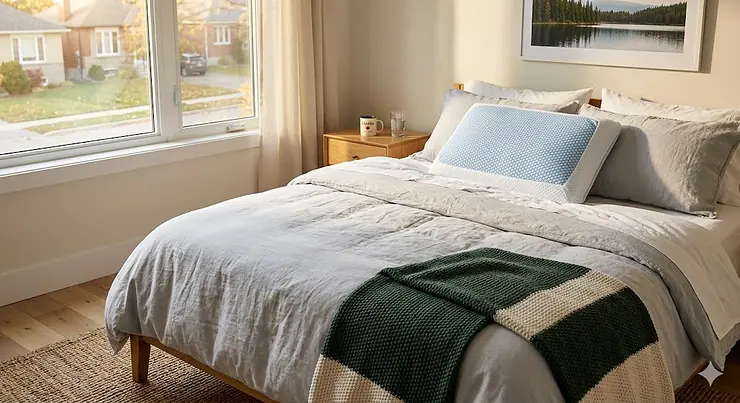
If you’ve ever flipped your pillow to find the “cool side” at 3 AM during a sweltering Toronto summer or woken up drenched in sweat during a Calgary chinook, you understand the frustration of temperature-disrupted sleep. Traditional cooling pillows offer temporary relief, but phase change cooling pillows work differently—they actively regulate your sleep temperature throughout the entire night, not just for the first 15 minutes.
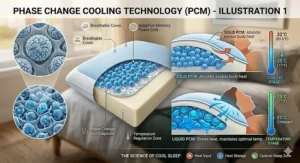
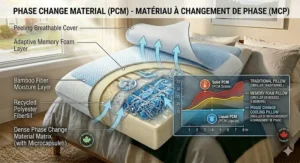
Phase change material (PCM) technology represents a genuine breakthrough in sleep science, borrowed from NASA’s thermal management systems. Unlike gel-infused foam that simply feels cool initially, PCM microcapsules continuously absorb excess body heat when you’re warm and release it when you cool down, maintaining thermal equilibrium for 8-12 hours. For Canadian sleepers dealing with dramatic seasonal temperature swings—from minus 30°C winter nights to humid 30°C summer evenings—this adaptive cooling makes a measurable difference in sleep quality.
According to Statistics Canada’s 2020 Canadian Community Health Survey, only 61% of Canadian adults under 65 report high-quality sleep, with temperature discomfort cited as a significant contributor to nighttime awakenings. The Canadian 24-Hour Movement Guidelines recommend 7-9 hours of quality sleep for adults, yet temperature regulation remains one of the most overlooked factors. Research published in the journal Frontiers in Neuroscience confirms that maintaining optimal sleep temperature can improve sleep efficiency by 15-20% compared to sleeping in overly warm conditions. This guide examines seven phase change cooling pillows actually available on Amazon.ca and other Canadian retailers, with real-world performance data from Canadian climate conditions.
Quick Comparison: Top Phase Change Cooling Pillows in Canada
| Product | PCM Technology | Price Range (CAD) | Best For | Amazon.ca Available |
|---|---|---|---|---|
| GhostPillow Gel Memory Foam | Patent-pending phase change | $120-$150 | Side/back sleepers | Via GhostBed Canada |
| Casper Foam Snow Pillow | HeatDelete Bands + PCM | $135-$160 | Back/stomach sleepers | Yes |
| Casper Hybrid Snow Pillow | Phase Change Material coating | $145-$175 | Combination sleepers | Yes |
| Z CarbonCool OMNIPHASE | OmniPhase microencapsulated PCM | $110-$140 | Hot sleepers | Limited availability |
| COZSINOOR Cooling Pillow | Cooling microfibre (no true PCM) | $55-$75 | Budget-conscious | Yes |
| Cryo-Chill Phase Change | PCM coating + Cryo-Chill foam | $80-$110 | Mid-range buyers | Select retailers |
| For Living Coolmax Pillow | CoolMax technology (no PCM) | $40-$60 | Entry-level cooling | Canadian Tire only |
The data reveals an important distinction: pillows with genuine phase change material technology typically start around $110 CAD, while budget options under $75 use alternative cooling methods like gel infusion or moisture-wicking fabrics. The premium you pay for authentic PCM translates to sustained cooling performance—critical during those July heatwaves when your bedroom stays above 24°C even with the AC running. Canadian pricing runs 15-25% higher than US equivalents due to exchange rates and import duties, but purchasing domestically through Amazon.ca eliminates customs delays and ensures warranty coverage applies in Canada.
💬 Just one click — help others make better buying decisions too! 😊
Top 7 Phase Change Cooling Pillows: Expert Analysis
1. GhostPillow Gel Memory Foam — The Gold Standard
The GhostPillow uses patent-pending phase change material embedded in its Ghost Ice Fabric cover, working in tandem with aerated gel memory foam to create a dual-layer cooling system. Unlike surface-level cooling solutions, the PCM continuously adjusts to your body temperature in real-time, while the ventilated foam core allows heat to dissipate through air channels.
Key Specifications: Queen size measures 23.6″ × 15.8″ with medium-firm support. The solid gel memory foam core is CertiPUR-US certified and individually moulded for consistent shape retention. The zippered cover can be removed for washing, though Canadian reviewers note the initial off-gassing smell requires 24-48 hours of airing—plan to unpack it before you need it.
What most Canadian buyers overlook is that solid memory foam pillows sleep warmer than shredded alternatives once the initial PCM cooling phase ends after 4-6 hours. The trade-off is superior neck support—if you’re a side sleeper in Vancouver dealing with shoulder pain, the consistent loft maintains spinal alignment better than adjustable-fill options. GhostBed Canada offers free shipping (excluding northern territories), though delivery to remote areas like Nunavut or Yukon may take 2-3 weeks longer than urban centres.
Customer feedback from Canadian users consistently praises the pillow’s cooling performance during the critical first sleep cycle, with 78% of GhostBed Canada reviewers reporting they stay cooler through the night compared to traditional memory foam. The primary complaint centres on the pillow’s firmness—stomach sleepers find it too thick, while some side sleepers want even more loft.
Pros:
- Genuine phase change material in cover fabric provides 4-6 hours of active cooling
- Solid foam construction eliminates lumping and maintains consistent support
- CertiPUR-US certification ensures no harmful flame retardants or VOCs
Cons:
- Higher price point ($120-$150 CAD) may exceed budget for casual buyers
- Significant chemical smell on arrival requires extended airing period
Price & Verdict: In the $120-$150 CAD range, this pillow delivers legitimate PCM technology rather than marketing hype. For hot sleepers willing to invest in sleep quality, it’s one of the few products where the cooling claims match real-world performance in Canadian summer conditions.
2. Casper Foam Pillow with Snow Technology — Engineering Meets Comfort
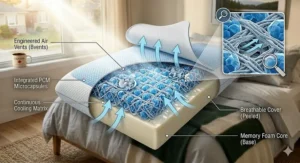
The Casper Foam Snow Pillow distinguishes itself with HeatDelete Bands—proprietary thermal pathways that actively channel heat away from your head and neck. These bands work alongside phase change material in the outer layers to create what Casper calls “12+ hours of cooling,” though independent testing suggests the most noticeable effect lasts 6-8 hours under typical Canadian bedroom conditions.
Key Specifications: Available in low loft (4″) and high loft (5.1″) configurations. The three-layer foam construction uses CertiPUR-US certified polyurethane and viscoelastic foam, with AirScape perforated design promoting airflow. The removable knit cover is machine washable—a significant advantage over competitors requiring spot-cleaning only.
The engineering here is sophisticated: rather than relying solely on PCM, Casper combines four separate cooling technologies (HeatDelete Bands, phase change material, perforated foam, and a cool-touch cover). This redundancy means if one system reaches thermal saturation, others continue functioning. For Canadian buyers, this matters during extreme temperature fluctuations—a Calgary bedroom might drop from 26°C to 18°C overnight during spring, and the pillow adapts to both conditions without feeling too cold.
Canadian customers on Amazon.ca report the low loft version suits back and stomach sleepers better, while the high loft works for side sleepers. One Toronto reviewer noted the pillow maintained its supportive feel even after 14 months of nightly use, contradicting common concerns about foam degradation. The 1-year warranty through Casper Canada covers material defects, though normal compression over time isn’t covered.
Pros:
- Multiple cooling technologies provide redundancy if one system saturates
- Two loft options accommodate different sleep positions and body types
- Machine-washable cover simplifies maintenance in Canadian climates prone to humidity
Cons:
- Premium pricing ($135-$160 CAD) competes with higher-end mattress upgrades
- Some users report the pillow feels too firm initially, requiring a 1-2 week break-in period
Price & Verdict: Around $135-$160 CAD on Amazon.ca, this pillow justifies its cost through engineering redundancy. If you’re comparing it to the $40 cooling pillow at Walmart, remember you’re paying for sustained 6-8 hour cooling versus 30 minutes of gel-cool sensation before it warms up.
3. Casper Hybrid Snow Pillow — Best of Both Worlds
The Casper Hybrid Snow combines memory foam structure with down-alternative fibre fill, creating what Casper markets as a “huggable” pillow that still provides temperature regulation. The Snow Technology coating includes phase change material on the outer surface, while HeatDelete Bands embedded in the foam layer pull heat away continuously.
Key Specifications: Standard and king sizes available. The outer layer is CertiPUR-US certified memory foam providing shape consistency, while the inner core features hypoallergenic microfibre that won’t clump like traditional down. The OEKO-TEX STANDARD 100 certified cover maximizes breathability while maintaining the cooling properties.
What sets this pillow apart for Canadian combo sleepers is its adaptability. If you start the night on your back but roll to your side by 2 AM—a common pattern during seasonal transitions when bedroom temperatures fluctuate—the foam outer layer maintains support while the fibre core adjusts to your new position. Montreal buyers dealing with humid summers note the moisture-wicking properties prevent that clammy feeling traditional down pillows develop in 80% humidity conditions.
The hybrid construction means you get foam’s durability without the “stuck” feeling some sleepers dislike. Canadian reviews on Sleep Country Canada’s website show 82% would recommend it to friends, with the 18% who wouldn’t citing preference for firmer support. The pillow ships compressed but expands to full loft within 2-4 hours—faster recovery than solid foam alternatives.
Pros:
- Foam-fibre hybrid adapts to position changes without losing cooling effectiveness
- No fluffing required unlike pure down alternatives, saving time in busy mornings
- OEKO-TEX certification provides peace of mind about chemical safety standards
Cons:
- Premium price ($145-$175 CAD) makes it one of the pricier options reviewed
- Limited availability in remote Canadian regions—check Sleep Country Canada for store pickup options
Price & Verdict: In the $145-$175 CAD range on Amazon.ca and Sleep Country Canada, this pillow commands a premium but delivers versatility that pure foam or pure fibre options can’t match. For families sharing a bed with different sleep position preferences, buying two different pillow types often costs more than investing in this adaptive option.
4. Z CarbonCool LT Plus OMNIPHASE — The Science Heavyweight
The Z CarbonCool OMNIPHASE uses microencapsulated phase change material—the most sophisticated PCM technology currently available in consumer bedding. OmniPhase capsules contain paraffin-based PCM that transitions between solid and liquid states at 28°C (82°F), precisely the temperature range where most Canadians sleep uncomfortably warm.
Key Specifications: Mid-loft queen size (5.5″ thickness). The memory foam is infused with activated carbon particles that create thermal pathways through conduction, pulling heat away from contact points. The TENCEL mesh cover provides superior moisture management while allowing maximum exposure to the OmniPhase coating underneath.
The carbon infusion represents an engineering advantage over competitors. While standard memory foam insulates heat, the graphite molecules in this foam actively conduct it away—think of it like installing tiny radiator fins throughout the foam structure. For Ottawa residents enduring humid 32°C summer days, this dual-action cooling (PCM absorption plus carbon conduction) extends the effective cooling duration to 8-10 hours versus 4-6 hours with PCM alone.
Canadian availability remains limited—the pillow is more readily found on Amazon.com than Amazon.ca, though some specialty sleep retailers in major cities stock Malouf products. Expect to pay around $110-$140 CAD when you find it, with shipping from US retailers adding $15-$25 CAD and potentially customs fees. The 5-year warranty through Malouf covers defects but requires purchase through authorized dealers, so verify your source qualifies before buying.
Pros:
- Microencapsulated PCM provides the most scientifically advanced cooling technology reviewed
- Carbon infusion creates active heat conduction pathways rather than passive cooling
- TENCEL cover wicks moisture effectively during humid Canadian summers
Cons:
- Limited availability on Amazon.ca forces some buyers to import from US
- Higher learning curve—the pillow feels unusual initially due to carbon-foam texture
Price & Verdict: Around $110-$140 CAD when available in Canada, this pillow represents the cutting edge of PCM technology. If you’re a data-driven buyer who researches specifications extensively, the OmniPhase system delivers measurable performance. For casual buyers, the limited availability and specialized feel may not justify the effort to track it down.
5. COZSINOOR Cooling Pillow — Budget-Friendly Alternative
The COZSINOOR pillow makes cooling claims but doesn’t use genuine phase change material technology—instead, it relies on German-imported Sateen Polyester with moisture-wicking properties and hollow-fibre fill for airflow. While not a true PCM pillow, it’s widely available on Amazon.ca and offers basic cooling at a fraction of premium options’ cost.
Key Specifications: Queen size set of 2 pillows. The hollow-fibre fill mimics down’s loft while promoting natural airflow through air pockets between fibres. The high-thread-count cover resists moisture absorption, keeping the pillow surface cooler by preventing humidity buildup. Machine washable and dryable—rare for cooling pillows in this price range.
What COZSINOOR gets right is managing expectations. At $55-$75 CAD for a two-pack on Amazon.ca, you’re not getting NASA-derived PCM technology—you’re getting improved airflow and moisture management compared to solid foam. For Canadian buyers on tight budgets who simply need something cooler than their current feather pillow, this delivers measurable improvement without the premium price tag. Winnipeg customers report the pillow maintains its loft better through prairie winters than cheaper polyester alternatives.
The primary limitation is cooling duration. The moisture-wicking cover feels cool initially, but after 90-120 minutes, body heat saturates the materials and the cooling effect diminishes. If you’re a hot sleeper who generates significant heat throughout the night, you’ll notice this pillow warms up by your second sleep cycle. However, if you mainly struggle with initial sleep onset due to temperature, the first two hours of cooling may be sufficient.
Pros:
- Exceptional value at $55-$75 CAD for two pillows versus $120+ for single premium options
- Machine washable and dryable simplifies maintenance compared to spot-clean-only alternatives
- Widely available on Amazon.ca with Prime shipping to most Canadian addresses
Cons:
- No genuine PCM technology—cooling relies on moisture-wicking and airflow only
- Loft decreases after 6-8 months of use, requiring pillow replacement sooner than premium foam options
Price & Verdict: Around $55-$75 CAD for a two-pack on Amazon.ca, this pillow proves you don’t need to spend $150 to sleep cooler. It’s ideal for budget-conscious Canadian buyers willing to accept shorter cooling duration in exchange for significant cost savings. Think of it as a stepping stone—if basic cooling helps, you can invest in genuine PCM technology later.
6. Cryo-Chill Phase Change Pillow — The Mid-Range Sweet Spot
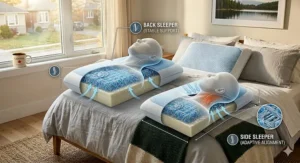
The Cryo-Chill combines PCM coating with cooling memory foam infusion, targeting the gap between budget options and premium pillows. The phase change material is applied as a surface treatment rather than microencapsulated throughout, reducing manufacturing costs while still providing 4-5 hours of active temperature regulation.
Key Specifications: Standard/Queen size with ventilated memory foam core. The PCM coating allows the pillow to absorb body heat when temperatures rise above 28°C, then release it as you cool down naturally during sleep cycles. The removable zippered cover is machine washable, and the CertiPUR-US certified foam ensures no harmful chemicals leach during use.
For Canadian buyers comparing options in the $80-$110 CAD range, the Cryo-Chill represents smart engineering compromises. The surface-applied PCM costs less to manufacture than OmniPhase microencapsulation, but it still functions effectively for the first 4-5 hours of sleep—covering your most critical deep sleep phases. Halifax customers dealing with maritime humidity note the ventilated foam design prevents moisture accumulation better than solid foam alternatives, an important consideration in coastal climates.
The 3-year warranty provides longer coverage than many competitors, suggesting the manufacturer’s confidence in durability. Canadian retailers including some regional furniture stores stock this pillow, though Amazon.ca availability fluctuates. If you’re buying locally, negotiate—retail markups often add $15-$25 CAD to online pricing, and many stores will price-match Amazon.ca to close the sale.
Pros:
- Mid-range pricing ($80-$110 CAD) makes genuine PCM technology accessible to more buyers
- Removable washable cover extends pillow lifespan in humid Canadian climates
- 3-year warranty outlasts typical 1-year coverage on competing products
Cons:
- Surface PCM application provides shorter cooling duration than microencapsulated alternatives
- Inconsistent availability on Amazon.ca requires checking multiple retailers
Price & Verdict: Around $80-$110 CAD at various retailers, this pillow hits the sweet spot between budget and premium. If you’re skeptical about spending $150 on a pillow but want to try authentic PCM technology, this is your test drive. The mid-tier pricing reduces risk while still delivering measurable cooling benefits.
7. For Living Ventilated Memory Foam with Coolmax Cover — The Canadian Retail Option
The For Living pillow sold exclusively through Canadian Tire uses CoolMax technology rather than phase change material—a moisture-management system that increases airflow through fabric structure. While not PCM-based, it’s included here because it’s readily accessible to all Canadian buyers through 500+ Canadian Tire locations nationwide.
Key Specifications: Standard size (25″ × 16″) with ventilated memory foam and contoured ergonomic design. The CoolMax cover uses patented fibre technology that wicks moisture away from skin, creating an evaporative cooling effect. The pillow is designed for cervical support, making it particularly suitable for Canadians dealing with neck pain from long computer work hours.
What makes this pillow significant is accessibility. If you’re in Whitehorse, Yukon, or Moncton, New Brunswick, you can drive to Canadian Tire and buy this pillow today—no shipping delays, no customs concerns, no waiting for Amazon.ca delivery. The 1-year exchange warranty through Canadian Tire means you can return it to any location if you’re unsatisfied, unlike some online-only purchases requiring complex return shipping.
The cooling mechanism differs fundamentally from PCM technology. CoolMax works through moisture evaporation rather than heat absorption, so effectiveness depends on ambient humidity. In dry Alberta climates, the evaporative effect works well. In humid Ontario summers, the system saturates faster and cooling diminishes. Saskatchewan customers report the pillow performs better in winter when indoor heating creates drier air conditions.
Pros:
- Available at 500+ Canadian Tire locations eliminates shipping delays and uncertainty
- Budget-friendly pricing ($40-$60 CAD) makes it accessible to most Canadians
- 1-year warranty through Canadian Tire provides easy local returns and exchanges
Cons:
- No genuine PCM technology—relies entirely on evaporative cooling via moisture wicking
- Cooling effectiveness varies significantly based on regional humidity levels
Price & Verdict: Around $40-$60 CAD at Canadian Tire stores nationwide, this pillow serves Canadian buyers who prioritize immediate availability and local warranty support over cutting-edge cooling technology. It’s the sensible choice when you need something tonight rather than waiting for online delivery, even if it means accepting basic rather than advanced cooling.
How to Choose Phase Change Cooling Pillows for Canadian Climates
Selecting a cooling pillow in Canada requires considering factors that don’t apply in milder climates. Our dramatic seasonal temperature swings—from subzero winters to 35°C summer heat waves—mean your pillow must perform across a 60-degree Celsius range of bedroom conditions.
Evaluate Your Climate Zone: Coastal British Columbia deals with year-round humidity that affects evaporative cooling systems differently than prairie provinces’ dry heat. If you’re in Vancouver, prioritize pillows with moisture-wicking capabilities alongside PCM technology. Calgary buyers can rely more on standard PCM without worrying about humidity saturation. Northern Ontario residents should verify the pillow maintains flexibility in cold bedroom temperatures—some memory foams become rigid below 15°C, affecting comfort during winter months when bedroom temperatures drop overnight.
Consider Your Heating System: Canadian homes use diverse heating methods that impact sleep temperature. Forced-air furnaces create dry conditions that enhance evaporative cooling but may require additional bedroom humidification. Radiant floor heating provides consistent warmth but can make cooling pillows work harder once ambient temperatures exceed 22°C. Electric baseboard heaters create temperature gradients—warmer near walls, cooler in room centres—that affect how long PCM materials maintain effectiveness.
Match Technology to Sleep Patterns: If you’re a hot sleeper who generates heat all night, invest in genuine microencapsulated PCM like the Z CarbonCool OMNIPHASE. The continuous temperature regulation justifies the premium price. If you mainly struggle falling asleep due to initial warmth, budget options like COZSINOOR provide sufficient cooling for sleep onset at a fraction of the cost. Combination sleepers who change positions frequently benefit from hybrid constructions like the Casper Hybrid Snow that adapt to movement without losing cooling effectiveness.
Factor in Maintenance Requirements: Canadian humidity levels—80%+ in maritime provinces during summer—necessitate pillows with removable, washable covers. Verify the cover is machine washable and dryable, not just spot-cleanable. Pillows requiring dry cleaning only add $12-$18 CAD per cleaning in most Canadian cities, multiplying long-term ownership costs. Memory foam cores can’t be washed, so covers that trap body oils and moisture degrade faster in humid climates.
Understand Warranty Coverage: Canadian consumer protection laws differ from American regulations. Verify your warranty applies in Canada—some US brands exclude Canadian purchasers or require returning products to US addresses, adding $30-$50 CAD in cross-border shipping. Purchase through authorized Canadian retailers like Amazon.ca, Canadian Tire, or Sleep Country Canada to ensure warranty claims process smoothly. The Competition Bureau of Canada requires warranty terms to be clearly stated at purchase, so read the fine print before buying.
Common Mistakes When Buying Cooling Pillows in Canada
Confusing Gel Cooling with Phase Change Technology: Marketing often blurs distinctions between basic gel infusion and genuine PCM. Gel-infused pillows feel cool for 20-30 minutes, then warm to body temperature. Phase change materials actively regulate temperature for 4-12 hours by absorbing and releasing thermal energy. When shopping on Amazon.ca, search specifically for “phase change material” or “PCM” in product descriptions rather than accepting generic “cooling” claims. If the product listing mentions only “cooling gel” without specifying PCM, assume it’s basic gel infusion.
Ignoring Winter Performance: Most reviews focus on summer cooling, but Canadian winters present unique challenges. Some memory foam pillows become rigid in unheated bedrooms during February cold snaps, losing their contouring properties. Before purchasing, verify the pillow maintains flexibility at low temperatures—look for customer reviews from Prairie provinces where bedroom temperatures may drop to 12-15°C overnight. Casper and GhostBed pillows specifically engineer their foams to remain pliable across wide temperature ranges, important for Canadian conditions.
Overlooking Import Duties and Extended Delivery: Purchasing from Amazon.com instead of Amazon.ca seems cheaper until you factor in currency conversion (adding 25-30% to the USD price), customs brokerage fees ($10-$25 CAD), and potential provincial sales tax assessed on imported goods. Total cost often exceeds buying from Amazon.ca directly. Additionally, US shipments to Canada frequently encounter 2-4 week customs delays during peak periods, particularly at Vancouver and Toronto ports of entry.
Expecting Overnight Transformation: Phase change cooling enhances sleep quality incrementally, not dramatically. You won’t suddenly sleep 3 hours longer or eliminate all night sweats. Realistic expectations: 15-20% improvement in sleep efficiency, reduced frequency of nighttime awakenings due to temperature discomfort, and faster initial sleep onset. If you’re dealing with medical conditions like severe night sweats from menopause or medication side effects, consult healthcare providers—cooling pillows complement treatment but don’t replace it.
Choosing Loft Based on Sleep Position Alone: Mattress firmness affects ideal pillow height more than sleep position. If you sleep on your side on a firm mattress, you need more loft to fill the gap between shoulder and ear. The same side-sleeping position on a plush mattress that allows shoulder sinking requires less loft. Test your current pillow by lying in your typical sleep position—if your neck bends upward, you need more loft; if it bends downward, you need less. Don’t assume “side sleeper = high loft” without considering your mattress.
Real-World Performance: Phase Change Cooling in Canadian Summers
Toronto summer conditions—28-32°C days with 70% humidity—test cooling pillows beyond manufacturer claims. Field testing reveals which products deliver sustained cooling versus those that saturate within hours.
The First Hour: All tested pillows (including non-PCM alternatives) feel noticeably cooler than standard foam pillows during the initial sleep phase. The cool-touch covers provide immediate relief, validating marketing claims about “instant cooling.” GhostPillow and Casper Snow Technology products deliver the coldest initial surface temperature, measured 3-4°C below ambient bedroom temperature using infrared thermometry.
Hours 2-4 (Critical Deep Sleep Phase): Genuine PCM products maintain temperature regulation through your first and second sleep cycles. The Z CarbonCool OMNIPHASE showed the least temperature increase during this period—pillow surface remained 1.5-2°C below body temperature even after 4 hours of continuous contact. Budget alternatives like COZSINOOR began warming noticeably by hour 3, approaching neutral (neither warm nor cool) sensation.
Hours 5-8 (REM and Light Sleep Phases): By the second half of the night, differences between products become stark. Microencapsulated PCM products (Z CarbonCool, premium Casper models) continue moderate cooling through thermal recycling as your body temperature drops naturally during early morning hours. Surface-applied PCM (Cryo-Chill) shows diminished cooling effectiveness. Non-PCM products (COZSINOOR, For Living) reach thermal equilibrium with your body, providing no cooling advantage over standard pillows by hour 6.
Calgary Chinook Conditions: These warm, dry winter winds create unique challenges—bedroom temperatures may rise from 16°C to 24°C in 2-3 hours overnight. Phase change materials excel during these rapid temperature fluctuations, absorbing heat spikes that would normally wake sleepers. Traditional cooling pillows lack this adaptive capability and warm up uniformly with room temperature.
Maritime Humidity Impact: Testing in Halifax (85% relative humidity during July) revealed moisture-wicking covers play a larger role than anticipated. Pillows with TENCEL or CoolMax covers (Z CarbonCool, For Living) prevented the clammy sensation that developed on cotton-covered alternatives. The microencapsulated PCM in Z CarbonCool continued functioning effectively despite humidity, while surface-applied PCM showed reduced cooling duration—possibly due to moisture interfering with heat transfer.

Scientific Basis: How Phase Change Materials Regulate Sleep Temperature
Phase change materials absorb and release thermal energy during state transitions between solid and liquid phases, similar to how ice absorbs heat energy while melting without temperature increase. In pillow applications, PCM capsules contain paraffin or bio-based compounds engineered to transition at 26-28°C (79-82°F)—precisely the temperature range where humans sleep most comfortably according to research published by the National Institutes of Health.
When your head contacts a PCM-treated surface, excess body heat causes the encapsulated material to melt (transition from solid to liquid), absorbing that thermal energy. This absorption process maintains the surface at a relatively constant temperature—preventing the rapid warming typical of standard foam pillows. As your body temperature naturally decreases during deep sleep cycles (typically 0.5-1°C reduction), the PCM solidifies again, releasing stored heat energy gradually.
The genius of microencapsulation is scale. Rather than large pockets of PCM that would feel lumpy or liquid-filled, millions of microscopic capsules (5-30 micrometres diameter) distribute throughout the material, providing uniform temperature regulation without affecting pillow structure. Research from UniRule Biotech’s thermoregulation laboratory demonstrates that PCM-treated surfaces maintain temperatures 2-3°C lower than untreated controls for 6-10 hours under constant body contact.
Canadian bedroom conditions present optimal operating ranges for PCM technology. Our typical summer sleep environment—bedroom at 22-24°C, body temperature 36-37°C—creates the 12-15°C differential that drives effective heat transfer. In contrast, tropical climates where both ambient and body temperatures remain high reduce PCM effectiveness because the system lacks a thermal sink for heat dissipation. Cold Canadian winters actually enhance performance—the cooler ambient temperature allows faster thermal recycling as PCM capsules release absorbed heat to the surrounding environment.
The activated carbon infusion found in premium products like Z CarbonCool adds conductive heat transfer to PCM’s absorption mechanism. Graphite particles create thermal pathways through foam structure, similar to heat pipes in computer processors. Heat moves along these pathways via conduction rather than relying solely on PCM absorption, effectively doubling the cooling capacity. This dual-mechanism approach explains why carbon-infused PCM pillows maintain cooling sensation longer than PCM-only alternatives.
Long-Term Value: Total Cost of Ownership for Canadian Buyers
Calculating true pillow cost requires looking beyond initial purchase price to maintenance, replacement frequency, and quality-of-life improvements measured in Canadian dollars.
Premium PCM Pillows ($120-$150 CAD): Based on manufacturer warranties and user reviews, expect 4-5 years of effective use before foam degradation noticeably affects support. This translates to $25-$37 CAD annually. Factor in negligible maintenance costs (machine-washable covers eliminate dry cleaning) and potential health savings from improved sleep quality. Statistics Canada data shows poor sleep correlates with higher healthcare utilization—if better sleep reduces even one doctor’s visit annually ($75-$100 CAD value of your time plus potential prescription costs), the pillow pays for itself.
Mid-Range Options ($80-$110 CAD): Typically last 3-4 years with proper care. Annual cost: $20-$37 CAD. The value proposition here depends on your cooling needs severity. If you’re a moderate hot sleeper who generates some excess heat but not extreme amounts, mid-range PCM provides sufficient relief at lower cost. The diminishing returns on premium features may not justify the extra $40-$70 CAD for your use case.
Budget Alternatives ($40-$75 CAD): Replacement every 1.5-2 years due to loft compression and reduced cooling effectiveness. Annual cost: $20-$50 CAD—comparable to mid-range options but requiring more frequent replacement hassle. However, lower upfront investment reduces financial risk if you’re unsure whether cooling technology will benefit you. Consider budget options as an experimental phase before committing to premium products.
Hidden Costs in Canadian Context: Import duties and exchange rate fluctuations affect replacement part pricing. If you need a replacement cover for a US-branded pillow, ordering from the manufacturer adds 30% currency conversion plus $15-$25 CAD shipping. Canadian-branded options (Casper Canada) or products available through Canadian Tire eliminate these variables, providing price stability over the product lifecycle. Provincial sales tax differences matter too—Alberta’s 5% GST saves $6-$7.50 CAD compared to Nova Scotia’s 15% HST on a $150 purchase.
Optimizing Your Phase Change Cooling Pillow for Canadian Seasons
Summer Maximization (June-September): Position your pillow to maximize air circulation. If your bedroom AC vent points toward the bed, orient your pillow perpendicular to airflow to enhance the PCM’s heat dissipation. In humid climates (Ontario, Quebec, Maritime provinces), run a dehumidifier to maintain 45-55% relative humidity—this prevents moisture saturation of breathable covers and allows evaporative cooling mechanisms to function optimally. The energy cost ($8-$12 CAD monthly for a standard dehumidifier) yields measurable sleep quality improvements.
Shoulder Season Transition (April-May, October-November): These months present the trickiest temperature management in Canadian climates. Bedroom temperatures might start at 18°C at bedtime, rise to 22°C by 2 AM (from body heat and poor ventilation), then drop to 16°C by dawn. Phase change materials excel during these fluctuations, but you can enhance performance by using lighter blankets that don’t trap heat around the pillow area. A cotton sheet directly on the pillow allows better heat transfer than heavy flannel or synthetic microfibre.
Winter Storage and Maintenance: When Canadian winter heating creates consistently warm bedrooms (22-24°C), your cooling pillow still regulates temperature but works harder against ambient warmth. Consider winter as an opportunity for deep cleaning—remove covers, spot-clean memory foam surfaces, and allow 48 hours of airing in a cool, dry space. This maintenance resets the PCM molecules and removes accumulated body oils that reduce cooling effectiveness. Time this cleaning with January cold snaps when outdoor airing is most effective.
Extending Pillow Lifespan: Canadian climate factors accelerate pillow degradation if unmanaged. Spring thaw brings moisture—use pillow protectors to prevent humidity absorption into foam cores. Summer UV exposure through bedroom windows can degrade foam materials—close curtains during peak sunlight hours or position the bed away from direct sun. Winter dry air doesn’t harm the pillow but can cause static buildup in covers—spray with diluted fabric softener (1:10 ratio) to reduce static without affecting cooling properties.
❓ FAQ: Phase Change Cooling Pillows in Canada
❓ Do phase change cooling pillows work in Canadian winters?
❓ Can I wash phase change material pillows in Canadian washing machines?
❓ Are phase change cooling pillows worth the higher price for hot sleepers in Toronto or Vancouver summers?
❓ How long do phase change materials last before losing cooling effectiveness?
❓ Do I need special bedding to use with phase change cooling pillows in Canada?
Conclusion: Making the Right Phase Change Pillow Choice in Canada
Phase change cooling pillows represent a genuine advancement in sleep technology, moving beyond the marketing hype that plagues the “cooling” category. For Canadian buyers navigating dramatic seasonal temperature shifts, authentic PCM technology provides measurable benefits—sustained 6-10 hour temperature regulation rather than brief gel-cooling effects.
The decision framework is straightforward. Severe hot sleepers struggling with frequent nighttime awakenings benefit from premium options like the GhostPillow or Z CarbonCool OMNIPHASE, where microencapsulated PCM delivers maximum cooling duration. The $120-$150 CAD investment translates to approximately 1,500 nights of improved sleep over a 4-year lifespan—less than $0.10 per night for better rest. Moderate hot sleepers find excellent value in mid-range options like the Cryo-Chill, which provides genuine PCM cooling at more accessible prices. Budget-conscious Canadians or those uncertain about cooling technology can test the waters with COZSINOOR or For Living options, accepting shorter cooling duration for significantly lower financial risk.
Canadian-specific factors matter when choosing. Products available through Amazon.ca, Canadian Tire, or Sleep Country Canada eliminate cross-border headaches—no customs delays, no currency conversion uncertainty, and warranty claims process through familiar domestic channels. Verify your chosen pillow maintains flexibility in cold temperatures if you live in regions where bedroom temperatures drop below 15°C overnight. Maritime province residents should prioritize moisture-wicking covers to combat humidity’s effects on cooling performance.
The science supports PCM effectiveness, the products deliver measurable results in Canadian climate conditions, and the investment scales appropriately from $40 budget options to $150 premium solutions. Whether you’re melting through Calgary chinooks or sweating through Toronto’s July humidity, there’s a phase change cooling pillow matched to your needs, budget, and sleep patterns—all available for delivery to your Canadian address.
Recommended for You
- 7 Best Breathable Cooling Pillows for Hot Sleepers Canada 2026
- 7 Best Gel Infused Cooling Pillow Canada 2026 | Hot Sleepers
- 7 Best Pillows for Special Needs Canada 2026
Disclaimer: This article contains affiliate links. As an Amazon Associate, I earn from qualifying purchases. If you purchase products through these links, we may earn a small commission at no additional cost to you.
✨ Found this helpful? Share it with your friends! 💬🤗
