
In This Article
If you’re waking up at 3 a.m. with damp hair and a warm pillow pressed against your face, you’re not alone. Over 40% of Canadians report experiencing heat-related sleep disruptions throughout the year — and while our brutal winters get all the attention, Canadian summers (especially across southern Ontario, the Lower Mainland, and the Prairies) can push bedroom temperatures well above the ideal 18-20°C range recommended by sleep researchers.

Here’s what most people don’t realize: your pillow accounts for roughly 15-20% of your total sleep surface contact area, yet it’s responsible for a disproportionate amount of heat retention. Traditional memory foam and polyester-fill pillows trap heat around your head and neck — precisely where your body has the highest concentration of thermoreceptors. The result? Your brain receives constant “too hot” signals that fragment your sleep cycles and prevent you from reaching the restorative deep sleep stages your body needs.
What is gel infused cooling pillow technology? A gel infused cooling pillow combines traditional pillow materials (typically memory foam) with cooling gel particles, beads, or layers that actively absorb and disperse body heat away from your head and neck. Unlike passive cooling methods that simply use breathable fabrics, gel infusion creates a thermal management system inside the pillow itself — think of it as a heat sink for your head that works continuously throughout the night.
The science is straightforward: gel has superior thermal conductivity compared to foam alone, meaning it pulls heat away from your skin faster and distributes it across a larger surface area where it can dissipate naturally. When manufacturers infuse gel beads directly into shredded memory foam or create gel layers bonded to solid foam cores, they’re engineering a material that stays 2-4°C cooler than standard foam throughout an 8-hour sleep cycle. For Canadians dealing with humid July nights in Toronto or chinook-warmed evenings in Calgary, that temperature difference translates directly into fewer nighttime awakenings and more time in REM sleep.
Quick Comparison: Top Gel Infused Cooling Pillows Available in Canada
| Pillow Model | Gel Technology | Adjustability | Price Range (CAD) | Best For |
|---|---|---|---|---|
| Coop Home Goods Cool+ | Gel-infused plus-shaped foam | Fully adjustable fill | $120-$160 | Hottest sleepers who need customization |
| Coop Home Goods Eden | Gel-infused memory foam blend | Fully adjustable fill | $85-$110 | Budget-conscious hot sleepers |
| Classic Brands Reversible Gel | Cooling gel layer on one side | Fixed loft, flip design | $45-$65 | Entry-level cooling, all positions |
| Weekender Gel Memory Foam | Gel-infused foam with cover | Fixed medium-firm | $50-$75 | Budget-friendly moderate cooling |
| SUPA MODERN Gel Pillow | Gel beads throughout foam | Fixed contour design | $40-$60 | Side sleepers, budget tier |
| Utopia Bedding Gel Fiber | Gel-infused microfiber fill | Plush, non-adjustable | $35-$50 | Down-alternative feel with cooling |
| EGOHOME Cooling Gel | Reversible gel layer design | Fixed ergonomic shape | $55-$80 | Back/side sleepers, firm support |
Looking at this comparison, the Coop Cool+ delivers the most aggressive cooling technology for severe hot sleepers, but the $120-$160 CAD investment only makes sense if you’re waking up multiple times nightly from heat. Mid-range options like the Classic Brands Reversible Gel ($45-$65 CAD) provide solid value for Canadians who experience occasional overheating — you get the gel layer benefit without paying for adjustability features you might not need. Budget buyers should note that gel fiber pillows (like Utopia Bedding at $35-$50 CAD) sacrifice some cooling performance compared to gel-infused memory foam, but they’re still a significant upgrade over standard polyester fill if you’re just dipping your toes into cooling pillow technology.
💬 Just one click — help others make better buying decisions too!😊
Top 7 Gel Infused Cooling Pillows: Expert Analysis for Canadian Buyers
1. Coop Home Goods Cool+ Adjustable Pillow
The Coop Home Goods Cool+ represents the current pinnacle of consumer cooling pillow technology available on Amazon.ca, combining three distinct cooling mechanisms in a single package. The proprietary “Oomph Cool+” gel memory foam features a unique plus-shaped cross-section (rather than traditional shredded pieces) that creates 50% more air circulation channels throughout the fill. Layer this with a phase-change gel liner that actively absorbs heat spikes and a cool-touch outer cover with a Q-max rating of 0.48 (out of a maximum 0.50), and you’re looking at a pillow engineered specifically for people who wake up sweating even in air-conditioned rooms.
Key specs: Queen size measures 43 × 68 cm with a 5 cm gusset; King size extends to 51 × 84 cm. The pillow ships overstuffed with approximately 1.4 kg of fill (Queen) that you can remove or add back as needed. Both CertiPUR-US and GREENGUARD Gold certified, meaning it meets strict standards for chemical emissions — important for Canadians concerned about indoor air quality during our long winters when homes are sealed tight. The dual-sided design lets you flip between a firmer gel-layer side and a softer direct-fill side depending on your preference.
Expert opinion: What separates this pillow from cheaper gel options is the engineering depth. Most gel pillows on Amazon.ca simply mix gel beads into standard shredded foam and call it a day. Coop actually redesigned the foam geometry itself to maximize airflow, then added the phase-change layer as a secondary heat management system. If you’re a Canadian commuting home from work in humid August weather, jumping into bed still carrying that core body heat, this pillow responds actively rather than just passively. The adjustability matters more than you’d think — Canadians sleeping in older homes without central AC might need more fill for elevation and airflow in summer, then remove some in winter when overheating is less of an issue.
Customer feedback: Canadian reviewers on Amazon.ca consistently mention the pillow staying noticeably cooler than their previous pillows, with the most common praise focused on “finally sleeping through the night” without flipping to find a cool spot. The main complaint centres on the initial loft being too high for some stomach sleepers, though this is easily resolved by removing fill. A few users note the pillow requires fluffing each morning to redistribute the plus-shaped pieces, which is standard for shredded fill designs.
✅ Three-layer cooling system (gel foam + phase-change liner + cool-touch cover)
✅ Fully adjustable loft — remove or add fill to match your exact sleep position
✅ CertiPUR-US and GREENGUARD Gold certifications for chemical safety
❌ Premium pricing in the $120-$160 CAD range
❌ Requires daily fluffing to maintain shape
Value verdict: Around $140 CAD for Queen size on Amazon.ca. The price puts it in premium territory, but the cooling performance justifies the investment for Canadians who are serious about solving chronic overheating. Less expensive gel pillows might work for mild warm sleepers; this one targets people for whom heat disruption is genuinely robbing them of quality sleep.

2. Coop Home Goods Eden Cooling Pillow
Think of the Eden as the Cool+’s more accessible younger sibling — same brand engineering philosophy, same adjustable design, but with a single-layer gel infusion approach that brings the price down to a much more palatable $85-$110 CAD range on Amazon.ca. The Eden uses gel-infused cross-cut memory foam blended with microfiber fill, creating a material that breathes better than solid foam while still providing the contouring support memory foam is known for. The proprietary Lulltra fabric cover (a polyester-rayon blend) adds surface-level breathability without the need for a separate cooling liner.
Key specs: Queen measures 43 × 68 cm with a 5 cm gusset, King extends to 51 × 84 cm. Ships with approximately 1.2 kg of fill (Queen) plus an additional fill bag so you can customize immediately. The gel infusion is distributed throughout the memory foam pieces rather than concentrated in a separate layer, which means the cooling effect is more gradual and sustained rather than the immediate “cold touch” sensation you get with gel layers. CertiPUR-US certified for foam safety.
Expert opinion: This pillow occupies the sweet spot for most Canadian buyers who sleep moderately warm but don’t need enterprise-grade cooling technology. The cross-cut memory foam geometry (small pieces with flat edges) allows air to circulate between the foam fragments while maintaining enough structure for proper neck support — crucial if you’re a side sleeper dealing with the shoulder compression common in colder months when we tend to curl up more. The Lulltra cover isn’t quite as aggressively cooling as the Cool+’s dual-layer system, but it’s moisture-wicking enough to handle the humidity spikes we get during Canadian summer thunderstorms.
What Canadian buyers need to understand is that gel infusion in the foam itself (rather than a separate gel layer) means the cooling effect builds gradually over the first 20-30 minutes as the gel absorbs your initial body heat, then maintains a steady cooler temperature throughout the night. If you need instant cold-to-the-touch sensation the moment your head hits the pillow, you’ll want a gel layer design instead. But if your issue is more about preventing heat buildup over hours (the classic 3 a.m. wake-up scenario), the Eden’s distributed gel approach actually works better long-term.
Customer feedback: Amazon.ca reviews from Canadian users frequently highlight the pillow’s versatility across seasons — it provides noticeable cooling in July and August without making you feel cold in December and January when bedroom temps drop. The adjustable fill gets consistent praise for accommodating different sleeping positions, with back sleepers typically removing some fill and side sleepers keeping most or all of it. A few reviewers mention the pillow feeling too soft initially, which is why Coop includes the extra fill bag.
✅ Mid-range pricing makes cooling technology accessible ($85-$110 CAD)
✅ Gel infusion throughout the foam for sustained all-night cooling
✅ Adjustable fill with extra bag included — customize to your exact preference
❌ Not as aggressively cooling as gel layer designs
❌ Requires break-in period of 3-5 nights for foam to fully expand
Value verdict: Around $95 CAD for Queen size on Amazon.ca. This is the pillow I’d recommend to most Canadians as their first gel cooling pillow — it delivers meaningful temperature regulation without the premium pricing, and the adjustability means you’re not stuck with a fixed loft that might not work for your sleep position.
3. Classic Brands Reversible Cool Gel Memory Foam Pillow
The Classic Brands Reversible takes a fundamentally different approach to cooling: instead of infusing gel throughout the foam, it bonds a solid gel layer to one side of a traditional memory foam core, giving you a flippable design where one side actively cools and the other provides standard memory foam comfort. This design philosophy makes sense for Canadians dealing with dramatic seasonal temperature swings — use the gel side in summer, flip to the foam side in winter, and you’ve essentially got two pillows in one.
Key specs: Standard size measures 41 × 61 cm with a 13 cm profile (medium-firm loft suitable for back and side sleepers). The gel layer is approximately 1 cm thick bonded to a 12 cm memory foam base. Total pillow weight around 1.1 kg. The cover is a breathable knit fabric (blend not specified but feels like polyester-rayon similar to most Amazon.ca pillows in this price range). Not adjustable — the loft and firmness are fixed, so what you see is what you get.
Expert opinion: Here’s what the product descriptions won’t tell you: gel layer pillows like this one provide the most immediate cooling sensation of any gel pillow design. The moment your head contacts that gel surface, you feel the temperature difference — it’s genuinely cool to the touch, not just “less warm than foam.” The physics are simple: the gel acts as a heat sink, pulling warmth away from your skin through direct conduction. For Canadians coming home from outdoor summer activities (biking, gardening, sports) and jumping into bed with elevated core body temperature, this instant cooling effect helps trigger your body’s natural sleep onset temperature drop faster than gradual cooling methods.
The trade-off? Gel layers work best for the first 2-3 hours of sleep, after which the gel becomes saturated with absorbed heat and loses some effectiveness. If you’re an 8-hour straight sleeper, this might not be ideal. But if your sleep pattern involves falling asleep quickly (where instant cooling helps) and you’re not prone to waking at 3 a.m. from heat, the gel layer design actually outperforms distributed gel infusion for your specific use case. The reversible aspect is legitimately useful for Canadians — our summer-to-winter temperature differential is among the most extreme in the world, and having the flexibility to switch sides based on season adds real value.
Customer feedback: Canadian Amazon.ca reviews consistently mention the “cool shock” sensation when first lying down on the gel side — it’s noticeable and immediate. Users appreciate the reversible design for seasonal flexibility, though some note the foam side doesn’t feel significantly different from a standard memory foam pillow (which makes sense, as it’s essentially just the foam core exposed). The fixed loft gets mixed feedback: back sleepers generally find it comfortable, side sleepers wish it was slightly higher, and stomach sleepers find it too thick.
✅ Immediate cold-to-the-touch cooling sensation on gel side
✅ Reversible design for seasonal flexibility (gel in summer, foam in winter)
✅ Budget-friendly at $45-$65 CAD for genuine gel technology
❌ Cooling effectiveness diminishes after 2-3 hours as gel saturates
❌ Fixed loft means no customization for different sleep positions
Value verdict: Around $55 CAD on Amazon.ca. This pillow represents excellent value for Canadians who want to try gel cooling technology without a major financial commitment. It’s not the most advanced design, but it delivers meaningful cooling where it matters most — during the critical sleep onset period.
4. Weekender Gel Memory Foam Pillow
The Weekender Gel Memory Foam Pillow positions itself as the “good enough” option for Canadian buyers who want gel cooling benefits without overthinking the decision. It uses a straightforward gel-infused memory foam construction with a medium-firm fixed loft designed to work for the broadest range of sleepers. The brand (a sub-label of Malouf, a respected bedding manufacturer) focuses on delivering reliable performance rather than cutting-edge features.
Key specs: Standard size measures 41 × 66 cm with a 14 cm loft (medium-firm feel). The foam is a single-piece solid core with gel beads distributed throughout, not shredded fill, so the pillow maintains its shape without requiring fluffing. Covered in a ventilated knit fabric (polyester blend) designed to enhance airflow. Weight approximately 1.3 kg. The pillow is CertiPUR-US certified, which means it meets North American standards for foam safety and off-gassing limits.
Expert opinion: What separates budget gel pillows from mid-tier options like the Weekender often comes down to foam quality and gel concentration. Cheaper Amazon.ca pillows (the $30-$40 range) typically use recycled foam scraps with minimal gel content — just enough to legally claim “gel infused” on the listing. The Weekender uses virgin foam with a higher gel bead density, which you can actually feel in the pillow’s response: it stays noticeably cooler than non-gel memory foam and maintains that temperature differential more consistently through the night.
The solid foam construction (as opposed to shredded fill) is both a strength and limitation for Canadian buyers. The strength is zero maintenance — you never need to fluff or redistribute fill, and the pillow holds its shape for years rather than months. The limitation is less airflow compared to shredded designs, which means the cooling performance caps out at “moderate” rather than “aggressive.” For Canadians who sleep warm but not blazing hot, this trade-off makes sense. For those waking up drenched in sweat, you’ll want the enhanced airflow of a shredded gel foam design instead.
One aspect worth noting for Canadian buyers: solid foam pillows like this one retain some body heat around the perimeter where your neck and shoulders contact the foam, even with gel infusion. This is less of an issue in our typically cooler Canadian bedrooms (we tend to run AC or at least open windows in summer, unlike some warmer climates where ambient bedroom temps stay elevated). If your bedroom stays below 20°C, the Weekender’s moderate cooling is sufficient. If you’re dealing with 24°C+ bedroom temps (common in older Toronto or Montreal apartments without AC), you’ll want more aggressive cooling technology.
Customer feedback: Amazon.ca reviews from Canadians emphasize the pillow’s consistency — it performs the same night after night without degradation. Users appreciate the medium-firm loft working for multiple sleeping positions (though strict side sleepers wish it was slightly higher). The cooling performance gets described as “noticeably cooler than my old pillow” rather than “shockingly cold,” which aligns with the moderate gel concentration. Some reviewers mention the pillow feeling too firm initially, with a break-in period of about a week before the foam fully softens.
✅ Solid construction means zero maintenance — no fluffing required
✅ Medium-firm loft works for back, combination, and some side sleepers
✅ Affordable at $50-$75 CAD while using quality virgin foam
❌ Moderate cooling only — not for severe hot sleepers
❌ Fixed loft means limited accommodation for strict side or stomach sleepers
Value verdict: Around $60 CAD on Amazon.ca. This is the pillow for Canadians who want reliable moderate cooling without the complexity of adjustable fill or the premium pricing of advanced multi-layer systems. It won’t change your life, but it will noticeably improve sleep quality if heat is a mild to moderate issue for you.
5. SUPA MODERN Contour Gel Pillow
The SUPA MODERN Contour Gel Pillow targets a specific slice of the Canadian market: side sleepers who need both cooling and neck support. The contoured ergonomic design (raised edges with a dip in the middle) cradles your neck while the gel-infused memory foam addresses heat buildup. This dual-purpose approach makes sense for the estimated 60% of Canadians who sleep primarily on their side, according to sleep position studies.
Key specs: Measures 50 × 30 cm with a 10 cm centre height rising to 12 cm at the edges (the contour design). Solid gel-infused memory foam core (not shredded), so it holds its ergonomic shape consistently. Cover is a basic polyester knit with some breathability but nothing special. Weight around 1 kg. The pillow is not adjustable — the contour shape and firmness are fixed.
Expert opinion: Contour pillows generally work brilliantly for side sleepers or not at all, with little middle ground. The raised edges are designed to fill the gap between your shoulder and head when you’re on your side, keeping your spine aligned horizontally (which prevents the neck pain and stiffness many side sleepers experience with standard flat pillows). For Canadians who curl up more during cold months (a natural response to lower temperatures), this spine alignment becomes even more important — your body is already in a flexed position, so you need your pillow to compensate and maintain neutral alignment.
The gel infusion in a contoured pillow serves double duty. First, it provides the expected cooling benefit, pulling heat away from your neck and the sides of your head. Second, and this is what many buyers overlook, gel infusion makes memory foam more responsive and less “dead” feeling. Pure memory foam in a contour shape can feel uncomfortably rigid when you first lie down; the gel beads create micro-pockets that allow the foam to compress slightly faster while still maintaining the overall contour. For Canadian buyers, this matters during our cold winters when memory foam naturally becomes firmer as room temperature drops — the gel helps maintain some give even at 16-18°C bedroom temps.
The limitation for Canadian buyers is versatility. If you’re a combination sleeper (switching between side and back throughout the night), the contour design actively works against you when you roll onto your back — that dip in the middle means your head sits lower than your neck, creating an uncomfortable reverse arch. The pillow is engineered specifically for side sleeping, period. Also worth noting: the SUPA MODERN brand is one of dozens of generic Chinese manufacturers selling through Amazon.ca, which means quality control can be inconsistent between production runs and customer service is minimal if you encounter issues.
Customer feedback: Canadian Amazon.ca reviews split clearly between side sleepers who love the combination of cooling and neck support, and back/stomach sleepers who find the contour uncomfortable. Side sleepers consistently mention reduced neck stiffness and shoulder pain within a week of use. The cooling performance gets rated as moderate (similar to other gel-infused solid foam pillows in this price tier). Several reviewers note the pillow has a strong chemical smell out of the package that requires 2-3 days of airing out before use.
✅ Contoured design provides excellent neck support for side sleepers
✅ Gel infusion keeps foam responsive even in cooler Canadian bedrooms
✅ Budget-friendly at $40-$60 CAD for specialized ergonomic design
❌ Only works for side sleepers — unsuitable for back or stomach positions
❌ Generic brand with minimal quality control or customer support
❌ Strong off-gassing smell requires airing out before first use
Value verdict: Around $50 CAD on Amazon.ca. This pillow makes sense for dedicated side sleepers who experience both heat disruption and neck pain — you’re solving two problems with one purchase. But if you’re a combination sleeper or primarily sleep on your back, skip this entirely and choose a flat adjustable design instead.
6. Utopia Bedding Gel Fiber Pillow
The Utopia Bedding Gel Fiber Pillow represents a fundamentally different cooling technology: instead of gel-infused memory foam, it uses gel-coated microfiber fill that mimics the plush feel of down while adding cooling properties. This approach appeals to Canadians who dislike the “sinking” sensation of memory foam but still want temperature regulation benefits.
Key specs: Queen size measures 51 × 76 cm (larger than standard) with a medium loft around 18 cm when fully lofted. The fill consists of polyester microfiber with a gel coating on each fiber strand, creating approximately 900 grams of total fill weight. The cover is 100% cotton with a 240 thread count — breathable but nothing premium. The pillow is machine washable (warm water, gentle cycle), which is uncommon for gel pillows and a significant advantage for Canadian buyers concerned about hygiene.
Expert opinion: Gel fiber pillows work through a different mechanism than gel foam. Instead of absorbing and conducting heat away through thermal mass, the gel coating on each fiber creates micro-air pockets that allow heat to dissipate through convection. Think of it like the difference between a heat sink (gel foam) and a radiator (gel fiber) — both cool, but through different physical processes. For Canadian buyers, this means the pillow feels cooler to the touch initially but doesn’t provide the sustained all-night cooling of gel-infused memory foam.
The down-alternative feel is the main selling point here. Memory foam (even gel-infused) has a characteristic “hug” that some people find claustrophobic or too warm despite the cooling technology. Gel fiber maintains the fluffy, moldable feel of traditional down or polyester fill while adding some temperature regulation. If you’re a Canadian who loves the feel of your old polyester pillow but needs it slightly cooler, this delivers exactly that upgrade without fundamentally changing the pillow experience.
The machine-washable aspect deserves special attention for Canadian buyers. Most gel foam pillows are spot-clean only (washing destroys the foam structure), which becomes a hygiene issue over time — pillows absorb sweat, oils, and dead skin cells that can’t be fully removed without washing. For families with allergies (increasingly common in Canadian urban centres) or anyone concerned about dust mite accumulation, being able to throw the entire pillow in the wash every few months is genuinely valuable. Just note that the gel coating on the fibers does degrade slightly with each wash, so cooling performance diminishes over the pillow’s 2-3 year lifespan.
Customer feedback: Amazon.ca reviews from Canadians emphasize the pillow’s softness and down-like feel as the primary appeal, with cooling as a secondary benefit. Users who prefer plush, compressible pillows rate it highly; those expecting firm support are disappointed. The cooling performance gets described as “slightly cooler than regular pillows” rather than “noticeably cold,” which aligns with the gel fiber technology limitations. Several reviewers appreciate the machine-washable feature, mentioning they wash the pillow every 2-3 months without issues (though some note the pillow loses loft after multiple wash cycles).
✅ Down-alternative plush feel — no memory foam “sinking” sensation
✅ Machine washable for easier hygiene maintenance
✅ Exceptionally budget-friendly at $35-$50 CAD
❌ Mild cooling only — not for moderate to severe hot sleepers
❌ Loses loft and cooling effectiveness after 12-18 months
❌ No loft adjustment — you get the fixed fill amount
Value verdict: Around $40 CAD on Amazon.ca. This pillow serves Canadian buyers who want a marginal cooling upgrade to their existing pillow type rather than a complete shift to memory foam technology. It’s the least cooling option in this list, but also the most accessible and easiest to maintain.
7. EGOHOME Cooling Gel Memory Foam Pillow
The EGOHOME Cooling Gel Memory Foam Pillow uses another variation on reversible gel layer design: one side features a bonded gel layer for active cooling, the other side exposes the memory foam directly for a softer, warmer feel. The ergonomic contoured shape (though less pronounced than the SUPA MODERN) provides some neck support while maintaining enough versatility for both back and side sleepers.
Key specs: Standard size measures 40 × 60 cm with a centre height of 10 cm rising to 11 cm at the edges (mild contour). The gel layer is approximately 0.8 cm thick bonded to a 10 cm memory foam base. The cover is a bamboo-polyester blend (30% bamboo viscose, 70% polyester) which adds natural moisture-wicking properties beyond standard polyester covers. Weight around 1 kg. The pillow is CertiPUR-US certified for foam safety.
Expert opinion: EGOHOME is another generic manufacturer selling through Amazon.ca, but this particular pillow shows better-than-average design thinking. The bamboo-blend cover is a smart addition — bamboo viscose naturally wicks moisture better than pure polyester, which matters for Canadians dealing with humid summer nights (especially across southern Ontario and the Lower Mainland where humidity can hit 70-80% during heat waves). The moisture-wicking works in tandem with the gel layer to create a dual cooling effect: the gel pulls heat away while the cover pulls sweat away, preventing that clammy feeling that disrupts sleep.
The mild contour design (compared to aggressive contour pillows like the SUPA MODERN) represents a compromise that works for more Canadians. The subtle elevation still provides some neck support for side sleepers without becoming uncomfortable when you roll onto your back. However, strict side sleepers who need significant loft (people with broader shoulders, common among taller Canadians) will find this pillow too flat. The reversible gel layer design gives you seasonal flexibility, similar to the Classic Brands pillow, though the EGOHOME’s gel layer is slightly thinner (0.8 cm versus 1 cm), which means marginally less cooling power.
One factor worth considering for Canadian buyers: the bamboo-blend cover is removable and machine washable, but you should never wash the foam core itself (this destroys the gel infusion). The cover can be washed every 2-3 weeks to maintain hygiene, while the core will last 3-4 years with proper care. For Canadian families running forced-air heating in winter (which creates dry indoor air that accelerates dust accumulation), regular cover washing helps maintain a cleaner sleep environment.
Customer feedback: Canadian Amazon.ca reviews highlight the bamboo cover’s softness and cooling touch as unexpected bonuses — many buyers purchase for the gel layer and are pleasantly surprised by how much the cover contributes to the overall cooling effect. Users mention the pillow works well for back sleepers and lighter-weight side sleepers, with heavier/broader individuals wishing for more loft. The reversible design gets consistent praise for seasonal versatility. A few reviewers note the gel side can feel slightly slippery, causing pillowcases to shift more than on standard foam.
✅ Bamboo-blend cover adds natural moisture-wicking to gel cooling
✅ Mild contour works for both back and side sleepers (compromise design)
✅ Removable, washable cover for better hygiene maintenance
❌ Thinner gel layer (0.8 cm) provides moderate rather than aggressive cooling
❌ Fixed loft may be too flat for broader-shouldered side sleepers
❌ Generic brand with limited quality control consistency
Value verdict: Around $65 CAD on Amazon.ca. This pillow occupies the middle ground between budget gel options and premium designs — you’re paying a bit more than bottom-tier pillows for the bamboo cover and better build quality, but not so much that you feel locked into a high-risk purchase. Good choice for Canadians who want reliable moderate cooling with better-than-average materials.
How Gel Infused Cooling Pillows Actually Work: The Science Behind Better Sleep
Most Canadians buy cooling pillows based on marketing claims without understanding the actual physics at play. Let’s break down exactly how gel technology manages heat, why it matters for your sleep quality, and what the different gel types mean in practice.
The Thermal Conductivity Advantage
Your body generates heat continuously through metabolism — even at rest, you’re producing approximately 100 watts of thermal energy (roughly equivalent to a standard incandescent light bulb). During sleep, your body needs to shed this excess heat to maintain the core temperature drop that triggers and sustains deep sleep stages. Traditional pillow materials (polyester fill, standard memory foam) act as insulators, trapping this heat against your head and neck where you have concentrated blood flow near the surface.
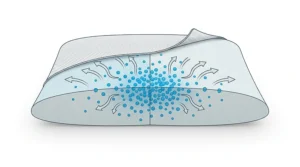
Gel changes this equation through superior thermal conductivity. While standard memory foam has a thermal conductivity around 0.03-0.04 W/mK, gel materials range from 0.2-0.5 W/mK depending on composition — that’s 5-15 times more efficient at moving heat. When gel beads or layers are distributed throughout or bonded to foam, they create thermal pathways that pull heat away from your skin and disperse it across a larger surface area where it can radiate into the surrounding air.
Research published in the journal Frontiers in Neuroscience (Harding, Franks, and Wisden, 2019) demonstrates that even modest reductions in sleep surface temperature — as little as 1-2°C — significantly increase time spent in slow-wave sleep (the deepest, most restorative stage). For Canadians whose bedroom ambient temperature might be ideal (18-20°C according to Canadian sleep guidelines) but whose pillow is 3-4°C warmer due to trapped body heat, gel infusion addresses the specific weak point in your sleep environment.
Three Types of Gel Technology: What’s Actually Different
Not all gel pillows are created equal, and understanding the three main approaches helps Canadian buyers match technology to their specific heat disruption patterns:
Gel-infused foam distributes gel beads or particles throughout shredded or solid memory foam. The gel beads create micro heat sinks throughout the foam matrix, pulling heat away from any point of contact and distributing it through the material. This provides sustained, gradual cooling that builds over 15-30 minutes and maintains effectiveness for 6-8 hours. Best for Canadians who don’t need instant cooling but want consistent temperature management through a full sleep cycle.
Bonded gel layers attach a 0.5-2 cm sheet of solid gel to one surface of a foam core. This design provides immediate cooling sensation on contact (the gel surface genuinely feels cold to the touch) but has limited capacity — once the gel absorbs heat equivalent to its thermal mass, effectiveness plateaus. Works best for Canadian buyers whose main issue is falling asleep quickly (where instant cooling helps trigger the body’s sleep onset temperature drop) but who don’t wake from heat in the middle of the night.
Gel-coated fibers apply a thin gel coating to polyester or microfiber fill strands. This is the least aggressive cooling technology, providing marginal temperature reduction through enhanced air circulation rather than active heat absorption. Suitable for Canadians who experience mild overheating and prefer down-alternative pillow feel over memory foam’s characteristic “hug.”
Why Phase-Change Materials Matter for Canadian Climates
The most advanced cooling pillows (like the Coop Cool+) incorporate phase-change materials (PCM) — substances engineered to absorb or release heat at specific temperatures. PCM works differently than gel: instead of conducting heat away through thermal mass, it absorbs heat energy by changing physical state (typically solid to liquid at the molecular level) at a trigger temperature around 31-33°C.
For Canadian buyers, PCM addresses a specific problem: dramatic temperature swings throughout the year. A pillow that cools aggressively in July might feel uncomfortably cold in December when bedroom temps drop to 16°C. PCM self-regulates — it only activates when your skin temperature exceeds the trigger point, meaning the pillow adapts to both summer heat and winter cold without manual adjustment. This makes PCM-equipped pillows particularly valuable for Canadians who don’t want to swap pillows seasonally or who experience significant temperature variation even within a single season (like the Prairies, where summer days can hit 30°C and nights drop to 12°C).
Real-World Application Guide: Getting Maximum Cooling Performance in Canadian Conditions
Buying a gel cooling pillow is step one. Actually experiencing the full cooling benefit requires understanding how Canadian bedroom conditions interact with pillow technology — and making a few strategic adjustments.
Winter Optimization: Managing Dry Air and Temperature Extremes
Canadian forced-air heating systems create uniquely challenging sleep environments. While you might set your thermostat to a reasonable 18-20°C overnight, the reality is your bedroom air is often bone-dry (15-25% relative humidity versus the ideal 40-50%) and unevenly heated. This affects cooling pillow performance in ways most buyers don’t anticipate.
Dry air accelerates moisture evaporation from your skin, which sounds beneficial for cooling but actually disrupts the moisture-wicking process most cooling pillows rely on. Gel fiber and bamboo-covered pillows work by pulling sweat away from skin into the fabric where it evaporates — but if humidity is too low, moisture evaporates too quickly, leaving salt residue on the cover and reducing wicking effectiveness over time. The fix: run a bedroom humidifier targeting 40% relative humidity. This optimizes both pillow performance and prevents the dry throat/nasal passages that plague many Canadians through winter.
Temperature stratification is the other winter issue. Forced-air heat creates temperature layers in your bedroom — air near the ceiling might be 21°C while floor-level air sits at 16°C. Your pillow’s cooling effectiveness depends on the ambient air temperature it can radiate heat into. If your bedroom has 5°C temperature variation from floor to ceiling, position your pillow to maximize contact with cooler air: avoid placing your bed directly under heating vents, and consider a ceiling fan on low (running in reverse to push warm air down gently rather than create a cooling breeze) to homogenize room temperature.
Summer Strategies: Maximizing Cooling When You Need It Most
Canadian summers, particularly across Ontario, Quebec, and BC’s Interior, bring both heat and humidity — the worst combination for sleep quality. Here’s how to leverage your gel cooling pillow’s full potential when ambient conditions work against you:
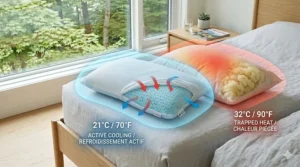
Pre-cool your pillow. Gel technology works best when starting from a cooler baseline. If your bedroom reaches 24-26°C during the day (common in non-AC homes), your pillow absorbs that ambient heat and needs time to dissipate it at night. Solution: store your pillow in a cooler room during the day (basement rooms often stay 3-5°C cooler than upper floors), or even refrigerate it for 20 minutes before bed (not freezer — too cold causes condensation issues). This gives the gel a head start on heat absorption.
Layer your bedding strategically. Your pillow doesn’t work in isolation — it’s part of a thermal management system that includes your sheets, mattress, and blankets. Use percale-weave cotton sheets (cooler than sateen) and avoid flannel pillowcases even if your sheets are cotton. The pillow is working to pull heat from your head; insulating it with thick flannel counteracts this effect. Some Canadian buyers make the mistake of using a thick mattress protector for waterproofing without realizing it traps heat — switch to a breathable bamboo or Tencel protector in summer.
Understand the 3 a.m. heat wall. Many Canadians report their cooling pillow works brilliantly at bedtime but loses effectiveness around 3-4 a.m. This isn’t pillow failure — it’s thermal saturation. After 4-5 hours of absorbing heat, gel layers and even gel-infused foam reach their capacity. The solution isn’t a different pillow; it’s addressing your bedroom’s ambient temperature overnight. Open a window if outdoor temps drop below 18°C at night (common across most of Canada even in summer), or use a timer on your AC to run a cycle at 2-3 a.m. to clear accumulated heat from the room.
The Pillowcase Problem: Why Most Canadians Sabotage Their Cooling Pillow
Here’s a mistake I see constantly: Canadians invest $80-$150 CAD in a premium gel cooling pillow, then immediately cover it with a standard cotton or flannel pillowcase from their linen closet. This is like buying a sports car and filling it with regular fuel — you’re undermining the technology.
Standard cotton pillowcases (200-400 thread count) act as insulation layers. The tighter the weave, the more heat gets trapped between your face and the pillow’s cooling surface. Flannel is even worse, designed specifically to retain warmth. If you’re experiencing less cooling than expected from your new pillow, check your pillowcase first.
The solution: cooling pillowcases made from Tencel, bamboo viscose, or specialized cooling fabric blends (look for Q-max ratings above 0.2). These materials enhance the pillow’s cooling rather than blocking it. A $20-30 CAD cooling pillowcase turns a moderate-cooling pillow into an aggressive-cooling system by removing the thermal barrier most standard pillowcases create. This is especially important for Canadian buyers using gel layer pillows (like the Classic Brands or EGOHOME) where the cooling technology is concentrated on one surface — putting a thick pillowcase on top defeats the entire design.
Choosing the Right Gel Cooling Pillow for Your Canadian Sleep Situation
Generic buying guides tell you to consider “sleep position” and “firmness preference.” That’s fine as far as it goes, but it misses the specific factors Canadian buyers face. Here’s how to actually match pillow technology to your situation:
Decision Factor 1: How Hot Do You Actually Sleep?
Be honest about your heat disruption severity. “I like flipping my pillow occasionally” is different from “I wake up sweating multiple times per night.” The first scenario needs mild cooling (gel fiber or basic gel-infused foam); the second needs aggressive cooling (gel layers with phase-change materials).
Test your actual heat levels: check your bedroom temperature at 3 a.m. using a thermometer. If it’s above 22°C, your issue is environmental (fix your AC/ventilation first). If it’s 18-20°C but you’re still overheating, your body is the heat source and you need serious cooling technology. Many Canadians waste money on premium cooling pillows when their actual problem is a bedroom running 24°C all night — no pillow can compensate for that.
Decision Factor 2: Do You Sleep in the Same Position All Night?
Combination sleepers (switching between side, back, stomach) need different pillow geometry than dedicated side sleepers. Contoured gel pillows (like the SUPA MODERN) provide excellent cooling and support for side sleeping but actively work against you if you roll onto your back. Fixed-loft pillows work for consistent sleepers; adjustable fill (Coop Eden, Cool+) is essential for people who change positions.
Canadian buyers should consider seasonal position changes too. Many Canadians naturally curl up more (side sleeping) in winter and sprawl out (back sleeping) in summer due to temperature and bedding differences. An adjustable-fill pillow lets you add loft for winter side sleeping and remove it for summer back sleeping without buying multiple pillows.
Decision Factor 3: What’s Your Actual Budget in CAD?
Gel cooling pillows on Amazon.ca range from $35 to $160 CAD. The performance difference between $35 and $65 is dramatic; the difference between $100 and $160 is marginal. Here’s the value breakdown:
$35-$50 tier: Gel fiber or basic gel-infused foam. Mild cooling, usually 12-18 month lifespan before losing effectiveness. Good for Canadians testing whether cooling technology helps them at all before committing to premium options.
$55-$85 tier: Quality gel-infused memory foam with better construction. Moderate to good cooling, 2-3 year lifespan. The sweet spot for most Canadian buyers — enough technology to make a meaningful difference without premium pricing.
$90-$160 tier: Multi-layer cooling systems with phase-change materials and advanced foam engineering. Aggressive cooling, 3-5 year lifespan. Only worth it for Canadians with severe heat disruption or those who’ve tried mid-tier options and still experience issues.
Decision Factor 4: Canadian-Specific Climate Considerations
Your location within Canada dramatically affects which cooling technology makes sense. Southern Ontario and the Lower Mainland deal with both heat and humidity (gel technology helps, but moisture-wicking covers are essential). The Prairies experience dry heat (gel layers work well; humidity is less of a factor). Atlantic Canada has moderate temperatures but high humidity year-round (prioritize moisture-wicking).
If you live in a region with dramatic day-night temperature swings (most of the Prairies and Interior BC), phase-change materials provide better value than static gel layers because they self-regulate. If you’re in a more stable climate (coastal BC, southern Ontario), simpler gel infusion works fine.
For Canadians without central AC (still common in older homes across most regions), your cooling pillow needs to work harder because ambient bedroom temperature will be higher. In these situations, aggressive cooling technology (gel layers + phase-change + cooling covers) becomes justified even if you’re a moderate warm sleeper elsewhere. The pillow is compensating for environmental factors beyond your control.
Common Mistakes Canadian Buyers Make with Gel Cooling Pillows
Mistake 1: Assuming All Gel Technology is Equal
Canadian Amazon.ca listings are flooded with pillows claiming “gel infused cooling technology,” but the actual gel content and distribution varies wildly. Budget pillows ($30-$40) often use minimal gel beads mixed into low-quality foam — enough to technically qualify as “gel infused” but not enough to create meaningful cooling. The gel content percentage is rarely listed, so you’re left judging by price, brand reputation, and detailed reviews from verified Canadian buyers.
Here’s the reality check: if a gel pillow costs $35 CAD, the actual gel content is probably under 5% by weight (the foam accounts for most of the cost). A $100 CAD pillow might have 15-20% gel content plus better foam quality. You’re not just paying for brand names; you’re paying for materially more cooling technology in the pillow.
Mistake 2: Ignoring Break-In Periods and Expecting Instant Results
Memory foam (including gel-infused varieties) requires 3-7 days to fully expand and reach optimal performance, especially when shipped in compressed packaging. Many Canadian buyers try their new gel pillow the first night, find it too firm or not cool enough, and immediately return it — missing the fact that the foam hasn’t fully expanded yet.
Temperature affects this break-in period. If you order a gel pillow during Canadian winter and it arrives at your door at -10°C, the foam will be compressed and firm until it reaches room temperature (wait 24 hours before even opening the packaging). The gel itself may feel harder at cold temperatures, then soften as it warms. Give the pillow a full week in your climate-controlled bedroom before judging its performance.
Mistake 3: Choosing Cooling Over Support
The biggest mistake I see: Canadians so focused on solving overheating that they sacrifice proper neck and spine support in the process. A pillow that keeps you cool but leaves you with neck pain isn’t a solution — it’s just trading one sleep disruption for another.
Here’s the rule: find the right loft and support level for your sleep position first, then look for cooling technology within that category. Side sleepers need higher loft (12-15 cm) regardless of cooling features; stomach sleepers need low loft (8-10 cm); back sleepers fall in between. Don’t buy a low-loft gel pillow just because it has great cooling if you’re a side sleeper — you’ll wake up with shoulder and neck pain even if you stayed cool all night.
Adjustable-fill gel pillows (like the Coop models) solve this elegantly — you can optimize both support and cooling independently rather than choosing one over the other. This is why I consistently recommend adjustable designs for Canadian buyers: our dramatic seasonal changes mean you might need different loft winter versus summer (we curl up more in cold weather), and adjustable fill lets you modify the pillow without buying a second one.
Mistake 4: Not Addressing Bedroom Temperature and Humidity
A gel cooling pillow can only compensate for so much. If your bedroom runs 25°C with 70% humidity all night (common in older Toronto or Montreal apartments without AC in July), no pillow technology will fully solve your problem. The pillow can create a 2-4°C cooler microclimate around your head, but it can’t overcome a fundamentally overheated sleep environment.
Canadian buyers should measure their actual bedroom conditions (digital thermometer/hygrometer units cost $15-25 CAD on Amazon.ca) before investing heavily in cooling pillow technology. Target 18-20°C with 40-50% humidity for optimal sleep according to Canadian sleep medicine guidelines. If you’re far outside those ranges, fix the environment first, then add a cooling pillow to fine-tune.
Many Canadians also neglect humidity’s massive impact on perceived temperature. 24°C at 40% humidity feels tolerable; 24°C at 75% humidity feels oppressive because sweat can’t evaporate efficiently to cool your skin. Gel cooling pillows work better in moderate humidity (30-50%) where moisture-wicking can function properly. In high humidity, even the best cooling pillow fights an uphill battle.
Gel Infused Cooling Pillow vs Traditional Cooling Methods: What Works Best for Canadians?
Before gel cooling pillows became widely available on Amazon.ca, Canadians relied on various cooling strategies with mixed results. Let’s compare modern gel technology to traditional approaches and understand when each makes sense.
Gel Cooling Pillows vs Water-Based Cooling Pillows
Water pillows (pouches filled with water acting as a cool surface) were popular in the 1990s and early 2000s. The advantage: water has excellent thermal capacity, absorbing significant heat before warming up. The disadvantages: potential leakage, sloshing sounds with movement, difficulty adjusting loft, and weight (a full water pillow can exceed 3 kg, creating neck strain for some users).
For Canadian buyers, gel technology surpasses water-based designs in almost every aspect except raw cooling power — water does absorb more total heat than gel. But the practical drawbacks (maintenance, durability, comfort) make gel the better choice for 95% of users. Water pillows still have a niche for extreme hot sleepers willing to trade convenience for maximum cooling.
Gel Cooling Pillows vs “Chillow” Insert Pads
Cooling insert pads (like the popular Chillow brand) are thin gel mats you place on top of your existing pillow. They work similarly to bonded gel layer pillows but as a separate accessory rather than integrated design. Cost around $25-40 CAD on Amazon.ca.
The advantage: you can add cooling to any pillow you already own and love for support/comfort. The disadvantages: the insert shifts during sleep, creates a barrier between your head and pillow support, and often feels too firm/cold initially. For Canadian buyers already happy with their pillow’s support characteristics, an insert pad is worth trying before buying an entirely new gel pillow. But if you need to upgrade your pillow anyway, an integrated gel design works better than adding a separate insert.
Gel Cooling Pillows vs Buckwheat/Ventilated Pillows
Buckwheat hull pillows and ventilated foam pillows cool through enhanced airflow rather than gel’s thermal conductivity. Air circulates freely through buckwheat hulls or foam ventilation channels, preventing heat buildup. They’re popular among Canadian buyers attracted to natural/organic products.
The performance comparison: buckwheat pillows sleep slightly cooler than gel pillows in very hot conditions (30°C+ ambient temperature) because active airflow beats passive thermal conduction at extreme heat. But buckwheat creates rustling sounds that disturb light sleepers, weighs significantly more (2-3 kg), and feels unfamiliar to people accustomed to foam or fiber fill. Gel pillows win for most Canadians due to better balance of cooling, comfort, and practicality — though buckwheat devotees swear by the natural approach.
Gel Cooling Pillows vs Dedicated Bedroom Cooling Systems
Some Canadians invest in bedroom cooling systems: AC units, ceiling fans, specialty cooling mattress pads, or even expensive systems like the Eight Sleep Pod (smart mattress with active water cooling, $3,000+ CAD). How do gel cooling pillows fit into this hierarchy?
The reality: a gel cooling pillow addresses localized head/neck heat while bedroom cooling systems manage ambient temperature. They’re complementary, not competing solutions. Many hot-sleeping Canadians find that combining a gel pillow with proper AC (targeting 18-20°C) delivers better results than either solution alone. The pillow creates a cooler microclimate even in a properly cooled room because your head generates concentrated heat from proximity to your brain and blood vessels.
For Canadian buyers on a budget, prioritize in this order: (1) Fix obvious environmental issues (block sunlight heating bedroom during day, improve ventilation); (2) Add a gel cooling pillow for $50-150 CAD; (3) If still experiencing issues, consider AC or mattress cooling pads. Don’t skip step 2 expecting environmental changes alone to solve sleep temperature issues — the pillow addresses heat generated by your body regardless of ambient temperature.
❓ Frequently Asked Questions About Gel Infused Cooling Pillows in Canada
❓ How long do gel infused cooling pillows last before they need replacement?
❓ Can I wash a gel infused cooling pillow, or does washing damage the gel?
❓ Do gel cooling pillows work in cold Canadian winters, or do they make you too cold?
❓ Are gel infused cooling pillows safe for side sleepers with neck pain?
❓ What's the difference between gel-infused foam and gel layer cooling pillows for Canadian buyers?
Conclusion: Finding Your Perfect Gel Cooling Pillow Match in Canada
The gel infused cooling pillow market on Amazon.ca has matured significantly over the past few years, giving Canadian buyers genuine options rather than gimmicky marketing. The technology works — gel’s superior thermal conductivity creates measurable temperature reductions that translate into better sleep quality for hot sleepers. But “works” doesn’t mean “works equally for everyone.”
Your perfect gel cooling pillow depends on how hot you actually sleep (mild, moderate, severe), your primary sleep position (side, back, stomach, combination), your budget in CAD, and your Canadian climate zone. A Toronto condo dweller without AC facing humid July nights needs different cooling technology than a Calgary homeowner with central air dealing with dry chinook winds. A strict side sleeper with broad shoulders requires different loft than a back sleeper with neck pain.
The research presented in this guide points to adjustable-fill gel-infused memory foam (like the Coop Eden at $85-110 CAD) as the best starting point for most Canadian buyers — it delivers meaningful cooling without premium pricing, adapts to your sleep position and seasonal needs, and provides the flexibility to fine-tune performance over time. If you need maximum cooling and can justify the investment, the Coop Cool+ ($120-160 CAD) adds phase-change materials and enhanced airflow engineering. Budget-conscious buyers or those new to cooling technology should start with reversible gel layer designs (Classic Brands at $45-65 CAD) to experience immediate cooling benefits before committing to higher-tier options.
What separates successful gel pillow purchases from disappointing ones isn’t the technology — it’s matching that technology to your actual sleep disruption patterns and Canadian environmental conditions. Measure your bedroom temperature and humidity, honestly assess your heat severity, prioritize proper support for your sleep position, and remember that even the best cooling pillow can’t overcome a fundamentally overheated bedroom. Address the environment first, then leverage gel cooling technology to fine-tune your personal sleep microclimate.
For Canadian buyers shopping Amazon.ca in 2026, the combination of improved manufacturing quality, competitive pricing, and Prime shipping availability means you can access professional-grade cooling pillow technology that previously required specialty sleep store purchases. Take advantage of Amazon.ca’s return policies to test your chosen pillow through a full week (remember the break-in period), use it through various bedroom temperature conditions, and don’t hesitate to try a different option if the first doesn’t deliver the cooling relief you need. Better sleep isn’t a luxury for Canadians dealing with our temperature extremes — it’s a foundational health investment that pays dividends in energy, focus, and overall well-being.
Recommended for You: Latest Sleep Optimization Guides for Canadians
- 7 Best Pillows for Special Needs Canada 2026
- 7 Best Pillows for Multiple Issues Canada 2026 | Pain + Allergy Relief
- 7 Best Chemical Free Pillows Canada: Non-Toxic Sleep 2026
Disclaimer: This article contains affiliate links. As an Amazon Associate, I earn from qualifying purchases. If you purchase products through these links, we may earn a small commission at no additional cost to you.
✨ Found this helpful? Share it with your friends! 💬🤗
