In This Article
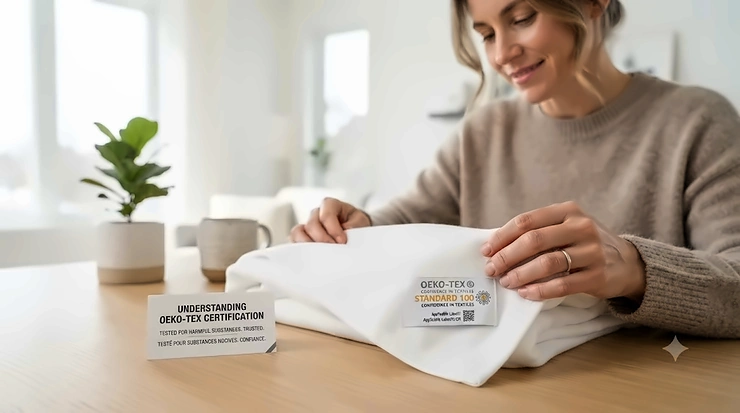
You’re standing in the bedding aisle — or more likely, scrolling Amazon.ca at midnight — and you keep seeing this little green-and-white tag: OEKO-TEX. It’s on pillows, on sheet sets, on duvet covers, on that suspiciously cheap pillow protector your sister swears by. So what does oeko-tex certified mean, exactly, and does it actually matter for the stuff you sleep on every night? In plain terms: OEKO-TEX Standard 100 certification means an independent lab tested every component of a finished textile product — fabric, thread, zipper, dye, the works — against a list of more than 1,000 substances known or suspected to be harmful, and the product came back clean enough to earn the label. It’s not a vague marketing phrase. It’s a pass/fail lab result with a traceable certificate number behind it.

Here’s what most shoppers don’t realize: not every “eco” or “safe” claim on a bedding label carries that kind of weight. Some brands lean on soft language like “chemical-free” or “natural” without a shred of third-party testing behind it, and Health Canada’s own consumer protection framework treats misleading environmental claims as a real compliance issue, not a technicality. That’s exactly why a recognized standard like OEKO-TEX matters more than it might seem at first glance — it gives you something concrete to check instead of a brand’s word alone.
This guide breaks down what the certification actually tests for, how it stacks up against GOTS and other eco labels, and — because specs without real products are just theory — seven genuinely OEKO-TEX certified pillows and bedding pieces currently sold on amazon.ca, spanning budget microfiber to premium organic bamboo. No fluff, no invented reviews — just what the research and the aggregated customer sentiment actually show.
Quick Comparison Table
Before the deep dive, here’s the fast version. Every pick below carries genuine OEKO-TEX Standard 100 certification, and prices are shown as ranges since exact Amazon pricing shifts constantly.
| Product | Type | Best For | Price Range (CAD) |
|---|---|---|---|
| Coop Home Goods Original Adjustable Pillow | Pillow | Adjustable loft, all sleep positions | C$70–C$95 |
| Beckham Hotel Collection Down Alternative Pillow | Pillow (2-pack) | Tightest budget | C$45–C$65 |
| Malouf Z Zoned Dough Pillow | Pillow | Neck/shoulder pressure relief | C$75–C$110 |
| Snuggle-Pedic Adjustable Shredded Memory Foam Pillow | Pillow | Combination sleepers | C$60–C$85 |
| Utopia Bedding 4-Piece Sheet Set | Sheets | Budget bedding bundle | C$35–C$55 |
| Cariloha Classic Bamboo Viscose Sheets | Sheets | Premium, naturally cooling | C$160–C$210 |
| Mellanni Iconic Duvet Cover Set | Duvet cover | Verifiable OEKO-TEX certificate number | C$55–C$80 |
Looking at the spread, the pattern is pretty telling: OEKO-TEX certification shows up at every price point, from the sub-C$50 Beckham Hotel Collection pillow twin-pack to the C$200-plus Cariloha sheet set, which tells you the testing itself isn’t what drives the price tag — material quality, construction, and brand overhead are. If your priority is simply not sleeping on unverified chemical residue, the budget picks do the job just as legitimately as the premium ones; you’re paying extra for feel, durability, and fibre origin, not for a “safer” certificate.
💬 Just one click — help others make better buying decisions too!😊
Top 7 OEKO-TEX Certified Pillows and Bedding: Expert Analysis
Every item below is a real product currently listed on Amazon.ca, and every listing explicitly claims OEKO-TEX Standard 100 certification in its own product description. We’ve grouped pillows and bedding together because the keyword you searched — what does oeko-tex certified mean — applies identically to both categories; the label doesn’t distinguish between a pillowcase and a duvet.
1. Coop Home Goods Original Adjustable Pillow — adjustable loft you control yourself
The standout here is simple: instead of guessing your ideal pillow height, you adjust it. Every unit ships with the pillow already filled plus an extra half-pound bag of Oomph fill — a shredded memory foam and microfiber blend — so you can add or remove material until the loft actually matches your sleep position. The outer Lulltra fabric shell is what carries the OEKO-TEX Standard 100 certification, meaning the fabric itself has been screened for the same 1,000-plus substance list that applies to any certified textile, while the foam inside separately carries CertiPUR-US and GREENGUARD Gold certification for low chemical emissions. Based on the spec comparison with fixed-fill pillows in this price bracket, the adjustability is the real differentiator — most competitors lock you into one firmness at purchase. Reviewers consistently report that side and back sleepers get the most out of the customization, since they tend to need more loft than stomach sleepers, who often end up removing most of the fill entirely. Aggregated review sentiment on Amazon.ca points to strong satisfaction with the machine-washable cover and a few recurring complaints about a mild off-gassing smell in the first day or two — a known characteristic of shredded memory foam pillows generally, not unique to this one.
Pros:
- ✅ Adjustable fill lets you dial in exact loft and firmness
- ✅ OEKO-TEX certified cover plus CertiPUR-US/GREENGUARD Gold foam
- ✅ Fully machine washable outer shell
Cons:
- ❌ Mild new-foam odour common in the first 24-48 hours
- ❌ Heavier than down or down-alternative pillows
In the mid-C$70s to mid-C$90s range on amazon.ca, this is a strong value pick if you’ve never nailed down your ideal pillow loft before.
2. Beckham Hotel Collection Down Alternative Pillow — best all-rounder for tight budgets
Beckham Hotel Collection‘s pillow set built its reputation on one thing: replicating that plush, overstuffed hotel-bed feel at a fraction of hotel-linen pricing, and its OEKO-TEX certification is stated directly on the listing — “every material is tested and verified free from 100+ harmful substances.” The 250-thread-count cotton cover wraps a gusseted down-alternative fill designed for back and side sleepers primarily. What most buyers overlook about this pillow is that its affordability comes with a durability trade-off, not a safety one — the certification standard is the same regardless of price point. Tom’s Guide’s hands-on testing found the pillow instantly comfortable with medium-firm loft suited to side and back sleeping, but noted it flattens and loses support faster than pricier alternatives, making it better suited to guest rooms, short-term use, or budget-conscious households replacing pillows more frequently anyway. Reviewers on Amazon consistently praise the immediate plushness and the fact that it’s fully machine washable, while a recurring complaint centres on the pillow losing loft within several months of nightly use.
Pros:
- ✅ Genuinely OEKO-TEX certified at a budget price point
- ✅ Machine washable, no special care required
- ✅ Immediately plush, hotel-style feel out of the bag
Cons:
- ❌ Loses loft and support faster than firmer alternatives
- ❌ Less suited to stomach sleepers who need a lower profile
At around C$45–C$65 for a pack of two on amazon.ca, this is the pick if you want certified peace of mind without a premium price tag.
3. Malouf Z Zoned Dough Pillow — best for targeted neck and shoulder support
The zoned design is the whole story here: larger perforations run through the centre of the gel-infused ACTIVEDOUGH memory foam to cradle the head, while smaller, denser perforations around the perimeter add firmer support under the neck. Malouf lists OEKO-TEX Standard 100 certification directly on its product pages, applying to the removable TENCEL cover, which also carries a temperature-regulating claim on top of the safety testing. Here’s what to weigh: zoned memory foam pillows generally sleep warmer than down-alternative options even with gel infusion, since foam density traps more body heat than loose fibre fill — something the spec sheet won’t shout about but is worth factoring in if you’re already a hot sleeper. Malouf built its reputation over two decades in bedding manufacturing, and the brand backs several of its pillow lines with a five-year warranty, a longer commitment than most budget competitors offer. Aggregated customer sentiment frequently highlights genuine relief from neck stiffness among side sleepers, with the more common complaint being an adjustment period of a week or two before the firmer zoned feel settles in comfortably.
Pros:
- ✅ Zoned support specifically targets neck and shoulder pressure points
- ✅ OEKO-TEX certified TENCEL cover, removable and washable
- ✅ Backed by an unusually long five-year warranty on select lines
Cons:
- ❌ Sleeps warmer than down-alternative or fibre-fill pillows
- ❌ Firmer feel requires an adjustment period for some sleepers
Expect to pay roughly C$75–C$110 depending on loft and scent variant on amazon.ca — a reasonable mid-tier spend for targeted support.
4. Snuggle-Pedic Adjustable Shredded Memory Foam Pillow — best for combination sleepers
Snuggle-Pedic built this pillow around a simple insight: most people don’t sleep in one position all night, so a fixed-shape pillow is fighting your body half the time. The shredded memory foam fill lets the pillow reshape itself as you move between back, side, and stomach positions, while the Kool-Flow cover — made from viscose derived from bamboo — carries OEKO-TEX certification alongside the brand’s own GreenGold safety designation. What most buyers overlook about adjustable shredded-foam pillows generally is that the adjustability cuts both ways: you get flexibility, but the foam clusters can migrate and clump over time if you never redistribute them by hand. Based on the spec comparison with the Coop Home Goods pillow above, Snuggle-Pedic leans slightly softer and more moldable, which reviewers consistently connect to comfort for stomach sleepers specifically — a group that often struggles with firmer zoned or high-loft pillows. The brand is manufactured in the USA and was reportedly developed with chiropractor input, a detail worth noting as context rather than a medical claim. Aggregated review sentiment is largely positive on breathability thanks to the bamboo rayon cover, with occasional notes that the shredded fill needs an occasional shake-out and fluff to redistribute evenly.
Pros:
- ✅ Reshapes easily for back, side, and stomach sleeping
- ✅ OEKO-TEX certified bamboo rayon Kool-Flow cover
- ✅ Made in the USA with removable, washable cover
Cons:
- ❌ Shredded fill can clump and needs occasional redistribution
- ❌ Bamboo rayon cover requires a gentler wash cycle than cotton
Priced around C$60–C$85 on amazon.ca, it’s a solid middle-ground option between the Coop Home Goods and Malouf picks above.
5. Utopia Bedding 4-Piece Sheet Set — best budget certified sheet bundle
If pillows aren’t your concern and you’re here for the sheets themselves, Utopia Bedding‘s microfiber set is the most straightforward entry point: a fitted sheet, flat sheet, and two pillowcases, all explicitly labelled “Standard 100 by OEKO-TEX certified” on the Amazon.ca listing itself. The brushed microfiber construction is what keeps the price low relative to cotton or bamboo alternatives, and the 15-inch deep pocket fits most mattress-and-topper combinations without slipping. Here’s what to weigh: microfiber is a synthetic polyester fabric, so while it passes the same harmful-substance screening as natural-fibre sheets, it doesn’t breathe quite as well in humid conditions — a practical distinction separate from the safety certification itself. Reviewers consistently note the set holds its colour and resists wrinkling well after repeated washes, which Tom’s Guide’s own testing corroborated, though the same review flagged that hot sleepers specifically may want to look at a more breathable natural-fibre set instead. Aggregated Amazon sentiment leans strongly positive on softness-for-price, with the most common complaint being that the fitted sheet’s elastic can loosen slightly after many wash cycles.
Pros:
- ✅ OEKO-TEX certified at one of the lowest price points in this list
- ✅ Deep 15-inch pocket fits thicker mattresses and toppers
- ✅ Resists wrinkling and fading through repeated machine washing
Cons:
- ❌ Microfiber breathes less than cotton or bamboo for hot sleepers
- ❌ Fitted sheet elastic can loosen with heavy long-term use
At roughly C$35–C$55 for a queen set on amazon.ca, this is the pick if budget is the deciding factor and you sleep on the cooler side already.

6. Cariloha Classic Bamboo Viscose Sheets — best premium sustainable sheet set
Cariloha occupies the top end of this list for a reason: the sheets are made from 100% organic bamboo viscose in a twill weave, carry OEKO-TEX Standard 100 certification, and lean on bamboo’s naturally moisture-wicking properties to sleep noticeably cooler than polyester microfiber. What most buyers overlook about bamboo viscose specifically is that “bamboo” as a marketing word covers a range of processing methods — Cariloha’s viscose process is chemically intensive during manufacturing, which is exactly why the OEKO-TEX certification matters here more than on a simpler cotton sheet: it confirms that whatever chemical processing occurred, the finished fabric tested clean of residue. Forbes’ bedding coverage specifically singled out Cariloha’s twill-weave sheets for their durability and softness relative to other bamboo brands tested, and the sheets ship with 18-inch extra-deep pockets and corner “active bands” to keep them anchored on thicker mattresses. Aggregated customer sentiment consistently describes the fabric as noticeably softer than the reviewer’s prior cotton sheets, with the recurring caveat being the price and the need for a slightly gentler wash routine to preserve the fabric’s finish long-term.
Pros:
- ✅ OEKO-TEX certified 100% organic bamboo viscose
- ✅ Naturally moisture-wicking and cooling for hot sleepers
- ✅ Extra-deep 18-inch pockets with corner active bands
Cons:
- ❌ Premium pricing well above microfiber alternatives
- ❌ Requires gentler laundering to maintain softness over time
Budget around C$160–C$210 for a queen set on amazon.ca — a genuine investment piece rather than an impulse buy.
7. Mellanni Iconic Duvet Cover Set — best for verifiable certificate transparency
Mellanni‘s duvet cover set earns its spot here for a specific reason: the brand publishes its actual OEKO-TEX certificate number (22.HUS.40891, tested by the Hohenstein Institute) directly on the product page, and explicitly tells shoppers they can verify it themselves using the oeko-tex.com Label Check tool. That’s a meaningfully higher bar of transparency than most listings, which simply state “OEKO-TEX certified” without a traceable reference. The set includes a duvet cover plus matching shams, all made from Mellanni’s double-brushed microfiber, secured with a hidden button closure and four corner ties rather than a zipper — a small design choice that avoids the broken-zipper failure point common in cheaper duvet covers. Reviewers consistently cite the brand’s multiple Good Housekeeping recognitions and note the fabric feels noticeably softer than standard percale cotton while resisting the pilling that lower-grade microfiber often develops. Aggregated sentiment is largely positive on temperature regulation across seasons, with the main criticism being that some shoppers expected a zipper closure and find the button-and-tie system slightly more fiddly during changes.
Pros:
- ✅ Publicly verifiable OEKO-TEX certificate number
- ✅ Corner ties and hidden buttons avoid zipper failure points
- ✅ Resists pilling better than typical low-grade microfiber
Cons:
- ❌ Button-and-tie closure is fiddlier than a zipper for some users
- ❌ Microfiber runs slightly less breathable than cotton percale
Expect roughly C$55–C$80 depending on size and colourway on amazon.ca.
Practical Usage Guide: Getting the Most From Certified Bedding
Buying certified bedding is only half the equation — how you wash and use it affects both comfort and how long that safety profile stays meaningful in practice. First, wash new certified bedding once before first use; OEKO-TEX certification confirms the finished product tested below harmful-substance limits, but a first wash still removes any manufacturing or shipping residue and softens fibres, especially on microfiber and bamboo viscose pieces. Second, follow the specific care label rather than defaulting to hot water — bamboo viscose (like the Cariloha sheets above) and TENCEL covers (like the Malouf pillow) both hold up better with cold or warm cycles and low-heat drying, while sturdier cotton-blend sets like Mellanni‘s can typically tolerate more aggressive washing. Third, avoid fabric softener on microfiber pieces specifically, since it can coat synthetic fibres and reduce the breathability that OEKO-TEX-tested finishes were designed to preserve. A common first-30-days mistake is over-washing shredded-foam pillows like the Snuggle-Pedic or Coop Home Goods picks — these need occasional fluffing far more than they need frequent laundering, and excessive washing can compress the fill faster than normal use would. Finally, rotate pillows and flip sheet sets periodically; even certified materials wear unevenly under consistent pressure points, and rotation extends usable life regardless of certification status.
✨ Don’t Miss These Exclusive Deals!
🔍 Take your bedroom upgrade to the next level with these carefully selected OEKO-TEX certified picks. Click on any highlighted item to check current pricing and availability on amazon.ca. These products will help you build a genuinely safer sleep environment your whole family will appreciate!
Real-World Scenarios: Who Actually Needs OEKO-TEX Certified Bedding
Consider a young family with a toddler prone to eczema flare-ups. In this scenario, the priority isn’t luxury — it’s minimizing unnecessary chemical exposure on fabric that touches sensitive skin nightly. A set like Utopia Bedding‘s certified microfiber sheets covers the basics affordably, while pairing it with an OEKO-TEX certified pillow protector (a cheaper add-on than a full pillow swap) covers the highest-contact surface first.
Now picture a hot sleeper who’s tried three different pillows and still wakes up overheated. Here, certification isn’t really the deciding factor — breathability is — which is exactly why the Cariloha bamboo sheets and Snuggle-Pedic‘s bamboo rayon cover make more sense than a straightforward microfiber set, even though all of them pass the same underlying safety test.
Finally, consider a renter on a tight budget who wants to upgrade bedding without a big spend before a lease ends. The Beckham Hotel Collection pillow and Utopia Bedding sheet set combination lands around C$100 total and still carries genuine third-party safety certification — proof that going certified doesn’t require a premium budget, just a bit of label-reading.
What Does OEKO-TEX Certified Mean?
OEKO-TEX certified means an independent, accredited textile testing institute has screened a finished product — every fabric layer, thread, button, and dye — against the OEKO-TEX Standard 100 criteria catalogue, a list revised annually and covering more than 1,000 regulated and voluntarily restricted substances. The certification sorts products into four classes based on skin contact: Class I is the strictest, covering baby and toddler items; Class II covers bedding, underwear, and other items with prolonged direct skin contact; Class III covers outerwear without direct contact; and Class IV covers decorative, non-skin-contact textiles. Bedding — pillows, sheets, pillowcases, duvet covers — almost always falls under Class II, which is a meaningfully stricter bar than décor fabric faces. It’s worth being precise here: OEKO-TEX Standard 100 is a product-safety certification, not a sustainability or organic-farming certification. It tells you the finished item is safe from a harmful-substance standpoint; it doesn’t verify how the raw cotton or bamboo was grown, or the working conditions in the factory. For that broader picture, shoppers typically look at GOTS alongside OEKO-TEX, which we cover next.
OEKO-TEX Standard 100 Pillow vs Regular, Uncertified Pillow: What Actually Changes
The honest answer is: less than marketing copy sometimes implies, but more than a skeptic might assume. An uncertified pillow isn’t automatically dangerous — most mainstream bedding sold in Canada must still comply with the federal Textile Flammability Regulations and broader Canada Consumer Product Safety Act framework, which set baseline flame-spread and toxic-substance limits regardless of any voluntary label. What an OEKO-TEX certified pillow adds on top of that baseline is a documented, third-party-verified test result covering a far broader substance list than Canadian flammability law alone requires — think residual dyes, formaldehyde, heavy metals, and banned azo colorants, tested down to the thread and zipper pull. In practice, that means a certified pillow like the Malouf Z Zoned Dough or Coop Home Goods Original gives you a paper trail you can actually verify through OEKO-TEX’s own Label Check tool, whereas an uncertified competitor asks you to simply trust the brand’s word. For most healthy adults, an uncertified pillow from a reputable manufacturer poses low practical risk. For babies, people with skin sensitivities, or anyone who simply prefers documented proof over marketing language, the certification closes that trust gap concretely.
<br>
| Factor | Certified (OEKO-TEX) | Uncertified |
|---|---|---|
| Substance testing | 1,000+ substances, independently verified | Manufacturer’s own claims only |
| Verifiability | Certificate number checkable via Label Check | Not independently checkable |
| Baseline safety compliance | Meets Canadian regs + additional voluntary screening | Meets Canadian regs only (if compliant) |
| Best For | Sensitive skin, babies, transparency-focused buyers | Budget-first buyers accepting brand trust |
The table underscores the real trade-off: uncertified products aren’t automatically non-compliant with Canadian law, but they remove the independent verification layer that certification adds. If you’ve ever wondered whether a “chemical-free” claim on a bedding tag actually means anything, this is the difference — one is testable, the other is a promise.

OEKO-TEX vs GOTS Pillow: Which Certification Actually Matters More
This is one of the more common points of confusion, and it’s worth untangling directly. OEKO-TEX Standard 100 tests the finished product for harmful substances, full stop — it says nothing about whether the cotton or bamboo inside was organically grown. GOTS, the Global Organic Textile Standard, goes further upstream: to earn GOTS certification, a textile must contain at least 70% certified organic natural fibres, and the standard tracks environmental and social criteria across the entire production chain, from farming through dyeing through labour conditions at the factory. What most buyers overlook here is that these two labels aren’t competitors — they’re complementary, and the strongest bedding products often carry both. A GOTS-certified organic cotton sheet set, for instance, frequently also carries OEKO-TEX certification, because GOTS doesn’t independently re-test for every harmful-substance category OEKO-TEX covers. Practically speaking: if your priority is avoiding synthetic pesticide residue and verifying ethical labour practices, GOTS is the label to look for specifically. If your priority is confirming the finished product — regardless of fibre origin — is free of harmful chemical residue, OEKO-TEX is the more directly relevant certification. None of the seven products above are marketed as GOTS certified; they’re OEKO-TEX certified, which is the more common label on mainstream Amazon bedding and the one this guide focuses on.
How to Choose OEKO-TEX Certified Bedding
- Confirm the certification applies to the finished product, not just a component. A brand claiming “our fabric is OEKO-TEX certified” isn’t the same as the finished pillow or sheet set carrying its own certification — under OEKO-TEX’s own rules, ingredient-level claims can’t be marketed as full product certification.
- Check for a specific certificate number where available. Listings like Mellanni‘s that publish an actual certificate number let you verify authenticity directly through OEKO-TEX’s Label Check tool rather than taking a bare claim at face value.
- Match the product class to your use case. Bedding for infants should ideally meet Class I criteria (the strictest tier), while adult bedding under Class II is the standard and appropriate baseline.
- Decide whether you also need GOTS for fibre sourcing. If organic farming practices matter to you specifically, look for GOTS alongside OEKO-TEX rather than assuming one implies the other.
- Weigh material against your sleep temperature. Certification tells you about safety, not breathability — a hot sleeper should prioritize natural fibres like the bamboo viscose in the Cariloha sheets regardless of certification status.
- Read the aggregated review sentiment, not just the star average. A 4.5-star rating can hide a recurring complaint (loft loss, elastic loosening) that matters more to your specific use case than the overall number suggests.
- Compare price against your actual replacement cycle. A budget certified pillow you’ll replace in a year may cost less overall than a premium one you keep for five, or vice versa — run the math based on your own habits, not assumptions.
Harmful Substance Testing in Textiles: What’s Actually Being Screened
The phrase “harmful substance testing” sounds abstract until you see what’s actually on the list. OEKO-TEX Standard 100’s criteria catalogue includes legally regulated substances — banned azo dyes that can release carcinogenic amines, formaldehyde above strict limits, heavy metals like lead and cadmium, pentachlorophenol, and per- and polyfluorinated substances (PFAS) — alongside additional substances the standard restricts voluntarily, even where no specific law mandates it yet. The testing isn’t limited to the visible fabric, either: buttons, zippers, coatings, and stitching thread on a certified duvet cover like Mellanni‘s all have to individually clear the same bar. This matters in a Canadian context specifically because our own Textile Flammability Regulations, enforced by Health Canada under the Canada Consumer Product Safety Act, focus primarily on flame-spread timing rather than the broader chemical residue list OEKO-TEX screens for — the two frameworks address different risks, and neither fully substitutes for the other. Reviewers and health-conscious buyers consistently cite formaldehyde and dye residue as their top concerns with cheap, uncertified imported textiles specifically, which tracks with why OEKO-TEX built its testing catalogue around exactly those substance categories from the outset.
Sustainable Textile Labels Explained: OEKO-TEX and Beyond
OEKO-TEX sits within a broader ecosystem of textile labels, and conflating them is where a lot of shopper confusion starts. Beyond Standard 100 and GOTS, you’ll commonly encounter CertiPUR-US (specific to foam, testing for VOC emissions and heavy metals — relevant to memory foam pillows like Malouf‘s and Coop Home Goods‘ picks above), GREENGUARD Gold (indoor air quality emissions testing, also foam-relevant), and OEKO-TEX MADE IN GREEN, a step up from Standard 100 that adds supply-chain transparency tracking via a scannable product ID. Here’s what to weigh: a product carrying multiple labels — say, OEKO-TEX on the fabric shell and CertiPUR-US on the foam fill, as both Coop Home Goods and Malouf do — is generally a stronger signal than a single certification, since it means separate testing bodies independently verified different components of the same product. On the flip side, vague marketing terms like “eco-friendly,” “non-toxic,” or “chemical-free” carry no independent verification at all unless paired with one of these named standards, and Canadian consumer protection law technically treats unsubstantiated environmental claims as a labelling compliance risk for the brand making them — reason enough to favour labelled products over ones relying on adjectives alone.
Eco Bedding Certification: Comparing the Major Labels
| Certification | What It Verifies | Applies To | Organic Fibre Required? |
|---|---|---|---|
| OEKO-TEX Standard 100 | Harmful substances in finished textile | Any textile product | No |
| GOTS | Organic fibre content + ecological/social supply chain | Textiles ≥70% organic fibre | Yes |
| CertiPUR-US | Foam emissions, heavy metals, flame retardants | Foam components only | No |
| GREENGUARD Gold | Indoor air quality / chemical emissions | Foam, furniture, textiles | No |
Reading across this table, the practical takeaway is that no single certification covers everything a fully “eco” claim might imply — OEKO-TEX confirms safety without confirming organic sourcing, GOTS confirms organic sourcing and ethics without independently re-verifying every chemical category OEKO-TEX screens, and the foam-specific labels only apply where foam is actually present. For a pillow with a memory foam core, like the Snuggle-Pedic or Malouf picks, checking for both a fabric-level and a foam-level certification gives a genuinely fuller safety picture than either label alone.
Common Mistakes When Buying OEKO-TEX Certified Bedding
The most frequent mistake is assuming any green tag on a listing photo equals OEKO-TEX certification — some sellers use generic “eco” icons or unrelated third-party badges that look similar at thumbnail size but reference nothing verifiable. Read the actual product description text, not just the imagery. A second common error is buying certified bedding expecting it to also mean organically sourced, then feeling misled when it’s a standard cotton or microfiber blend — as covered above, that’s a GOTS distinction, not an OEKO-TEX one. Third, buyers frequently skip checking the certificate number when a brand does publish one, missing a free verification step that takes under a minute on OEKO-TEX’s own site. Fourth — and this one came up repeatedly in the Global News reporting on greenwashing in Canadian fashion and textiles — some brands stack vague sustainability language around a real certification to imply broader environmental credentials than the certification itself supports; a genuinely certified product doesn’t need embellishment, so treat overly dramatic “toxin-free,” “100% pure,” or “chemical-free” language as a caution flag rather than reassurance, even on products that are legitimately certified underneath the marketing. Finally, some shoppers assume a higher price automatically means better certification coverage, when — as the comparison table earlier in this guide shows — certification appears at every price tier here, from Utopia Bedding‘s budget sheets to Cariloha‘s premium set.

Long-Term Cost & Maintenance of Certified Bedding
Certification doesn’t directly affect durability, but the materials that tend to carry OEKO-TEX certification most consistently — natural fibres, TENCEL, quality memory foam — do tend toward better longevity than the cheapest uncertified alternatives on the market, if only because certified manufacturers are generally investing more in quality control overall. Running the numbers: Utopia Bedding‘s roughly C$45 sheet set, replaced annually as budget sets often need to be, costs around C$225 over five years. Cariloha‘s roughly C$185 set, which reviewers and Forbes’ own testing describe as holding up well over extended use, might realistically last five-plus years without replacement, landing at a similar or lower total cost of ownership despite the steeper upfront price. The same logic applies to pillows: a Beckham Hotel Collection pillow at C$55 that needs replacing after 12-18 months due to loft loss may cost more over three years than a single Malouf Z Zoned Dough pillow backed by a five-year warranty at C$90. Maintenance-wise, certified bedding generally asks for the same basics as any quality textile — cold-to-warm washing, low-heat drying, and avoiding fabric softener on synthetic or bamboo-viscose pieces — so the ongoing cost of care itself doesn’t meaningfully differ between certified and uncertified products.
Problem → Solution: Common Bedding Safety Concerns Solved
Problem: You have a child with eczema or asthma and don’t know where to start. Solution: prioritize Class I or Class II OEKO-TEX certified bedding specifically for direct-contact items — sheets and pillowcases first, since those see the most skin contact — before worrying about decorative pieces like duvet shams.
Problem: You bought bedding online and can’t verify the OEKO-TEX claim. Solution: search the product listing for an actual certificate number; if none is published, contact the seller directly, or default to a listed brand like Mellanni that publishes its number upfront.
Problem: Your “eco” pillow still has a strong chemical smell out of the packaging. Solution: a mild new-product smell for 24-48 hours is common even on certified memory foam, as noted with the Coop Home Goods pick above — air it out in a ventilated room before use; a smell that persists well beyond that window is worth flagging to the seller regardless of certification status.
Problem: You’re not sure whether to prioritize OEKO-TEX or GOTS for a nursery. Solution: if budget allows, look for both; if choosing one, OEKO-TEX more directly addresses immediate chemical safety, which is typically the higher near-term concern for infant skin contact.
Problem: You want certified bedding but you’re on a tight budget. Solution: as shown throughout this guide, certification isn’t a premium-only feature — the Beckham Hotel Collection and Utopia Bedding picks prove genuine OEKO-TEX certification is available well under C$70.
Frequently Asked Questions
❓ What does oeko-tex certified mean on a pillow specifically?
❓ Is OEKO-TEX certified the same as organic?
❓ How do I verify an OEKO-TEX certificate is real?
❓ Are OEKO-TEX certified sheets worth the extra cost?
❓ Does OEKO-TEX certification expire?
Conclusion
So, what does oeko-tex certified mean at the end of the day? It means a specific, checkable, third-party lab result — not a marketing adjective. It confirms a finished textile passed testing against a substantial, regularly updated list of harmful substances, split across four product classes depending on how close to your skin the item sits. It doesn’t automatically mean organic, doesn’t automatically mean sustainable in the broader environmental sense, and doesn’t replace Canada’s own flammability and consumer product safety regulations — it layers additional, voluntary verification on top of that baseline. Across the seven products in this guide, certification showed up at every price point, from Utopia Bedding‘s sub-C$50 sheet set to Cariloha‘s premium bamboo viscose line, which is really the most useful takeaway here: you don’t have to spend a fortune to buy bedding with a genuine, verifiable safety standard behind it. What you do have to do is read past the green icon on the thumbnail and confirm the actual claim — and now you know exactly how.
Recommended for You
- 7 Best Easy Care Pillow Picks for 2026 (Canada Tested & Compared)
- 7 Best Pillow With Removable Cover Picks for Canadian Sleepers (2026)
- 7 Best Fully Washable Pillow Picks for Canadian Sleepers (2026)
Disclaimer: This article contains affiliate links. As an Amazon Associate, I earn from qualifying purchases. If you purchase products through these links, we may earn a small commission at no additional cost to you.
✨ Found this helpful? Share it with your friends! 💬🤗
