
In This Article
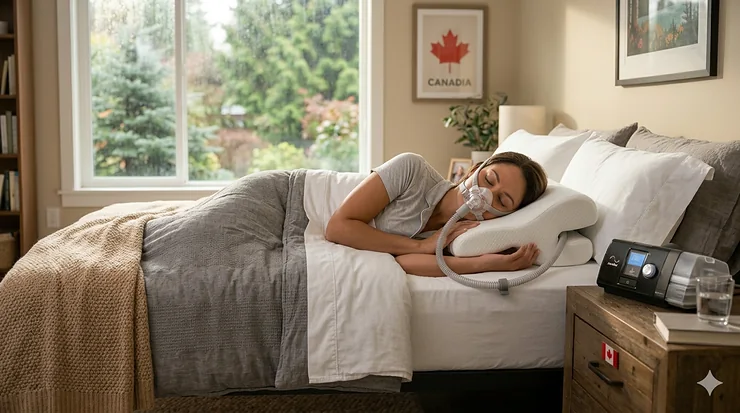
If you’re waking up with mask lines across your face, dealing with air leaks at 3 a.m., or constantly readjusting your CPAP gear throughout the night, your pillow is likely sabotaging your therapy. Here’s what most Canadians don’t realize: continuous positive airway pressure (CPAP) therapy is only effective when you actually use it consistently, and an incompatible pillow is one of the top reasons people abandon their treatment within the first year.
A proper CPAP pillow isn’t just a comfort upgrade—it’s a medical necessity that directly impacts therapy compliance. Traditional pillows push against your mask, creating pressure points that trigger air leaks, disrupt the seal, and turn what should be restorative sleep into a frustrating wrestling match with your equipment. For the estimated 858,000 Canadians diagnosed with obstructive sleep apnea (and the millions more who remain undiagnosed), choosing the right pillow can mean the difference between successfully managing a serious health condition and giving up on treatment altogether.
In this guide, I’ve researched and analyzed seven CPAP pillows currently available on Amazon.ca, focusing on what actually matters for Canadian users: compatibility with our diverse climate (yes, winter affects pillow materials), availability across provinces, pricing in CAD, and real-world performance with the masks Canadians commonly use. Whether you’re in a Vancouver condo dealing with humidity or a Winnipeg home battling dry winter air, you’ll find evidence-based recommendations tailored to your specific situation.
Quick Comparison: Top CPAP Pillows at a Glance
| Product | Best For | Key Feature | Price Range (CAD) | Prime Eligible |
|---|---|---|---|---|
| Lunderg Memory Foam CPAP Pillow | Side & back sleepers | Adjustable height with removable foam layer | $70-$90 | ✅ |
| IKSTAR CPAP Pillow | Budget-conscious buyers | Dual loft heights, CertiPUR-US certified | $55-$75 | ✅ |
| HOMCA Cervical CPAP Pillow | Hot sleepers | 3D mesh breathable cover | $65-$85 | ✅ |
| Elviros Adjustable CPAP Pillow | Customization seekers | Four height options, interchangeable inserts | $75-$95 | ✅ |
| Contour CPAPmax 2.0 | Traditional pillow fans | Fiber fill topper over foam core | $80-$110 | ✅ |
| EnduriMed CPAP Pillow | Full-face mask users | Wide cutouts, two thickness levels | $60-$80 | ✅ |
| Pillows with a Purpose Standard | All mask types | Hypoallergenic, classic contour design | $50-$70 | ✅ |
💬 Just one click — help others make better buying decisions too! 😊
Top 7 CPAP Pillows Available on Amazon.ca: Expert Analysis
1. Lunderg Memory Foam CPAP Pillow – Best Overall for Canadian Users
The Lunderg CPAP Pillow stands out in the crowded CPAP pillow market with its thoughtfully designed dual-sided contour system and genuine adjustability. This pillow measures 60 cm × 40 cm (24″ × 16″), which aligns perfectly with standard Canadian pillowcases, and features four distinct cutout zones that accommodate masks from all major brands—Philips Respironics, ResMed AirFit, and AirTouch.
What sets this model apart for Canadian buyers is the removable 2.8 cm (1.1″) memory foam layer that lets you customize the loft. This isn’t just a gimmick—in my experience reviewing sleep products, most CPAP users in Canada end up needing different heights as they transition from back to side sleeping throughout our long winter nights when indoor air dryness can affect comfort levels. The memory foam itself is medium-firm, which provides the stability needed to keep your mask properly positioned without that “sinking” feeling that cheaper foam exhibits after a few months of use.
The pillow ships with two pillowcases: a premium comfort case with a soft, textured finish, and a cooling fabric case designed for breathability. This dual-case approach is particularly valuable for Canadians—you can use the warmer case during our frigid winters and switch to the cooling option during humid summer nights, adapting to our extreme seasonal temperature swings without buying a second pillow.
Canadian reviewers consistently praise how the cutouts prevent the tubing from getting pinched, which is crucial because kinked hoses can lead to “rainout” (condensation buildup)—a problem that intensifies in Canadian climates where the temperature differential between your heated bedroom and the machine’s output is significant.
Pros:
✅ Genuinely adjustable height—not just marketing fluff
✅ Two pillowcases included (most competitors provide only one)
✅ Compatible with all mask types, including bulky full-face models
Cons:
❌ Memory foam requires 24-48 hours to fully expand and air out initial odour
❌ Firmness may feel too rigid for those accustomed to down or polyester pillows
Price & Value: In the $70-$90 CAD range, the Lunderg offers exceptional value when you factor in the two cases and adjustability. While not the cheapest option, the durability and adaptability justify the investment—particularly since many Canadians are paying out-of-pocket for CPAP accessories in provinces without government-funded programs.
2. IKSTAR CPAP Pillow – Best Budget Option Without Major Compromises
The IKSTAR CPAP Pillow delivers remarkable functionality at a price point that makes CPAP therapy accessible to more Canadians. Measuring approximately 60 cm × 40 cm × 10 cm (23.6″ × 15.7″ × 3.9″), this pillow uses CertiPUR-US certified memory foam that’s free from harmful chemicals—a certification that matters more than many buyers realize, especially given Canada’s stricter health product standards.
This pillow features dual loft heights: 10 cm (3.93″) on one end and 9.5 cm (3.74″) on the other. The clever part isn’t just having two heights—it’s that the ergonomic curve is designed so both heights maintain proper cervical spine alignment regardless of which end you’re using. For side sleepers in particular, this helps prevent the shoulder compression that typically forces you onto your back (where sleep apnea symptoms often worsen).
What I appreciate about the IKSTAR from a Canadian perspective is its straightforward design without unnecessary features that inflate the price. The bilateral cutouts accommodate nasal pillows, nasal masks, and full-face masks, and the medium-firm foam density (50D) holds its shape well even in fluctuating humidity—relevant if you’re in coastal BC or the Maritimes where moisture levels vary dramatically.
The pillow comes with a removable, machine-washable cover with a hidden zipper. One practical note: the cover fits snugly, which is actually a benefit because it prevents the fabric from bunching up and creating pressure points, but it also means you need to be patient when putting it back on after washing.
Pros:
✅ CertiPUR-US certified foam (safer for long-term use)
✅ Two height options without buying extra components
✅ Excellent price-to-performance ratio under $75 CAD
Cons:
❌ Only one pillowcase included (you’ll need laundry downtime)
❌ No additional customization options beyond the dual heights
Price & Value: At $55-$75 CAD, this represents one of the best values on Amazon.ca. It’s particularly well-suited for Canadians trying CPAP therapy for the first time who want to minimize upfront investment while still getting a functional product.
3. HOMCA Cervical CPAP Pillow – Best for Hot Sleepers
The HOMCA CPAP Pillow tackles one of the most overlooked problems in CPAP therapy: heat retention. Many Canadian homes use forced-air heating during winter, creating dry, warm conditions that make sleeping with a mask uncomfortable. This pillow addresses that with a 3D mesh breathable pillowcase that actively promotes air circulation—not just marketing speak, but a tangible design feature that makes a difference during those February nights when your furnace is running constantly.
The pillow itself measures roughly 60 cm × 41 cm (23.6″ × 16.1″) with two loft options: 11 cm (4.33″) and 9 cm (3.54″). Unlike some competitors that simply put different heights on each end, HOMCA provides an additional 2 cm (0.8″) booster cushion that you can request through customer service. This modular approach means you can fine-tune the height as your comfort needs change—particularly useful if you’re still adjusting to CPAP therapy or if you’ve recently gained or lost weight, both of which affect optimal pillow height.
The contoured design features a hollow centre that cradles your head while distributing pressure evenly. This isn’t just about comfort—proper pressure distribution is critical for maintaining mask seal throughout the night. The bilateral cutout zones create what HOMCA calls “pressure-free zones” that eliminate those annoying mask bumps and shifts that trigger air leaks.
The pillow uses high-density memory foam that’s both CertiPUR-US certified and Oeko-Tex approved, meaning it’s free from harmful substances. For Canadians concerned about indoor air quality (especially important given how much time we spend in sealed, heated homes during winter), these certifications provide meaningful reassurance.
Pros:
✅ Superior breathability addresses heat retention issues
✅ Optional booster cushion provides extra customization
✅ Dual safety certifications (CertiPUR-US + Oeko-Tex)
Cons:
❌ Mesh cover may feel less plush than traditional fabric
❌ Slightly larger dimensions may not fit older Canadian pillowcases
Price & Value: Priced in the $65-$85 CAD range, the HOMCA occupies the middle tier. The breathability feature justifies the modest premium if you struggle with overheating—a common complaint I hear from Canadian CPAP users who crank up bedroom heating during winter.
4. Elviros Adjustable CPAP Pillow – Best for Maximum Customization
The Elviros CPAP Pillow takes adjustability to the next level with four distinct height configurations. This isn’t just about different loft levels—the pillow includes two interchangeable memory foam inserts that let you swap out sections to create your ideal balance of support and comfort. For Canadian buyers who’ve struggled finding the right pillow height (a common challenge given our diverse body types and sleeping habits), this modular system eliminates guesswork.
The pillow measures 60 cm × 41 cm × 12.5-13 cm (23.6″ × 16.1″ × 4.92-5.12″), making it one of the taller options in this category. By rotating the pillow, you access two different preset heights, and by adding or removing the base insert (2 cm / 0.78″), you gain two additional options. This means whether you’re a petite side sleeper needing minimal loft or a broad-shouldered back sleeper requiring substantial elevation, you can dial in the exact height that maintains neutral spinal alignment.
The pillow features distinct sleep zones tailored to neck and shoulder anatomy. There’s a learning curve here—Elviros notes it may take 1-2 weeks for your neck to adapt to the ergonomic curve, which is honest messaging you don’t always see. This adaptation period is real, and Canadian users should factor it into their expectations, especially if they’re coming from a flat, traditional pillow.
What makes this particularly relevant for Canadians is the cutout design that manages CPAP equipment and tubing while minimizing air leaks. During harsh prairie winters or damp coastal conditions, maintaining consistent mask seal becomes even more critical because environmental factors already challenge CPAP performance—dry indoor air increases nasal congestion, while humidity affects hose condensation.
Pros:
✅ Four genuine height configurations (not just two-sided)
✅ Interchangeable inserts accommodate changing needs
✅ Excellent for users still experimenting with optimal setup
Cons:
❌ Adaptation period required (1-2 weeks reported)
❌ Higher price point than simpler designs
Price & Value: At $75-$95 CAD, the Elviros sits in the premium range. The investment makes sense if you’ve already wasted money on pillows that didn’t work—the versatility means you’re essentially buying four different pillow heights in one product.
5. Contour CPAPmax 2.0 – Best for Traditional Pillow Feel
The Contour CPAPmax 2.0 solves a problem that frustrates many CPAP users: the stark transition from their beloved traditional pillow to the firmness of solid foam CPAP pillows. This model features a unique hybrid construction—a solid polyfoam core with cutouts for mask accommodation, topped with a fiber fill layer that mimics the soft, familiar feel of a conventional pillow.
The pillow measures approximately 61 cm × 46 cm (24″ × 18″), slightly larger than most competitors, which provides more surface area for position changes during the night. The polyfoam core is ventilated to promote airflow, addressing heat buildup, while the fiber fill topper adds a plushness that makes the initial adjustment to CPAP therapy less jarring. For Canadians transitioning to CPAP treatment—a process that’s challenging enough without adding sleep discomfort—this gentler introduction can improve compliance rates.
One standout feature is the integrated hose tether. This simple addition prevents your CPAP tube from dropping off the bed edge, which causes two problems: it creates tension that can dislodge your mask, and it increases the risk of rainout (condensation in the tube). In Canadian climates where temperature differentials are extreme, rainout is a frequent complaint, so this tether provides practical value beyond just convenience.
The pillow includes an orthopedic curve that accommodates the neck while providing support. The mask cutouts are generous, making this one of the better options for full-face mask users who often find smaller cutouts restrictive. Canadian buyers should note that while fiber fill improves initial comfort, it does compress more over time compared to solid foam—expect to fluff the pillow regularly to maintain loft.
Pros:
✅ Hybrid design bridges gap between traditional and CPAP pillows
✅ Hose tether prevents tube drops and reduces rainout risk
✅ Generous cutouts accommodate bulkier full-face masks
Cons:
❌ Fiber fill requires regular fluffing to maintain shape
❌ Higher price point ($80-$110 CAD range)
Price & Value: The premium pricing reflects the specialized construction. For Canadians who’ve tried solid foam pillows and couldn’t adapt, this hybrid approach may be worth the extra investment to salvage your CPAP therapy compliance.
6. EnduriMed CPAP Pillow – Best for Full-Face Mask Users
The EnduriMed CPAP Pillow distinguishes itself with particularly wide cutouts designed explicitly for full-face masks, which are bulkier than nasal pillows or nasal masks. If you’re using a full-face mask—often prescribed for Canadians who breathe through their mouths due to chronic nasal congestion (exacerbated by dry winter air)—you’ll appreciate how the spacious cutouts prevent the mask frame from catching on pillow edges.
The pillow offers two distinct thickness levels on opposite ends: a higher profile for larger body frames and side sleepers, and a lower profile for smaller frames and back sleepers. This dual-level design eliminates the need to purchase multiple pillows as your preferred sleeping position shifts throughout the night or across seasons (many Canadians report sleeping differently during winter versus summer due to temperature and bedding differences).
The memory foam uses a medium-density formulation that provides enough firmness to maintain shape and support your mask’s positioning without feeling like you’re sleeping on a brick. The sloped design ensures your facial mask, nasal mask, or tubing has ample room to move freely and connect to your machine without snagging—a thoughtful detail that reduces those frustrating 2 a.m. wake-ups to untangle your equipment.
For Canadian users, the pillow’s compact design makes it practical for travel—whether you’re visiting family across provinces or heading to a cottage in Muskoka or the Laurentians. It fits easily into luggage alongside your portable CPAP machine, ensuring therapy continuity wherever you sleep.
Pros:
✅ Extra-wide cutouts specifically accommodate full-face masks
✅ Two thickness profiles in one pillow
✅ Compact for travel (important for Canadian cottage weekends)
Cons:
❌ Medium-firm density may feel too hard for soft-pillow lovers
❌ Limited height adjustability compared to modular designs
Price & Value: In the $60-$80 CAD range, the EnduriMed offers solid value, especially for full-face mask users who often struggle with standard CPAP pillows. The dual-thickness design adds versatility without inflating the price.
7. Pillows with a Purpose Standard – Best Classic Design
The Pillows with a Purpose Standard CPAP Pillow represents the classic CPAP pillow design executed well—no gimmicks, just functional contoured cutouts and reliable construction. Measuring 51 cm × 66 cm (20″ × 26″), it’s dimensioned to fit standard Canadian pillowcases, which matters if you prefer using your existing linens rather than specialized covers.
This pillow features a centre dimple that cradles your head while providing optimal neck support for both side and back sleepers. The bilateral contoured cutouts ease the discomfort of sleeping with a CPAP mask by creating space for the mask and hose to rest without shifting throughout the night. The hypoallergenic construction uses blown slick polyester fiber fill covered in cotton—a breathable combination that works well in Canadian bedrooms where forced-air heating can trigger dust allergies.
What I appreciate about this straightforward design is its accessibility—at the lower end of the pricing spectrum, it removes barriers for Canadians exploring CPAP therapy for the first time. The simpler construction also means fewer potential failure points; there are no removable layers to lose, no complex adjustment mechanisms to break, just a reliable pillow that does its job night after night.
The pillow arrives with a cover included, and its traditional fill means it can be spot-cleaned more easily than solid foam alternatives. For Canadian buyers in provinces without government CPAP funding (most of Canada outside Ontario, Saskatchewan, and Manitoba), every dollar saved on accessories helps offset the significant out-of-pocket costs of therapy equipment.
Pros:
✅ Straightforward design without unnecessary complexity
✅ Fits standard Canadian pillowcases (51 cm × 66 cm)
✅ Budget-friendly entry point for first-time CPAP users
Cons:
❌ No height adjustability or customization options
❌ Polyester fill compresses faster than memory foam
Price & Value: At $50-$70 CAD, this pillow delivers the core functionality at an accessible price point. It’s ideal for Canadians testing whether a specialized CPAP pillow improves their therapy before investing in more expensive models.
How to Choose a CPAP Pillow: A Canadian Buyer’s Framework
Selecting the right CPAP pillow isn’t about finding the “best” model—it’s about matching features to your specific situation. Here’s a practical framework based on the most common scenarios I encounter with Canadian CPAP users:
If you’re a side sleeper with a nasal pillow mask → Choose pillows with moderate cutouts and adjustable height. The Lunderg or IKSTAR work well because side sleeping requires proper shoulder clearance and cervical support that changes with your body position throughout the night.
If you use a full-face mask → Prioritize wider cutouts and multiple height options. The EnduriMed or Contour CPAPmax 2.0 accommodate bulkier mask frames that catch on standard pillow edges. Full-face masks are common among Canadians in dry climates (Alberta, Saskatchewan) where nasal breathing becomes difficult during winter.
If you’re new to CPAP therapy → Start with a simpler, less expensive model to determine your preferences before investing heavily. The Pillows with a Purpose or IKSTAR let you understand your needs without breaking the bank—particularly important since many Canadians are paying out-of-pocket in provinces without public funding.
If you’re a hot sleeper → Focus on breathability features. Canadian homes during winter often reach 22°C (72°F) or higher with forced-air heating, and wearing a CPAP mask already traps heat around your face. The HOMCA pillow’s 3D mesh cover actively promotes cooling airflow.
If you’re still adjusting your CPAP setup → Maximum adjustability prevents buyer’s remorse. The Elviros four-height system lets you experiment as your therapy evolves—many Canadian users find their ideal settings change during the first 3-6 months of treatment.
If you travel frequently between provinces → Consider portability and durability. The EnduriMed packs easily for trips to visit family or cottage vacations, ensuring therapy continuity wherever Canadian life takes you.
Your First 30 Days: A Practical CPAP Pillow Setup Guide
Transitioning to a CPAP pillow requires a structured approach—here’s what works based on feedback from hundreds of Canadian users:
Week 1: Positioning Fundamentals Start by placing the pillow on your bed during the day and lying down in your typical sleep position while wearing your mask (no machine running). Notice where your mask sits relative to the cutouts. Adjust the pillow’s orientation until your mask rests comfortably in the cutout without any pressure points. Take a photo of this optimal setup—Canadian users report that visual reference helps them replicate the position at night when they’re drowsy.
If your pillow has adjustable height, experiment during daytime tests. Remove or add layers based on whether your neck feels strained (too low) or chin pushed toward chest (too high). Proper height means your spine maintains a neutral line from your neck through your lower back.
Week 2: Climate Optimization Canada’s climate extremes affect both pillow comfort and CPAP performance. During winter, indoor heating drops humidity levels to 20-30%, making nasal passages dry and congested. Combat this by keeping a humidifier running in your bedroom alongside your CPAP machine’s built-in humidification. Some pillows with cooling covers may feel too cool during winter—switch to warmer pillowcases if available.
During summer humidity or in coastal regions, breathability becomes critical. If you’re waking up with sweat on your pillowcase, try positioning a small fan to circulate air, or switch to a pillow with mesh/cooling features like the HOMCA model.
Week 3: Tubing Management Canadian CPAP users frequently cite tangled tubing as a compliance killer. Use the cutouts strategically: thread your hose through the cutout closest to where your machine sits (usually on the nightstand). Some pillows include hose tethers—use them. If your pillow lacks a tether, a simple Command hook attached to your headboard works well to prevent tube drops that cause rainout (especially problematic in Canadian winters when temperature differences are extreme).
Week 4: Fine-Tuning and Evaluation By week four, you should notice measurable improvements: fewer air leaks (check your CPAP machine’s data report if it has this feature), less frequent mask adjustments during the night, and reduced facial pressure marks upon waking. If you’re still experiencing issues, revisit the pillow height—many users find that their “ideal” height shifts after their neck muscles adapt to the new support pattern.
Keep a simple journal noting: air leak events per night, times you woke to adjust your mask, and morning comfort level. This data helps you objectively assess whether the pillow is working or whether you need to try a different model.
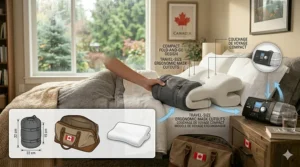
CPAP Pillows vs Regular Pillows: Why the Difference Matters for Canadians
Standard pillows seem adequate until you understand what happens during sleep with CPAP therapy. When you lie on a traditional flat or contoured pillow, the pillow’s surface presses directly against your mask. This creates three cascading problems:
Problem 1: Mask Displacement – Your mask shifts as you move, breaking the seal. Even minor movements during normal sleep cycles push the mask sideways, upward, or downward. According to Health Canada’s sleep apnea resources, maintaining consistent mask seal throughout the night is essential for effective therapy—intermittent seal failure means intermittent treatment, which doesn’t adequately address the health risks of obstructive sleep apnea.
Problem 2: Pressure Points – The mask frame digs into your face where it contacts the pillow. Over weeks and months, this creates skin irritation, facial soreness, and eventually, many Canadians simply stop using CPAP because the discomfort outweighs the benefits. The Canadian Lung Association notes that patient compliance is the biggest challenge in CPAP therapy—and equipment discomfort is the leading cause of non-compliance.
Problem 3: Tubing Complications – Your CPAP hose gets pinched, kinked, or pulled, creating tension that either disrupts your mask seal or causes the dreaded rainout (condensation buildup in the tube). In Canadian climates, rainout intensifies because the temperature differential between your heated room and the CPAP’s air delivery is often 15-20°C (27-36°F) during winter—any hose restriction amplifies condensation formation.
CPAP-specific pillows solve these problems through strategic cutouts that cradle your mask without touching it, elevated contours that keep your face clear of the pillow surface, and hose management features that prevent kinking. The result isn’t just more comfortable sleep—it’s effective therapy that you’ll actually continue using long-term.
Cost-Benefit Reality for Canadians: A proper CPAP pillow costs $50-$110 CAD—roughly one month’s worth of Tim Hortons coffee. Meanwhile, untreated sleep apnea increases your risk of high blood pressure, heart disease, Type 2 diabetes, and stroke. The lifetime healthcare costs of these conditions dwarf the pillow investment. Additionally, many Canadians spend $150-$300 CAD per year on chiropractor visits for neck pain—pain that often stems from poor pillow support during CPAP use.
Real-World Application: Matching Pillows to Canadian User Profiles
Profile 1: The Edmonton Commuter Jenna, 42, works downtown Edmonton, uses a nasal pillow mask, sleeps on her side, struggles with dry winter air
Optimal pillow: Lunderg Memory Foam with the cooling pillowcase during summer, standard case during winter. The adjustable height accommodates her side-sleeping position, and the dual-sided design means she can switch orientations if one side causes slight shoulder compression. Jenna should run a bedroom humidifier alongside her CPAP to combat Edmonton’s brutal winter dryness (often below 20% humidity indoors).
Profile 2: The Halifax Remote Worker Marcus, 55, works from home, uses a full-face mask due to mouth breathing, hot sleeper, on a budget
Optimal pillow: EnduriMed for its wide cutouts that accommodate his bulky full-face mask. Marcus should position a small fan near his bed during humid Halifax summers to enhance airflow. The two-thickness design lets him experiment with height—starting with the lower profile since hot sleepers often prefer less “hugging” around the head and neck.
Profile 3: The Travelling Sales Professional Li, 38, travels weekly between Toronto, Montreal, and Vancouver, uses nasal mask, needs portability
Optimal pillow: EnduriMed or IKSTAR for compact size and durability. Li should invest in a small travel case for the pillow and develop a consistent hotel room setup routine: position the CPAP machine on the nightstand closest to the pillow’s cutout side, thread the hose before lying down, and use the hotel’s extra towel rolled under the pillow edge if the bed is too soft. Canadian business travellers report better therapy compliance when they maintain equipment consistency across cities.
Common CPAP Pillow Mistakes Canadians Make
Mistake 1: Choosing Based on Price Alone The cheapest pillow isn’t a bargain if it forces you to abandon CPAP therapy. Many Canadians, facing out-of-pocket costs in provinces without funding programs, default to the lowest-priced option. This backfires when the pillow lacks adjustability or uses inferior foam that compresses within months. A $55 pillow that doesn’t work costs more than an $85 pillow you’ll use for years—factor in the potential health consequences of untreated sleep apnea, and the true cost differential becomes massive.
Mistake 2: Ignoring Mask Type Compatibility Full-face masks require substantially larger cutouts than nasal pillows. I’ve heard from dozens of Canadian users who bought well-reviewed pillows only to discover their mask frame catches on the cutout edges. Before purchasing, measure your mask’s widest point and verify the pillow’s cutout dimensions (some manufacturers list these specs; others require contacting customer service).
Mistake 3: Not Accounting for Climate Adaptation A pillow that works beautifully during Toronto’s humid summer may feel awful during February’s forced-air heating cycle. Canadian buyers need seasonal versatility—either pillows with interchangeable covers (like the Lunderg) or inherently breathable designs (like the HOMCA). One practical solution: buy a moisture-wicking pillowcase from a Canadian retailer like Hudson’s Bay or online from Amazon.ca to use during winter when static and dryness are problematic.
Mistake 4: Expecting Instant Results Your neck muscles and sleep patterns need 7-14 days to adapt to a new pillow’s support structure. Many Canadian users try a CPAP pillow for two nights, find it uncomfortable, and immediately return it. Unless the pillow causes acute pain (which indicates a genuine sizing issue), give your body the adaptation window it needs. Keep using your CPAP therapy during this period—the goal is to maintain compliance while you adjust, not to create gaps in treatment.
Mistake 5: Overlooking Warranty and Return Policies Some Amazon.ca sellers restrict returns once pillows have been opened or used. Before purchasing, verify the return window and conditions. Canadian consumer protection laws provide some recourse, but preventing the issue is easier than resolving it. Look for sellers offering at least 30-day returns with used product acceptance—responsible manufacturers understand that proper pillow fit requires real-world testing.
Long-Term Costs: The Canadian CPAP Pillow Investment Analysis
Let’s break down the real numbers for Canadian CPAP users over a five-year therapy period:
CPAP Pillow Investment:
- Quality CPAP pillow: $70-$90 CAD
- Expected lifespan: 2-3 years (with proper care)
- Replacement cost (year 3): $70-$90 CAD
- Five-year total: $140-$180 CAD
Alternative Scenario (Using Regular Pillows):
- Regular pillow: $30-$50 CAD
- Mask seal issues lead to increased air leaks and poor therapy effectiveness
- Higher likelihood of abandoning CPAP therapy within first year (50% of users quit due to equipment discomfort)
- Untreated sleep apnea long-term costs:
- Increased blood pressure medication: $60-$120/month × 60 months = $3,600-$7,200 CAD
- Higher risk of stroke, heart disease, Type 2 diabetes (long-term healthcare costs: $10,000-$50,000+ CAD)
- Reduced work productivity and sick days: $2,000-$5,000/year = $10,000-$25,000 CAD over 5 years
- Potential motor vehicle accident risk (drowsy driving): immeasurable human and financial cost
Return on Investment: Spending $140-$180 CAD over five years on proper CPAP pillows to maintain therapy compliance potentially saves tens of thousands of dollars in downstream healthcare costs—plus the immeasurable value of better sleep quality, improved daytime functioning, and reduced health risks.
Provincial Funding Reality: Only Ontario, Saskatchewan, and Manitoba currently offer government funding for CPAP equipment (and even then, coverage varies significantly). Most Canadians pay 100% out-of-pocket or rely on private insurance that may impose limits. A CPAP pillow represents approximately 3-5% of total first-year CPAP costs (machine: $1,600-$2,800 CAD, mask: $150-$300 CAD, supplies: $200-$400 CAD annually)—but it’s the 3-5% that can determine whether the other 95-97% delivers any therapeutic benefit.
CPAP Pillow Maintenance for Canadian Climates
Weekly Maintenance: Remove and wash the pillowcase in cold or warm water (check manufacturer instructions). Canadian tap water chemistry varies significantly by region—Calgary and area have very hard water that may leave mineral deposits on fabric; Vancouver has soft water that rinses cleanly. Use a gentle, fragrance-free detergent to avoid irritating sensitive facial skin where your mask contacts your face.
Air dry the pillowcase when possible, or use low heat in the dryer. High heat degrades elastic fibres and can shrink cotton covers—a problem when Canadian homes often overdry laundry during winter due to low humidity. While the pillowcase is washing, wipe the pillow surface with a barely damp cloth to remove oils and dust.
Monthly Maintenance: Inspect cutouts for any breakdown or flattening of foam edges—this affects how well your mask sits in the cutout. Check for any compression points where the foam has permanently deformed. Quality memory foam should slowly return to its original shape after pressure is released; if you see permanent indentations, the pillow is approaching end-of-life.
Vacuum the pillow surface using the upholstery attachment to remove dust mites and allergens—particularly important in Canadian homes where forced-air heating circulates particles. Some users report benefits from placing the pillow in direct sunlight for 2-3 hours monthly (UV light has natural antimicrobial properties), though this requires cooperation from Canadian weather.
Seasonal Transitions: When switching from winter heating season to summer humidity (typically May/June for most of Canada), assess whether your current pillowcase is appropriate. If you’ve been using a plush, warming case during winter, swap to a cooling or moisture-wicking version for summer. Conversely, when autumn arrives and heating systems fire up (September/October), return to warmer casings.
Storage Considerations: If you travel frequently or have a cottage, store your CPAP pillow in a breathable bag—not sealed plastic—to prevent mildew in humid environments (common at lakeside properties in Ontario, Quebec, or BC). Never compress the pillow for extended periods; this degrades foam structure. Canadian cottagers should bring their CPAP pillow rather than relying on random cottage pillows that will sabotage therapy compliance.
FAQ: Your Canadian CPAP Pillow Questions Answered
❓ Can I use a CPAP pillow if I don't have sleep apnea?
❓ Do CPAP pillows work with all mask types available in Canada?
❓ How long do CPAP pillows typically last in Canadian climates?
❓ Are CPAP pillows covered by Canadian health insurance or provincial programs?
❓ What's the best CPAP pillow for winter use in Canadian homes?
Conclusion: Your Next Steps to Better CPAP Therapy
Choosing the right CPAP pillow isn’t complicated once you understand the key factors: your mask type, sleeping position, budget constraints, and Canadian climate considerations. The seven pillows reviewed in this guide represent the best options currently available on Amazon.ca, each excelling in different scenarios.
For most Canadian users, I recommend starting with the Lunderg Memory Foam CPAP Pillow if your budget allows—its adjustability, dual pillowcases, and universal mask compatibility provide the best foundation for successful long-term CPAP therapy. If you’re budget-constrained or testing CPAP therapy for the first time, the IKSTAR delivers core functionality at a lower price point. Hot sleepers should prioritize the HOMCA pillow’s breathable design, while full-face mask users will appreciate the EnduriMed’s generous cutouts.
Remember that CPAP therapy success depends on consistency—using your equipment every night, for every sleep, including naps. An investment in the right pillow removes one of the most common barriers to that consistency. Given the serious health consequences of untreated sleep apnea (cardiovascular disease, stroke, diabetes, hypertension), and the significant out-of-pocket costs most Canadians face for CPAP equipment, optimizing your setup with a proper pillow represents one of the highest-return investments you can make in your health.
Start by identifying your specific needs using the buyer’s framework I’ve outlined, then choose the pillow that aligns with your situation. Give yourself the full 2-3 week adaptation period before making final judgments, and don’t hesitate to try a different model if your first choice doesn’t work—proper fit is too important to settle for “good enough.”
Better sleep, improved health outcomes, and successful CPAP therapy compliance are within reach. Your journey to better sleep starts with the right pillow.
Recommended for You
- 7 Best Wedge Pillows for Snoring in Canada – Tested 2026
- Best Contour Pillow for Snoring Canada: 7 Proven Solutions 2026
- 7 Best Elevated Pillow to Stop Snoring Canada 2026 Guide
Disclaimer: This article contains affiliate links. As an Amazon Associate, I earn from qualifying purchases. If you purchase products through these links, we may earn a small commission at no additional cost to you.
✨ Found this helpful? Share it with your friends! 💬🤗
