
In This Article
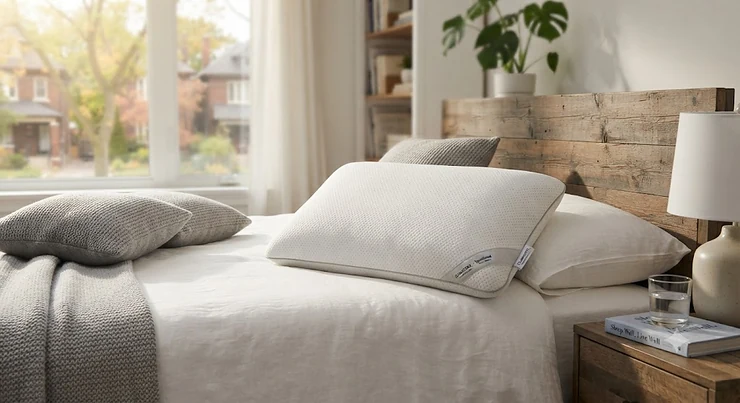
Here’s a truth nobody prints on the pillow packaging: not all “cooling” pillows actually cool you down. A ventilated pillow is a foam pillow engineered with air channels, perforations, or an open-cell structure that lets heat escape instead of building up against your face all night. That’s it. That’s the whole idea — airflow instead of insulation. If you’ve ever flipped your pillow at 2 a.m. hunting for the “cool side,” you already understand the problem this category is trying to solve.
Canadian bedrooms complicate things further. Forced-air furnaces dry out winter air, humid Ontario and Quebec summers trap heat indoors, and a lot of us are sleeping under duvets built for a climate that swings 50°C across the seasons. Add a heat-trapping solid memory foam pillow into that mix and you’ve got a recipe for waking up damp and cranky. That’s exactly why sleep researchers keep circling back to temperature regulation as a factor in sleep quality — Statistics Canada’s overview of national sleep data notes that a meaningful share of Canadian adults report sleep that isn’t refreshing, and a hot, damp pillow is a common, fixable contributor.
We spent time digging through real product specs, verified aggregated customer sentiment, and independent lab-style reviews to build this list — not a rewritten Amazon description dressed up as advice. Below are seven genuinely ventilated pillows, covering budget contour foam through premium dual-sided cooling gel, with the honest trade-offs of each laid out plainly. Every product mention here uses price ranges, not fixed figures, because Amazon pricing shifts constantly — always confirm current pricing on the product page before you buy.
Quick Comparison Table: Best Ventilated Pillows at a Glance
| Pillow | Foam Type | Firmness | Price Range (CAD) | Best For |
|---|---|---|---|---|
| Weekender Ventilated Gel Memory Foam Pillow | Single-piece gel-infused, perforated | Medium-firm | C$35-C$55 | Best overall value |
| EPABO Contour Memory Foam Pillow | Perforated contour foam | Firm | Under C$50 | Tightest budget |
| Classic Brands Conforma Ventilated Memory Foam Pillow | Solid, perforated | Medium-firm | C$45-C$65 | Back/side sleepers |
| Amerisleep Comfort Classic | Bio-Pur open-cell foam | Medium | C$120-C$160 | Eco-conscious hot sleepers |
| Coop Home Goods Original Adjustable Pillow | Cross-cut shredded, adjustable | Adjustable | C$85-C$130 | Customizable airflow |
| Silk & Snow Adjustable Pillow | Shredded foam + microfibre hybrid | Adjustable | C$80-C$100 | Canadian-made value |
| Tempur-Cloud Breeze Dual Cooling Pillow | Solid TEMPUR with dual gel layers | Medium-soft | C$220-C$300 | Premium dual-sided cooling |
Looking at the spread above, price and airflow architecture move together in a fairly predictable way: solid one-piece foam pillows with drilled ventilation holes (like the Weekender Ventilated Gel Memory Foam Pillow and Classic Brands Conforma Ventilated Memory Foam Pillow) sit at the accessible end, while shredded and adjustable designs (the Coop Home Goods Original Adjustable Pillow, Silk & Snow Adjustable Pillow) trade a bit of contouring precision for airflow that happens naturally between the foam pieces. At the top, the Tempur-Cloud Breeze Dual Cooling Pillow stacks gel layers onto dense TEMPUR foam, which is why it costs roughly four to six times what the budget picks do. None of these guarantee an ice-cold surface all night — that’s not how foam physics works — but each genuinely improves on a sealed, solid memory foam block.
💬 Just one click — help others make better buying decisions too!😊
Top 7 Ventilated Pillows: Expert Analysis
1. Weekender Ventilated Gel Memory Foam Pillow — best all-rounder for hot sleepers on a budget
The Weekender Ventilated Gel Memory Foam Pillow is a single molded piece of gel-infused foam, dotted throughout with precision ventilation holes rather than relying on shredded fill or add-on cooling pads. That single-piece construction matters more than it sounds: because there’s no fabric shell full of loose fill to compress unevenly, the pillow holds a consistent shape night after night while still letting air move through the drilled channels. It comes in standard, queen, and king sizing, with a medium-firm feel and a removable, machine-washable cover — a real convenience feature that a lot of solid foam pillows skip entirely. Based on the spec comparison with sealed foam competitors, the gel infusion plus the ventilation holes work as two separate cooling mechanisms rather than one gimmick standing in for the other, which is part of why this model shows up so consistently across independent sleep-review sites. Reviewers consistently report that it sleeps noticeably cooler than a standard solid memory foam pillow, though a handful note that, like most one-piece foam pillows, it never gets truly cold to the touch — ventilation reduces heat buildup, it doesn’t manufacture cold. It’s best suited to back and side sleepers who want consistent support without the fluffing and re-shaping that shredded pillows demand.
Pros:
- ✅ Single-piece foam holds its shape night after night
- ✅ Gel infusion plus drilled holes double up on cooling
- ✅ Machine-washable cover simplifies upkeep
Cons:
- ❌ Firmness feels flat for committed stomach sleepers
- ❌ Ventilation reduces heat, doesn’t create a cold surface
At around C$35-C$55 depending on size, the Weekender Ventilated Gel Memory Foam Pillow is one of the strongest value propositions in this entire roundup — check current price for your preferred size before ordering.

2. EPABO Contour Memory Foam Pillow — most breathable budget pick with cervical support
The EPABO Contour Memory Foam Pillow takes a different approach from the flat-profile pillows above: it’s shaped with a raised center ridge and lowered edges, aimed specifically at neck alignment for side and back sleepers, with a removable insert layer so you can shave down the loft if the contour feels too aggressive out of the box. What most buyers overlook about contour pillows is that the ergonomic shape and the breathability are separate engineering problems, and EPABO addresses both — the foam itself is described as breathable with better air circulation, and the included pillowcase is a lighter cotton-polyester blend rather than a heat-trapping quilted cover. Here’s what to weigh: this is a firmer, more clinical feel than the plush pillows on this list, which is exactly the point for people managing neck stiffness, but it means a slower adjustment period. Aggregated review sentiment across major retail platforms points to two recurring themes: genuine relief for neck and shoulder discomfort within the first couple of weeks, and an initial off-gassing smell that dissipates after airing the pillow out, which is standard for freshly molded memory foam and not unique to this brand.
Pros:
- ✅ Removable insert lets you customize loft height
- ✅ Contour shape targets cervical alignment specifically
- ✅ Among the most affordable ventilated options available
Cons:
- ❌ Noticeable adjustment period for new users
- ❌ Firm contour feel won’t suit soft-pillow preferences
Sitting under C$50 in most sizes, the EPABO Contour Memory Foam Pillow is the pick to reach for if cervical support matters as much as breathability — confirm the current price and size availability before checkout.
3. Classic Brands Conforma Ventilated Memory Foam Pillow — firmest real airflow for back and side sleepers
The Classic Brands Conforma Ventilated Memory Foam Pillow is a solid block of perforated memory foam wrapped in a plush velour cover, and it’s one of the more thoroughly reviewed ventilated pillows on the market, with a published 3-year warranty backing it. On paper this means the open-cell foam structure combined with visible perforation channels is doing double duty: pressure relief through contouring, and heat dissipation through the holes running straight through the core. Independent lab-style testers have consistently classified this as a medium-firm to firm feel — firmer than the Weekender pick above — which makes it a strong match for back and side sleepers who want their head to sit up rather than sink in. The spec sheet won’t tell you this, but reviewer consensus repeatedly flags the same trade-off: excellent temperature regulation for a solid foam pillow, paired with a firmness level that stomach sleepers and anyone who likes to sink deep into a pillow will find too dense. The velour cover is a nice touch for perceived comfort, though it’s noticeably thinner than what you’d get on a premium pillow, and some reviewers swap it for their own pillowcase.
Pros:
- ✅ Genuinely firm, stable support that holds loft
- ✅ Backed by an unusually long 3-year warranty
- ✅ Machine-washable velour cover included
Cons:
- ❌ Too firm and flat for most stomach sleepers
- ❌ Velour cover feels thin compared to premium covers
Priced in the C$45-C$65 range, the Classic Brands Conforma Ventilated Memory Foam Pillow rewards buyers who already know they want a firm, no-nonsense pillow — check today’s listing for exact sizing before you commit.
4. Amerisleep Comfort Classic — most advanced open-cell foam technology in this lineup
The Amerisleep Comfort Classic is built around the brand’s proprietary Bio-Pur foam, a partially plant-based memory foam engineered with an open-cell structure rather than the closed-cell density of traditional memory foam — meaning air moves through the material itself, not just through drilled holes on the surface. Amerisleep pairs that open-cell core with additional cooling channels and a breathable knit cover, so cooling happens on three separate levels rather than relying on a single gimmick. Based on the spec comparison with drilled-hole competitors, this is a genuinely different cooling mechanism: open-cell foam is inherently more breathable at a material level, which is why Amerisleep also uses Bio-Pur in its mattress lines specifically to combat heat retention. At a 6-inch loft, this pillow runs taller than most on this list, making it a strong option for back and combination sleepers with broader shoulders, though side sleepers with a narrower frame may find that loft too high without some adjustment. Reviewers consistently note quicker responsiveness than dense traditional memory foam — it doesn’t feel like sinking into wet sand — and the CertiPUR-US certification (which verifies the foam is made without ozone depleters, PBDEs, or heavy metals) is a genuine reassurance point rather than marketing fluff.
Pros:
- ✅ Open-cell Bio-Pur foam is inherently more breathable
- ✅ Quick-response feel instead of slow, sinking memory foam
- ✅ 10-year warranty signals real manufacturer confidence
Cons:
- ❌ 6-inch loft may sit too tall for narrow-framed side sleepers
- ❌ Premium price relative to drilled-hole competitors
Running around C$120-C$160 CAD depending on size, the Amerisleep Comfort Classic justifies its premium mainly through the open-cell material science — verify the current price and loft options before ordering.
5. Coop Home Goods Original Adjustable Pillow — best customizable loft for airflow control
The Coop Home Goods Original Adjustable Pillow ditches the solid-foam-block approach entirely in favour of cross-cut shredded memory foam blended with microfibre, all packed inside a breathable Lulltra fabric cover — and, critically, it ships with an extra half-pound bag of fill so you can add material if you want more loft, or remove it if you sleep hot and want less foam trapping warmth against your neck. What most buyers overlook about shredded designs is that the airflow advantage isn’t a feature bolted on top — it’s structural. Loose, cut foam pieces simply can’t seal together the way a solid block does, so air moves freely between the pieces no matter how you position your head. Consumer Reports testing has given this pillow strong marks across side support, back support, and resilience categories, and aggregated Canadian buyer sentiment consistently praises the ability to dial in exact loft for a specific mattress firmness or sleep position. The trade-off is maintenance: shredded pillows need occasional fluffing and redistribution, something the solid pillows on this list simply don’t require, and the adjustable feel can seem less “supportive” to sleepers who prefer a firm, stable surface.
Pros:
- ✅ Add or remove fill to control loft precisely
- ✅ GREENGUARD Gold and CertiPUR-US certified
- ✅ Strong third-party test results for support
Cons:
- ❌ Needs periodic fluffing to avoid lumping
- ❌ Less structured feel than solid foam pillows
Typically listed in the C$85-C$130 range on amazon.ca, the Coop Home Goods Original Adjustable Pillow earns its price through genuine customization — check the current listing for size-specific pricing.

6. Silk & Snow Adjustable Pillow — best Canadian-made hybrid for breathable comfort
The Silk & Snow Adjustable Pillow is a Toronto-based brand’s answer to the shredded-foam category, combining an adjustable core of shredded memory foam with an outer layer of down-like microfibre inside a 100% cotton shell. What most buyers overlook here is that the microfibre outer layer isn’t just for softness — it adds a second breathable layer around the foam core, so heat has to pass through two airy materials instead of getting trapped against a single dense surface. The company backs the pillow with a 100-night trial and a 3-year warranty when purchased directly, and the foam carries CertiPUR-US and OEKO-TEX certification, addressing the same chemical-safety questions that come up with any imported foam product. Reviewers and Canadian sleep-product testers consistently point to two strengths: genuine Canadian availability without cross-border shipping headaches, and a plush-but-adjustable feel that splits the difference between the firm solid pillows and the fully shredded ones on this list. On the honest downside, direct-purchase warranty and trial terms are stronger than what you get buying through a third-party Amazon listing, so it’s worth confirming the seller before checkout.
Pros:
- ✅ Hybrid shredded-foam-plus-microfibre design breathes well
- ✅ Canadian company, easier shipping and support
- ✅ CertiPUR-US and OEKO-TEX certified materials
Cons:
- ❌ Full trial/warranty terms depend on purchase channel
- ❌ Softer feel than dedicated firm-support pillows
Generally priced around C$80-C$100 CAD, the Silk & Snow Adjustable Pillow is worth a look specifically for buyers who want a Canadian company behind the product — check current amazon.ca pricing and seller details before buying.
7. Tempur-Cloud Breeze Dual Cooling Pillow — best premium pick for dual-sided cooling gel
The Tempur-Cloud Breeze Dual Cooling Pillow sits at the top of this list for a reason: it’s a single piece of TEMPUR’s proprietary pressure-relieving material with a full cooling gel layer laminated onto both sides of the pillow, not just one “cool side” you have to hunt for. The spec sheet won’t tell you this, but reviewers who compare it directly to cheaper gel-topped pillows note the difference is noticeable specifically because both faces are treated, so flipping the pillow doesn’t mean flipping back to a warm surface. It comes with a quilted, removable cotton cover and a 5-year limited warranty, well ahead of what most pillows in this category offer. Based on the spec comparison, this is a slow-response, dense memory foam rather than the quicker Bio-Pur foam used by Amerisleep — TEMPUR material famously prioritizes deep contouring and motion isolation over bounce, which some sleepers love and others find genuinely too heavy and slow to reposition on. Independent reviewers consistently flag it as the most expensive pillow in Tempur-Pedic’s own lineup, precisely because of the dual gel layers, and note that the internal foam isn’t adjustable — what you unbox is what you’re stuck with, unlike the shredded options above.
Pros:
- ✅ Cooling gel on both faces, not just one side
- ✅ Deep, precise pressure relief from TEMPUR material
- ✅ Backed by a full 5-year limited warranty
Cons:
- ❌ Slow, dense feel some sleepers find too heavy
- ❌ Non-adjustable core — no way to change loft
Expect to pay in the C$220-C$300 range for this one, positioning the Tempur-Cloud Breeze Dual Cooling Pillow firmly as a long-term investment purchase — check the current price before deciding if the dual-gel upgrade is worth it for you.
Top 7 Ventilated Pillows: Spec & Rating Comparison
| Pillow | Loft | Cover Type | Adjustable? | Warranty | Best For |
|---|---|---|---|---|---|
| Weekender Ventilated Gel Memory Foam Pillow | Standard | Removable, washable | No | Manufacturer-request | Everyday value |
| EPABO Contour Memory Foam Pillow | Adjustable (removable insert) | Cotton/poly blend | Partial | 30-day guarantee | Neck pain relief |
| Classic Brands Conforma Ventilated Memory Foam Pillow | ~5 inches | Velour, removable | No | 3-year | Firm-support sleepers |
| Amerisleep Comfort Classic | 6 inches | Breathable knit | No | 10-year | Hot sleepers wanting open-cell foam |
| Coop Home Goods Original Adjustable Pillow | Fully adjustable | Lulltra breathable | Yes | Manufacturer-standard | Loft customization |
| Silk & Snow Adjustable Pillow | Fully adjustable | 100% cotton | Yes | 3-year (direct) | Canadian buyers |
| Tempur-Cloud Breeze Dual Cooling Pillow | Fixed | Quilted cotton | No | 5-year | Premium dual-sided cooling |
This table makes the real trade-off obvious once you line the pillows up side by side: adjustability and warranty length don’t move together in any predictable way, so a longer warranty doesn’t necessarily mean more customization. The Amerisleep Comfort Classic stands out with a 10-year warranty despite having a fixed loft, which signals real manufacturer confidence in the Bio-Pur material’s durability specifically. Meanwhile, both adjustable picks — Coop Home Goods Original Adjustable Pillow and Silk & Snow Adjustable Pillow — sacrifice the “set it and forget it” simplicity of a solid pillow in exchange for a loft you can fine-tune to your exact mattress and sleep position.
Practical Usage Guide: Getting the Most Airflow From Your Ventilated Pillow
Buying a ventilated pillow is step one — using it correctly is what actually determines whether you feel the airflow benefit. First, let any new foam pillow fully decompress before your first night; compressed shipping means most arrive flattened, and manufacturers typically recommend 24-48 hours (sometimes longer for denser foams) before the cell structure — ventilated or open-cell — reaches its intended loft and airflow capacity. Second, skip a thick quilted pillowcase for the first few weeks while you’re evaluating cooling performance; a heavy protector layer can undo a lot of the ventilation engineering underneath it, since heat has to pass through the case before it ever reaches the ventilation holes. Third, rotate solid ventilated pillows occasionally even though they don’t need “fluffing” the way shredded pillows do — this evens out compression from a consistent sleep position and keeps the ventilation channels working across the whole surface rather than just the section under your head. For adjustable models like the Coop Home Goods Original Adjustable Pillow or Silk & Snow Adjustable Pillow, the most common first-30-days mistake is overstuffing right out of the box; add fill in small increments over a week or two instead of dumping the entire bonus bag in at once.
Real-World Scenarios: Matching a Pillow to Your Sleep Life
Picture three different Canadian sleepers. First, a university student in a non-air-conditioned Toronto apartment who runs hot and sleeps on their side — budget matters, and airflow matters even more during a humid August. The Weekender Ventilated Gel Memory Foam Pillow or the EPABO Contour Memory Foam Pillow both fit that brief without straining a student budget. Second, consider a remote worker managing chronic neck tension from long hours at a laptop, who wants targeted support alongside breathability — the EPABO Contour Memory Foam Pillow‘s cervical shape or the Amerisleep Comfort Classic‘s taller, open-cell loft both address alignment specifically rather than just softness. Third, imagine a couple furnishing a primary bedroom for the long term, willing to invest more upfront for durability and a stronger warranty — the Amerisleep Comfort Classic at 10 years or the Tempur-Cloud Breeze Dual Cooling Pillow at 5 years both signal that kind of long-haul confidence, with the Tempur pick specifically worth the premium if one partner runs noticeably hotter than the other and dual-sided cooling actually matters for them.
Problem → Solution: Common Ventilated Pillow Complaints, Solved
Reviewers across every ventilated pillow in this category tend to report the same handful of issues, and most have a straightforward fix. Problem one: “it still feels warm after an hour.” This usually means a thick pillowcase or mattress protector is blocking airflow — switch to a lighter cotton or bamboo-blend case and the ventilation holes can actually do their job. Problem two: “the pillow flattened out faster than expected.” Solid foam pillows like the Classic Brands Conforma Ventilated Memory Foam Pillow hold shape longer than shredded ones, so if flattening is a dealbreaker, an adjustable model where you can simply add fill — like the Coop Home Goods Original Adjustable Pillow — solves this permanently rather than requiring a replacement. Problem three: “there’s a chemical smell out of the box.” This is normal off-gassing from fresh memory foam, and it’s exactly what CertiPUR-US certification is designed to make safe rather than eliminate entirely — unbox in a well-ventilated room and give it 24-48 hours. Problem four: “the loft feels wrong for my sleep position.” Side sleepers generally need more loft to fill the gap between ear and shoulder, while back and stomach sleepers need less — if you’re unsure, an adjustable pillow removes the guesswork entirely.
How to Choose a Ventilated Memory Foam Pillow
Picking the right ventilated pillow comes down to matching construction to your specific sleep needs, not just chasing the word “cooling” on the label. Follow these steps:
- Identify your sleep position first. Side sleepers generally need 4-6 inches of loft to keep the spine neutral; back and stomach sleepers usually want less.
- Decide between solid and shredded ventilation. Solid foam with drilled holes (like the Weekender Ventilated Gel Memory Foam Pillow) holds its shape longer; shredded and adjustable designs (like Coop Home Goods) breathe more naturally but need occasional fluffing.
- Check for CertiPUR-US or OEKO-TEX certification. This confirms the foam was tested for harmful chemicals — a genuine safety signal, not marketing filler.
- Match firmness to body type and position. Firmer pillows like the Classic Brands Conforma suit back/side sleepers who want the head propped up; softer options suit stomach sleepers.
- Factor in the cover material. A breathable knit or cotton cover supports the foam’s ventilation; a thick quilted cover can undercut it.
- Set a realistic budget band. Ventilated pillows in this list range from under C$50 to over C$250 — decide whether you need entry-level cooling or premium dual-sided gel before you shop.
- Read the warranty length as a durability signal. Longer warranties (5-10 years) generally reflect denser, more durable foam formulations.
Ventilated Memory Foam Pillow vs Traditional Memory Foam
The core difference between a ventilated memory foam pillow and a traditional, sealed memory foam pillow comes down to how each handles trapped body heat. Traditional memory foam is dense and closed-cell by design — that’s exactly what gives it slow, contouring “sink” — but that same density traps heat against your skin with nowhere for it to go. Ventilated designs interrupt that seal in one of two ways: physically drilling air channels through a solid block (the approach used by the Weekender Ventilated Gel Memory Foam Pillow and Classic Brands Conforma Ventilated Memory Foam Pillow), or using an inherently open-cell foam structure that lets air move through the material itself, as with Amerisleep’s Bio-Pur foam.
| Factor | Traditional Memory Foam | Ventilated Memory Foam |
|---|---|---|
| Heat retention | High — closed-cell structure | Lower — engineered airflow |
| Contouring | Deep, slow-response | Similar, slightly faster response |
| Best sleep climate | Cool, air-conditioned rooms | Warm rooms, hot sleepers |
| Typical price premium | Baseline | 10-30% higher for equivalent quality |
What the table doesn’t fully capture is that ventilation is a spectrum, not a binary — a pillow with a handful of small holes drilled through dense foam will run cooler than sealed foam but still noticeably warmer than a fully open-cell or shredded design. Buyers who sleep genuinely hot, or who live somewhere without central air conditioning through a Canadian summer, generally see the biggest real-world benefit from stepping up to open-cell or shredded designs rather than settling for basic drilled ventilation.
✨ Ready to stop overheating tonight? Check today’s price on your top pick and see what’s actually in stock!
What Is Open-Cell Foam Technology?
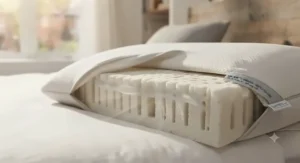
Open-cell foam technology refers to a memory foam structure where the individual foam cells are interconnected rather than sealed shut, allowing air to pass freely through the material instead of getting trapped in isolated pockets. This is the mechanism behind materials like Amerisleep’s Bio-Pur, and it’s genuinely different from surface-level drilled ventilation. According to background material on foam structure, open-cell foams are generally softer and more breathable than closed-cell equivalents, because the connected pore structure allows both air and moisture vapour to move through rather than being sealed inside a dense block. In practical terms for a pillow, this means the cooling effect isn’t limited to the drilled channels near the surface — the entire foam mass participates in releasing heat, which is part of why open-cell pillows like the Amerisleep Comfort Classic tend to feel cooler through the night compared to a solid pillow with a handful of surface perforations, even at a similar price point.
Airflow Foam Design: What Actually Cools You Down
Not every “ventilated” label describes the same engineering, and airflow foam design breaks down into three distinct approaches worth understanding before you buy. The first is drilled-hole ventilation — a solid foam block with cylindrical channels cut straight through it, used in the Weekender Ventilated Gel Memory Foam Pillow and Classic Brands Conforma Ventilated Memory Foam Pillow. This is the most affordable method to manufacture and delivers a moderate cooling improvement over sealed foam. The second is open-cell foam, where the airflow happens at a material level rather than through visible channels, as in the Amerisleep Comfort Classic. The third is shredded or cross-cut foam, where individual foam pieces simply can’t pack together tightly enough to seal out air, used by the Coop Home Goods Original Adjustable Pillow and Silk & Snow Adjustable Pillow. Reviewers consistently note that shredded designs tend to feel the most consistently breathable night-to-night, since there’s no way for the airflow to get “sealed off” the way a solid pillow can compress under sustained pressure — though they trade some of the precise, contoured support that solid foam delivers.
Breathable Sleep Surface: Beyond the Pillow
A ventilated pillow only solves part of the overheating equation — the mattress surface, sheets, and duvet underneath and around it matter just as much for a genuinely breathable sleep surface. Cotton percale and linen sheets move air far more effectively than tight-weave microfibre, and a heavyweight winter duvet layered over a cooling pillow largely cancels out the benefit if your torso is still trapped under synthetic insulation. Health data compiled by the Public Health Agency of Canada points to a cool, comfortable sleep environment as one of the basic recommended sleep hygiene practices, alongside consistent bed and wake times — reinforcing that pillow choice is one lever among several, not a standalone fix. Practically, this means a hot sleeper who invests in the Tempur-Cloud Breeze Dual Cooling Pillow but sleeps under a heavy synthetic duvet on non-breathable sheets is likely to still wake up warm; matching the whole sleep surface, not just the pillow, is what delivers the full benefit.
Common Mistakes When Buying a Ventilated Pillow
The single most common mistake is treating “ventilated” and “gel-infused” as interchangeable marketing terms when they describe genuinely different cooling mechanisms — gel infusion changes the foam’s thermal properties, while ventilation changes its physical airflow, and the best pillows on this list, like the Weekender Ventilated Gel Memory Foam Pillow, actually combine both. A second frequent error is buying based on loft height alone without considering sleep position — a tall 6-inch pillow like the Amerisleep Comfort Classic is excellent for a back sleeper with broad shoulders and miserable for a narrow-framed side sleeper who needs less gap to fill. Third, buyers often skip checking whether the cover is removable and washable, then discover months later that spot-cleaning a fixed cover doesn’t cut it for regular hygiene. Fourth, and perhaps most costly: ignoring firmness reviews entirely and assuming all memory foam feels the same — the gap between the firm Classic Brands Conforma and the plush, adjustable Silk & Snow Adjustable Pillow is significant enough to change your entire sleep experience.
Long-Term Cost & Maintenance
Thinking in cost-per-night rather than sticker price changes the calculus on ventilated pillows considerably. A budget pick like the EPABO Contour Memory Foam Pillow, priced under C$50 with roughly a two-to-three-year functional lifespan before it needs replacing, works out to only a few cents per night — genuinely hard to beat for value. A premium pick like the Tempur-Cloud Breeze Dual Cooling Pillow, priced in the C$220-C$300 range but backed by a 5-year warranty and denser, more durable TEMPUR material that historically holds shape longer than budget foam, can work out to a comparable or even lower cost-per-night if it genuinely lasts the full warranty period. Maintenance costs matter too: pillows with removable, machine-washable covers (most of this list) add essentially zero ongoing cost, while pillows with fixed covers that require spot-cleaning or dry-cleaning quietly add up over years of ownership. The adjustable options — Coop Home Goods Original Adjustable Pillow and Silk & Snow Adjustable Pillow — offer a unique long-term advantage: instead of replacing the entire pillow when loft flattens, you simply add fresh fill, which can meaningfully extend usable life beyond what a fixed-foam pillow offers.
Features That Actually Matter (And Those That Don’t)
Cutting through marketing language: CertiPUR-US certification actually matters, because it’s an independent, verifiable chemical-safety standard rather than a self-issued claim. Removable, washable covers actually matter, for basic hygiene over years of nightly use. Genuine warranty length actually matters, since it reflects how confident a manufacturer is in their own foam’s durability. On the other side of the ledger, marketing terms like “hotel quality” or “luxury” carry essentially no verifiable meaning and shouldn’t factor into a buying decision at all. Similarly, an impressively high thread-count claim on the cover fabric matters far less for a pillow than it does for sheets, since the cover’s job here is breathability, not softness or durability under friction. And while gel infusion genuinely does something (it changes the foam’s thermal conductivity), buyers should be skeptical of pillows that lean entirely on the word “gel” or “cooling” in the title without any actual ventilation architecture — as this list shows, the strongest performers combine multiple real cooling mechanisms rather than relying on one buzzword.
Ventilated Foam Pillow Reviews: What Real Buyers Say
Pulling together aggregated sentiment across the pillows in this roundup, a few consistent patterns emerge rather than isolated anecdotes. Reviewers of drilled-hole pillows like the Weekender Ventilated Gel Memory Foam Pillow and Classic Brands Conforma Ventilated Memory Foam Pillow consistently describe a “noticeably cooler than my old pillow” experience rather than a dramatic, ice-cold transformation — which lines up honestly with how ventilation physics actually works. Buyers of the Amerisleep Comfort Classic and other open-cell foam pillows tend to describe a faster, more responsive feel underneath the cooling benefit, a secondary effect of the material itself rather than the ventilation specifically. Adjustable pillow owners — for both Coop Home Goods and Silk & Snow — repeatedly cite the ability to fine-tune loft as the deciding factor in their purchase, often after having previously bought a fixed-loft pillow that turned out wrong for their sleep position. And at the premium end, Tempur-Cloud Breeze reviewers consistently flag the price as the biggest hesitation point, with buyers who do commit generally reporting satisfaction specifically with the dual-sided gel performance rather than the base TEMPUR material, which they note is available at a lower cost in non-cooling TEMPUR pillows.

Frequently Asked Questions
❓ Is a ventilated memory foam pillow worth it for hot sleepers?
❓ How long do ventilated foam pillows typically last?
❓ What's the difference between gel-infused and ventilated pillows?
❓ Can a ventilated pillow help with neck pain too?
❓ Are adjustable pillows more breathable than solid foam pillows?
Conclusion
There’s no single “best” ventilated pillow here — there’s a best match for your sleep position, your budget, and how genuinely hot you sleep. If you want the strongest overall value, the Weekender Ventilated Gel Memory Foam Pillow combines gel infusion and drilled ventilation without a premium price tag. If neck alignment is your bigger concern, the EPABO Contour Memory Foam Pillow earns its spot on a tighter budget. Hot sleepers chasing the most advanced cooling mechanism should look hardest at the Amerisleep Comfort Classic‘s open-cell Bio-Pur foam, while anyone who wants full control over loft should consider the Coop Home Goods Original Adjustable Pillow or the Canadian-made Silk & Snow Adjustable Pillow. And if budget genuinely isn’t the deciding factor, the Tempur-Cloud Breeze Dual Cooling Pillow‘s dual-sided gel layers remain the most thorough cooling engineering in this entire lineup. Whichever you choose, remember that price ranges shift on Amazon regularly — always confirm the current price before buying, and give any new foam pillow the full 24-48 hours to decompress before judging how it actually sleeps.
Recommended for You
- Gel Pillow vs Memory Foam Pillow: 7 Picks That Actually Cool You Down (2026)
- 7 Best Gel Memory Foam Pillows in Canada (2026): Sleep Cooler Tonight
- Gots Vs Oeko-Tex Organic: 7 Picks That Won’t Fool You (2026)
✨ Found your next pillow on this list? Share it with a friend who’s tired of flipping to the cold side! 💬🤗
