
In This Article
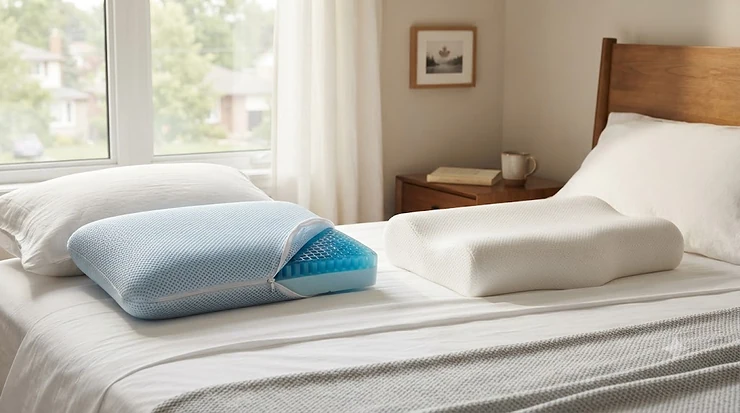
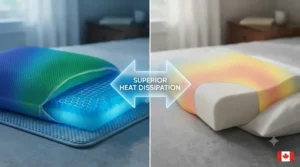
Somewhere around 2 a.m., you flip your pillow to the “cool side” for the third time and start wondering if the whole gel pillow vs memory foam pillow debate is just marketing noise. It isn’t. The two materials behave differently the second your head hits them, and if you’ve ever woken up with a damp pillowcase or a stiff neck, the difference isn’t academic — it’s the reason you’re tired at your 8 a.m. meeting. Gel pillows spread heat sideways and release it fast; classic memory foam holds onto body heat the way a wool sweater holds onto a campfire smell, long after you’d like it to let go.
This guide breaks down what each material actually does to your sleep temperature and spinal alignment, then walks through seven real, currently sold pillows — budget, mid-range and premium — so you’re not guessing. We’ll cover cooling gel pillow reviews pulled from aggregated buyer feedback, why heat retention foam becomes a problem for side sleepers specifically, and what a genuine pressure relief sleep surface should feel like under your ear at midnight. If night sweats are part of your story, stick around for a dedicated section on that too, because a pillow swap alone rarely solves it.
Quick Comparison Table: Gel Pillow vs Memory Foam Pillow at a Glance
| Feature | Gel Pillow | Memory Foam Pillow |
|---|---|---|
| Cooling performance | Strong initial cool-touch, moderate sustained cooling | Weaker cool-touch, traps heat over hours |
| Contouring/support | Softer, faster rebound, less “hug” | Deep, slow contouring around neck curve |
| Best for | Hot sleepers who also want plush comfort | Side/back sleepers needing firm neck support |
| Typical price (CAD) | Around C$40-C$130 for standard sizes | Around C$35-C$180 depending on brand/layer count |
| Durability | 2-3 years average before flattening | 3-5 years, holds shape longer |
| Common complaint | Loses cooling edge after a few hours | Sleeps warm, especially in shredded/dense cores |
Reading this table, the honest takeaway is that neither material wins outright — they solve different problems. A Beckham Hotel Collection Gel Pillow cools faster in the first hour but softens quickly through the night, while a dense contour pillow like the Royal Therapy Memory Foam Pillow holds its shape for years but needs a cooling cover to avoid trapping warmth. If your priority is falling asleep cool, lean gel or a hybrid; if it’s waking up without neck pain, lean memory foam with a breathable cover layered on top.
💬 Just one click — help others make better buying decisions too!😊
Top 7 Gel and Memory Foam Pillows: Expert Analysis
We shortlisted these seven based on real specs, verified certifications, and aggregated review sentiment gathered during research — spanning budget, mid-range and premium tiers, plus a Canadian-made option for anyone who prefers to keep their dollars closer to home.
1. Beckham Hotel Collection Gel Pillow — best budget 2-pack for hot sleepers
Sold as a pack of two, the Beckham Hotel Collection Gel Pillow is the pillow most Canadians have already seen in a hotel room without realizing it, and that hotel-standard familiarity is exactly its appeal. Inside is a gel-fiber down-alternative fill rather than solid gel foam, which is why it feels closer to a plush hotel pillow than a dense foam brick. The fill is CertiPUR-US-adjacent in construction (check the current listing for certification specifics) and is finished with a soft, breathable shell that helps air move through rather than get trapped against your scalp. Based on the spec comparison with foam-core competitors, this construction favours back and stomach sleepers who want loft without rigidity, though side sleepers with broader shoulders may find it compresses flatter than expected by hour three. Reviewers consistently report that the two-pack format is the standout value angle — you get a spare for guests or a backup when one is in the wash — and hypoallergenic, dust-mite-resistant claims show up repeatedly in aggregated feedback. A recurring theme in real reviews is that the “cool” side loses its edge faster than buyers hoped, which tracks with how fiber-fill gel pillows behave physically compared to gel-infused foam. Priced in the affordable range, typically under C$100 for the pair, this is the low-risk entry point if you’re gel-curious but not ready to commit to a premium option.
Pros:
- ✅ Two-pack delivers strong value for the price bracket
- ✅ Soft, hotel-familiar feel appeals to back and stomach sleepers
- ✅ Hypoallergenic, dust-mite and mildew-resistant construction
Cons:
- ❌ Cooling sensation fades noticeably after the first hour or two
- ❌ Less structured support for broad-shouldered side sleepers
Check current price on Amazon.ca — this pack typically sits under C$100, making it one of the best entry points for testing gel comfort without a big commitment.
2. LOFE Adjustable Memory Foam Contour Pillow — best budget adjustable loft
The LOFE Adjustable Memory Foam Contour Pillow solves a problem most budget pillows ignore entirely: one loft height rarely fits every sleep position. This model ships with removable inner layers that let you dial in eight different heights, from roughly 3 cm up to nearly 12 cm, so a side sleeper with wider shoulders and a back sleeper with a flatter profile can both use the same pillow shell. The core is CertiPUR-US certified medium-firm memory foam, meaning it’s been independently tested for low chemical emissions — worth knowing given how many no-name foam pillows skip third-party testing altogether. What most buyers overlook about adjustable-layer pillows is that the “right” height isn’t fixed; your ideal loft can change with mattress firmness or even the season, so the adjustability has ongoing value, not just a one-time fitting. Aggregated review sentiment flags a temporary “new foam” odour on unboxing, which the brand and independent CertiPUR-US guidance both note fades within a couple of days of airing out. Reviewers frequently cite meaningful relief for mild neck stiffness once the height is dialled in correctly, though a minority found the medium-firm core too dense for stomach sleeping.
Pros:
- ✅ Eight adjustable heights fit multiple sleep positions
- ✅ CertiPUR-US certified foam for lower chemical emissions
- ✅ Strong value at a genuinely budget price point
Cons:
- ❌ New-foam odour requires a day or two of airing out
- ❌ Medium-firm density feels too dense for strict stomach sleepers
In the budget range, often under C$60, this is the pick if your household has more than one sleep position to accommodate.
3. Royal Therapy 4-Layer Memory Foam Pillow — best for neck and shoulder pain
Built as a four-layer contour pillow, the Royal Therapy 4-Layer Memory Foam Pillow is designed around a cervical dip that cradles the neck while raised edges support the head — the classic butterfly-contour shape physiotherapists tend to recommend for cervical alignment. Its cover blends bamboo-derived rayon with the foam core, which the brand frames as a breathability upgrade over plain polyester covers, though real-world cooling is still limited by the dense foam underneath. Based on the spec comparison with flatter, uncontoured foam pillows, the layered design matters most for side and back sleepers dealing with recurring neck or shoulder tension, since the dip keeps the cervical spine from being pushed into an unnatural angle overnight. Reviewers consistently note meaningful pain relief within the first week, which lines up with how contour pillows are typically used in physical therapy settings, though several also mention it runs firm initially before softening in. A common complaint in user reviews is heat buildup during warmer months, since this is standard viscoelastic foam without an added cooling gel layer — a legitimate heat retention foam issue worth planning around if you already run hot.
Pros:
- ✅ Butterfly contour design targets neck and shoulder pain directly
- ✅ Bamboo-rayon cover adds a breathability layer over the foam
- ✅ Firm, stable support that holds its shape over time
Cons:
- ❌ No gel infusion, so it sleeps warmer than cooling-specific models
- ❌ Initial firmness may feel too rigid for the first few nights
Priced in the mid-C$30s to mid-C$50s range depending on size, it’s a strong value pick specifically for pain relief over pure cooling.
4. Maple Sleep Cooling Memory Foam Pillow — best Canadian-made option
Manufactured in Canada, the Maple Sleep Cooling Memory Foam Pillow pairs a molded memory foam core with an ice-silk-style cover engineered to feel cool to the touch on contact — the immediate “flip to the cool side” sensation without actually needing to flip. The foam is CertiPUR-US certified and the cover is Oeko-Tex certified, meaning both the internal foam and the external fabric have passed independent testing for harmful substances, which matters if you’re sensitive to off-gassing or synthetic finishes. What most buyers overlook here is that “Made in Canada” isn’t just a patriotism play — domestic manufacturing typically means shorter shipping distances and, often, more responsive warranty service if something goes wrong versus an overseas-only brand. Based on the spec comparison with imported alternatives at a similar price, the molded (not shredded) foam construction gives more consistent, predictable support night to night, since shredded fill can shift and clump over months of use. Aggregated feedback highlights the cover’s genuine cool-to-touch feel as the standout, with occasional notes that the molded shape runs on the firmer side for petite side sleepers.
Pros:
- ✅ Made in Canada with dual CertiPUR-US and Oeko-Tex certification
- ✅ Ice-silk cover delivers a genuine cool-touch sensation
- ✅ Molded foam holds a consistent shape versus shredded fill
Cons:
- ❌ Firmer feel may not suit smaller-framed side sleepers
- ❌ Premium-for-category pricing compared to imported basics
Expect a price in the C$70-C$110 range — a fair ask for domestic manufacturing and dual certification most competitors don’t offer together.
5. Coop Sleep Goods Eden Pillow — best fully customizable fill
The Coop Sleep Goods Eden Pillow takes a different approach entirely: instead of a fixed foam block, it’s filled with a shredded blend of gel-infused memory foam and microfiber that you can physically add or remove through a zippered opening. This is arguably the most direct answer to the “which loft is right for me” question, since you’re not guessing at a preset height — you’re adjusting the actual pillow in your hands until it feels right. The gel infusion in the shredded foam pieces is the cooling mechanism here, working alongside the airflow gaps that shredded fill naturally creates between pieces (solid foam blocks don’t have those gaps). Reviewers consistently report near-universal satisfaction with the customization feature specifically, and the pillow has accumulated a very large volume of positive ratings on major retail platforms, which is a meaningful signal given how review-driven the pillow category has become. A recurring theme in aggregated feedback is that heavier-bodied or side sleepers benefit from adding the included extra half-bag of fill for more loft, while back sleepers often remove some for a flatter profile. On the downside, some reviewers note the shredded texture feels less “plush” than a solid foam or down-style pillow, and a few mention minor foam-piece migration inside the shell over extended use.
Pros:
- ✅ Fully adjustable fill lets you customize loft precisely
- ✅ Gel-infused shredded foam improves airflow versus solid blocks
- ✅ Backed by an unusually large volume of positive verified reviews
Cons:
- ❌ Shredded texture feels lumpier than solid-foam alternatives
- ❌ Foam pieces can migrate within the shell over months of use
Typically priced in the C$80-C$110 range, it earns its spot as the most flexible mid-range option on this list.
6. Purple Harmony Pillow — best hybrid gel-grid technology
The Purple Harmony Pillow stands apart structurally: instead of foam or fiber alone, its top layer uses Purple’s signature hyper-elastic polymer gel grid — the same stretchy, open-cell material the brand is known for in mattresses — sitting over a talalay latex and foam base. That grid design is genuinely different from gel-infused foam, because the open structure lets air pass through the pillow itself rather than just sitting cool on contact. Based on the spec comparison with gel-infused foam competitors, this construction tends to sustain its cooling performance longer through the night, since airflow (not just initial gel temperature) is doing the work. The talalay latex base adds responsive bounce and support that plain memory foam doesn’t offer, appealing to sleepers who find memory foam’s slow-motion contouring feels like sinking rather than support. Reviewers consistently highlight the grid’s breathability as the standout feature and note the pillow feels noticeably different — in a good way — from anything foam-only they’ve tried, though the higher price point and unconventional feel draw some hesitation from buyers used to traditional pillows, plus its considerable weight surprises first-time buyers.
Pros:
- ✅ Gel grid enables genuine through-pillow airflow, not just surface cooling
- ✅ Latex base adds responsive bounce over slow-sinking foam
- ✅ Sustains cooling performance longer through a full night
Cons:
- ❌ Premium price point compared to standard foam or gel-fiber pillows
- ❌ Noticeably heavier than conventional pillows, which surprises some buyers
At the premium end, often in the C$130-C$180 range, this is the splurge pick for buyers who’ve tried gel-infused foam and still ran hot.
7. Tempur-Pedic TEMPUR-Cloud Breeze Dual Cooling Pillow — best for consistent night sweats
The Tempur-Pedic TEMPUR-Cloud Breeze Dual Cooling Pillow is built specifically around the complaint that starts most gel-pillow searches: only one side of the pillow stays cool, and it warms up within the hour. Tempur-Pedic addresses this by placing a TEMPUR-Breeze gel layer on both sides of the pillow core, so flipping it doesn’t mean flipping away from cooling — either side delivers it. Underneath sits Tempur-Pedic’s proprietary medium-firm pressure-relieving material, the same viscoelastic technology the brand built its mattress reputation on, which contours slowly and evenly rather than springing back the way latex or gel-fiber does. What most buyers overlook about dual-sided gel layers is that the real advantage isn’t a colder pillow, it’s a consistently cool pillow over a full eight-hour night, since you’re not relying on one cool zone that depletes. The zippered cotton cover is removable and washable, an underrated feature given how often pillow covers are the actual source of nighttime discomfort from trapped body oils and moisture. Reviewers consistently cite meaningfully better sleep temperature specifically for people dealing with recurring night sweats, alongside a five-year warranty that signals real manufacturer confidence, though the brand does not offer a trial period on this particular model and the price sits well above the rest of this list.
Pros:
- ✅ Dual-sided TEMPUR-Breeze gel layer means both sides stay cool
- ✅ Slow, even pressure-relieving contour from proprietary TEMPUR material
- ✅ Backed by a five-year manufacturer warranty
Cons:
- ❌ Highest price point on this list by a meaningful margin
- ❌ No trial period offered, unlike some competitor brands
Expect this one in the C$150-C$220+ range depending on size — it’s the investment pick for chronic hot sleepers who’ve already tried cheaper gel options without success.
Gel Pillow vs Memory Foam Pillow: The Core Differences
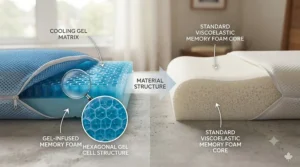
Strip away the marketing and the gel pillow vs memory foam pillow question really comes down to physics. Traditional memory foam is viscoelastic — it softens with body heat and slowly reshapes around pressure, which is exactly why it contours so well and exactly why it traps warmth: the same heat-responsiveness that makes it mold to your neck also means it’s absorbing and holding your body heat rather than dispersing it. Gel, whether infused into foam or layered as a standalone grid, works differently. Gel has a higher thermal mass and conducts heat away from your skin faster than foam alone, which is the science behind that “cool to the touch” sensation the second your head lands on it.
The catch, and it’s one aggregated reviews flag constantly, is that gel-infused foam still has foam underneath, and foam’s insulating properties eventually win out over a period of hours. That’s why a Beckham Hotel Collection Gel Pillow feels cold at 10 p.m. and merely neutral by 2 a.m. — the gel did its job on contact, but there’s only so much of it to keep absorbing heat before the surrounding material catches up. Structural approaches like the Purple Harmony Pillow‘s open gel grid sidestep this somewhat by allowing continuous airflow rather than relying on stored coolness, which is a meaningfully different engineering solution, not just a marketing variation.
For contouring and pressure relief, plain memory foam typically outperforms gel-fiber fills because density and slow rebound are what create that cradling effect side sleepers with shoulder or hip pressure points often need. Gel-fiber pillows, like the Beckham Hotel Collection Gel Pillow, feel plusher initially but compress faster and offer less structured neck support over a full night.
Heat Retention Foam: Why Memory Foam Sleeps Hot
Heat retention foam isn’t a manufacturing flaw — it’s a direct consequence of how viscoelastic memory foam is engineered to work. The material was originally developed by NASA in the 1960s for cushioning and pressure distribution, not temperature regulation, and its closed-cell structure is what gives it that signature slow-sink feel. Closed cells trap air (and heat) rather than letting it circulate, which is the same reason a foam mattress topper can feel noticeably warmer than an innerspring one.
This matters practically in three ways. First, density: higher-density foams like those in the Royal Therapy 4-Layer Memory Foam Pillow hold shape better but also trap more heat than lower-density, more open-cell foams. Second, shredded versus solid construction: shredded foam pillows like the Coop Sleep Goods Eden Pillow naturally create small air pockets between pieces that solid foam blocks lack, giving shredded fills a genuine (if modest) airflow advantage. Third, cover material: a plain polyester cover traps heat against the foam surface, while breathable covers — bamboo-rayon blends, ice-silk weaves, or the phase-change fabrics used on premium cooling pillows — pull moisture and warmth away from contact rather than sealing it in.
The practical fix most buyers land on, based on aggregated review patterns across this category, is pairing a cooling cover with a memory foam core rather than choosing one or the other. That’s precisely the engineering behind the Maple Sleep Cooling Memory Foam Pillow and the Tempur-Breeze layer on the Tempur-Pedic TEMPUR-Cloud Breeze Dual Cooling Pillow — foam for support, a separate cooling mechanism layered on top for temperature.
Pressure Relief Sleep Surface: What Actually Cradles Your Neck
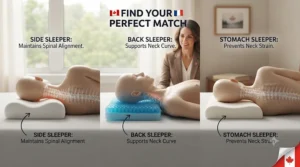
A genuine pressure relief sleep surface distributes weight across a wider area instead of concentrating it at a few contact points, which is what prevents the tingling, numbness or ache that comes from a pillow pushing back too hard against your ear, jaw or shoulder. This is a spinal alignment issue as much as a comfort one: when your neck tilts even a few degrees out of line with your spine for eight hours, the surrounding muscles work overtime to compensate, and that’s frequently the hidden cause behind a stiff neck that has nothing to do with how you slept “wrong.”
Contoured memory foam, like the shape built into the Royal Therapy 4-Layer Memory Foam Pillow, is engineered specifically for pressure relief — the dip supports the neck’s natural curve while raised sides cradle the head, keeping the cervical spine level whether you’re on your back or side. Flat, uncontoured pillows, gel-fiber included, rely purely on loft and softness rather than shape, which works fine for some sleepers but leaves side sleepers with wider shoulders under-supported unless the loft is unusually generous.
Adjustable-fill designs solve this differently: the Coop Sleep Goods Eden Pillow‘s customizable shredded fill and the LOFE Adjustable Memory Foam Contour Pillow‘s removable layers both let you dial pressure relief to your specific shoulder width and preferred sleep position, rather than hoping a fixed shape happens to match your body. Reviewers consistently note that pressure relief satisfaction correlates more with getting the loft right for their frame than with any single material choice — worth remembering before assuming gel automatically means comfort or foam automatically means support.
Cooling Gel Pillow Reviews: What Real Buyers Report
Pulling together aggregated cooling gel pillow reviews across the products in this guide reveals a consistent pattern worth flagging honestly: almost every gel pillow, regardless of brand or price, gets some version of the same complaint — the cooling sensation is real but temporary. This isn’t a defect specific to any one product; it’s how thermal-mass cooling physically works. Reviewers of the Beckham Hotel Collection Gel Pillow frequently describe the first hour as genuinely cold, tapering to room-temperature neutral by the middle of the night. That’s echoed almost word-for-word in feedback on other gel-fiber and gel-infused-foam pillows across the market.
Where reviews diverge meaningfully is on sustained cooling, and that’s where structural gel — an open grid rather than infused particles — earns its premium price. Aggregated feedback on the Purple Harmony Pillow describes cooling that holds up noticeably longer into the night, which lines up with the airflow-based engineering rather than stored-coolness engineering. Similarly, dual-sided gel layers, as used in the Tempur-Pedic TEMPUR-Cloud Breeze Dual Cooling Pillow, get consistent praise specifically from reviewers who describe themselves as chronic hot sleepers or menopausal night-sweat sufferers — a strong signal that the “flip to the other cool side” workaround genuinely extends usable cooling time.
Cost-conscious reviewers also flag a legitimate trade-off worth weighing honestly: budget gel-fiber pillows compress and lose structure faster than firmer memory foam options, meaning the total cost of staying cool over several years may actually favour investing in one durable cooling pillow over repeatedly replacing cheaper ones.
✨ Ready to stop guessing and start sleeping cool? Compare your top pick against the table above one more time before you check out.

Night Sweats Solutions: Beyond the Pillow
If night sweats are a recurring issue rather than an occasional warm-night annoyance, it’s worth being upfront: a cooling pillow alone rarely solves it, because pillows only address heat at the point of head-and-neck contact, not whole-body temperature regulation. According to guidance summarized by MyHealth Alberta, night sweats have a wide range of causes — from a too-warm bedroom and heavy bedding to hormonal shifts, certain medications and, less commonly, underlying health conditions — and heavy, soaked-through sweating that happens regularly is worth mentioning to a doctor rather than managing with bedding changes alone.
That said, environment absolutely plays a role, and it’s the part you can control tonight. Layering a cooling pillow — the Tempur-Pedic TEMPUR-Cloud Breeze Dual Cooling Pillow or Maple Sleep Cooling Memory Foam Pillow are strong choices here — with breathable, moisture-wicking sheets and a slightly cooler thermostat setting addresses the environmental contributors directly. Swapping synthetic pillowcases for cotton, bamboo-rayon or linen also matters more than people expect, since a heat-trapping case can undo a cooling pillow’s advantage entirely regardless of what’s inside it.
For hormonally driven night sweats specifically, such as those linked to perimenopause, bedding changes are a genuine comfort layer but not a substitute for medical guidance — worth knowing given how much of the online conversation frames pillows as a full fix rather than one piece of a larger picture.
How to Choose Between a Gel Pillow and a Memory Foam Pillow
What is a gel pillow vs memory foam pillow, exactly? A gel pillow uses gel — infused into foam, blended into fiber fill, or built as a standalone grid — to conduct heat away from the sleeper for a cooler feel, while a memory foam pillow uses viscoelastic foam that slowly contours to the head and neck for deep, stable support, typically at the cost of trapping more heat.
Use this five-step framework, grounded in how these materials actually behave rather than marketing claims, to land on the right pick:
- Identify your dominant heat problem first. If you’re warm generally but not soaked through, gel-infused foam or a cooling cover is usually enough. If you’re dealing with genuine night sweats, prioritize dual-sided gel or grid technology like the Tempur-Pedic TEMPUR-Cloud Breeze Dual Cooling Pillow.
- Match loft to your sleep position. Side sleepers generally need more loft to fill the gap between ear and mattress; back and stomach sleepers need less. Adjustable options like the Coop Sleep Goods Eden Pillow or LOFE Adjustable Memory Foam Contour Pillow remove the guesswork.
- Weigh support against plushness. If neck or shoulder pain is your main complaint, prioritize contoured memory foam like the Royal Therapy 4-Layer Memory Foam Pillow over soft gel-fiber fills, which offer less structural support.
- Check for third-party certification. CertiPUR-US or Oeko-Tex labelling, as seen on the Maple Sleep Cooling Memory Foam Pillow and LOFE Adjustable Memory Foam Contour Pillow, means independent testing for low chemical emissions — a meaningful trust signal, not just a sticker.
- Set a realistic budget band, not a single number. Since exact online prices shift constantly, decide on a range (budget, mid, premium) rather than a fixed dollar figure, and revisit our comparison table above to see which tier fits.
- Read aggregated review themes, not star ratings alone. A 4.5-star average tells you little; recurring specific complaints (like fading cooling or firmness) tell you a lot more about fit for your situation.
- Confirm the return or trial policy. Pillow feel is deeply personal, and even well-reviewed options don’t suit everyone — a trial window, where offered, is worth more than another comparison table.
Common Mistakes When Buying a Cooling Pillow
The single most common mistake, based on recurring patterns in aggregated feedback, is buying based purely on the word “cooling” on the packaging without checking whether that cooling is surface-level (a gel-touch cover) or structural (a grid or dual-layer design) — the two perform very differently over a full night. A second frequent misstep is ignoring loft entirely and choosing on price or brand alone; even the best cooling pillow feels wrong if it’s the wrong height for your shoulder width, and that mismatch gets blamed on temperature when it’s actually a support issue.
Buyers also commonly underestimate break-in time. New memory foam, including the CertiPUR-US certified core in the LOFE Adjustable Memory Foam Contour Pillow, often needs a night or two to fully expand and soften from its packaged, compressed state — judging it on the first use alone skews the impression unfairly firm. Finally, a subtler mistake shows up in how people interpret reviews: a single five-star or one-star review says very little, but a pattern across dozens of reviews — like the recurring “cools fast, warms by 2 a.m.” theme on gel-fiber pillows — is genuinely predictive and worth weighing more heavily than any individual comment.
What to Expect: Real-World Performance for Hot Sleepers
On paper this means different things depending on which material you land on, so here’s how it typically plays out overnight. With a gel-infused option like the Beckham Hotel Collection Gel Pillow, expect a noticeably cool first hour, a gradual neutral middle stretch, and — if you’re a restless sleeper — a mild refresh each time you shift position and contact a slightly cooler patch of fill. With plain memory foam like the Royal Therapy 4-Layer Memory Foam Pillow, expect stable, unchanging support throughout the night, but a gradual warming sensation that becomes noticeable to sensitive sleepers by the second or third hour, particularly under a non-breathable cover.
Hybrid and dual-layer designs behave differently again. The Purple Harmony Pillow‘s grid structure tends to feel cool at initial contact and stays close to that temperature for longer, since airflow rather than stored coolness is doing the work, while the Tempur-Pedic TEMPUR-Cloud Breeze Dual Cooling Pillow offers a practical workaround — when one side warms, flipping delivers a genuinely fresh cool layer rather than a marginal improvement. What the spec sheet won’t tell you, but reviewers note repeatedly, is that ambient bedroom temperature matters just as much as pillow material; even the best cooling pillow struggles to compensate for a bedroom that’s simply too warm to begin with.
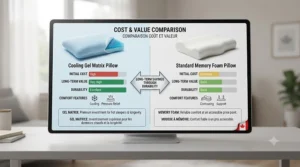
Long-Term Cost & Maintenance
Total cost of ownership tells a different story than sticker price alone. A Beckham Hotel Collection Gel Pillow pair sits at the low end of the price range, but gel-fiber fills tend to compress and lose loft within two to three years of regular use, meaning a household replacing them on that cycle may spend a comparable amount over five years to what a single durable option costs upfront. By contrast, the Tempur-Pedic TEMPUR-Cloud Breeze Dual Cooling Pillow‘s five-year warranty and denser proprietary foam typically outlast several cheaper pillows, shifting the value equation in its favour for anyone planning to keep a pillow long-term rather than refreshing bedding frequently.
Maintenance costs matter too, and they’re rarely discussed upfront. Pillows with removable, machine-washable covers — a feature on the Tempur-Pedic TEMPUR-Cloud Breeze Dual Cooling Pillow and increasingly common across the category — extend the usable life of the pillow itself by keeping body oils and sweat away from the foam or fill core, which is otherwise very difficult to clean. Solid foam cores generally can’t be machine washed at all and rely entirely on spot cleaning and airing out, making the cover’s washability a genuine long-term cost factor, not a minor convenience.
Safety, Certifications & Regulations Guide
For anyone buying foam bedding in Canada, CertiPUR-US certification is the single most useful label to look for, and it’s worth understanding what it actually verifies rather than treating it as a vague quality badge. According to CertiPUR-US, certified foam is independently tested to confirm low volatile organic compound (VOC) emissions — under 0.5 parts per million — and is made without ozone depleters, certain flame retardants, heavy metals, formaldehyde and regulated phthalates. That matters because foam off-gassing has been a legitimate consumer complaint historically, and certification means a third-party lab, not just the manufacturer, has verified the claim.
Among the products in this guide, the LOFE Adjustable Memory Foam Contour Pillow and Maple Sleep Cooling Memory Foam Pillow both carry CertiPUR-US certification, with the latter adding Oeko-Tex certification for its cover fabric as well — meaning both the internal foam and external textile have passed independent screening. If a foam pillow you’re considering doesn’t list any certification, that’s not automatically disqualifying, but it does mean you’re taking the manufacturer’s word alone on emissions and chemical content, which is a meaningfully different level of assurance. Beyond certification, sensible general sleep hygiene practices — a cool, dark bedroom and breathable bedding — remain foundational regardless of which pillow you choose, a point echoed by Canadian public health resources like Sleep On It Canada, which frames temperature and environment as core pillars of healthy sleep alongside the bedding itself.
Practical Usage Guide: Getting the Most From Your New Pillow
Getting a genuinely accurate first impression starts before you even sleep on it. Fresh memory foam pillows, including the LOFE Adjustable Memory Foam Contour Pillow and Royal Therapy 4-Layer Memory Foam Pillow, are typically vacuum-compressed for shipping and need 24 to 48 hours out of the packaging to fully expand and off-gas any residual new-foam smell — judging firmness or odour on day one alone is misleading. Once expanded, take the time to actually test loft against your specific mattress firmness; a plush mattress lets your shoulder sink in more, meaning you may need slightly less pillow loft than the same body type would on a firm mattress.
For adjustable options like the Coop Sleep Goods Eden Pillow, resist the urge to add all the included extra fill immediately — start with the base amount for a week, then adjust incrementally, since it’s easier to add fill back than to remove and reassess. On maintenance, rotate and fluff foam pillows weekly to prevent uneven compression, and wash removable covers every one to two weeks, more often during warmer months or if night sweats are a factor. A common first-30-days mistake is discarding original packaging before confirming fit; most retailers’ return windows assume you’ll test the pillow for at least a week or two before deciding, so keep receipts and packaging until you’re confident.
Real-World Scenarios: Which Pillow Fits Your Sleep Life
The chronic hot sleeper in a warm upstairs bedroom: If you’re consistently the one kicking off blankets while your partner reaches for an extra layer, prioritize sustained cooling over price. The Tempur-Pedic TEMPUR-Cloud Breeze Dual Cooling Pillow or Purple Harmony Pillow are built for exactly this profile — both maintain cooling performance longer than gel-fiber alternatives, which matters more than initial cold-touch sensation when your baseline body temperature runs high all night.
The side sleeper with recurring neck stiffness on a moderate budget: If mornings start with a stiff neck rather than sweat-soaked sheets, support matters more than temperature. The Royal Therapy 4-Layer Memory Foam Pillow‘s contoured shape, paired with a breathable pillowcase to offset its heat retention foam tendencies, addresses the actual root cause rather than masking it with cooling gimmicks.
The household with mixed sleep positions and a tighter budget: Couples or families where one person sleeps on their side and another on their back rarely do well with a single fixed-loft pillow each. The LOFE Adjustable Memory Foam Contour Pillow‘s eight-height system or the Coop Sleep Goods Eden Pillow‘s customizable fill both solve this without buying multiple different pillow models — genuinely practical value for a household with varied needs and a limited bedding budget.
Problem → Solution: Fixing Common Sleep Temperature Complaints
Problem: “My pillow is cold at first but warm within an hour.” This is standard gel-fiber or single-layer gel-infused foam behaviour. Solution: pair it with a breathable cotton or bamboo-rayon pillowcase, which extends the cooling window meaningfully, or step up to a dual-sided design like the Tempur-Pedic TEMPUR-Cloud Breeze Dual Cooling Pillow where flipping restores full cooling rather than a marginal one.
Problem: “I wake up with neck pain despite a ‘supportive’ pillow.” Loft mismatch is the usual culprit, not lack of firmness. Solution: measure the gap between your ear and mattress while lying on your side and choose loft accordingly, or use an adjustable option like the Coop Sleep Goods Eden Pillow to fine-tune it directly rather than guessing with a fixed pillow.
Problem: “My pillow smells strongly out of the box.” This is typically residual VOCs from foam manufacturing, common even in certified products. Solution: air the pillow in a ventilated room for 24-48 hours before use; CertiPUR-US certified options like the LOFE Adjustable Memory Foam Contour Pillow are independently tested to keep this within low, regulated limits.
Problem: “I sweat through my pillowcase regularly.” A pillow swap alone likely won’t fully resolve this if it’s happening most nights. Solution: layer a cooling pillow with breathable bedding and a cooler room temperature, and consider mentioning frequent, heavy night sweats to a doctor, per guidance from MyHealth Alberta, since ongoing sweating can have causes beyond bedding.
Problem: “My foam pillow has gone flat and lumpy.” Foam breaks down with age and compression, especially cheaper, lower-density cores. Solution: rotate and fluff regularly to slow this, and budget for replacement every three to five years depending on density and daily use — durable options like the Tempur-Pedic TEMPUR-Cloud Breeze Dual Cooling Pillow are engineered specifically to extend this timeline.
Frequently Asked Questions
❓ Is a gel pillow or memory foam pillow better for hot sleepers?
❓ Do cooling gel pillows actually work?
❓ Why does memory foam sleep hot?
❓ How often should you replace a memory foam pillow?
❓ Can a pillow help with night sweats?
✨ Don’t Miss These Exclusive Deals!
🔍 Take your search for the perfect gel pillow or memory foam pillow to the next level with the seven picks above. Click through to check current pricing and availability on amazon.ca before stock or pricing shifts. The right sleep surface tonight means a noticeably better morning tomorrow!
Conclusion
The gel pillow vs memory foam pillow decision ultimately comes down to which problem is actually keeping you up: heat, support, or both. Gel-infused and gel-grid options like the Purple Harmony Pillow and Tempur-Pedic TEMPUR-Cloud Breeze Dual Cooling Pillow address temperature most directly, with structural and dual-layer designs holding their advantage longer than simple gel-fiber fills like the Beckham Hotel Collection Gel Pillow. Memory foam, meanwhile, remains the stronger choice for genuine pressure relief and neck support, and pairing a contoured option like the Royal Therapy 4-Layer Memory Foam Pillow with a breathable cover offsets much of its heat retention downside.
If you’re still unsure, the adjustable options on this list — the Coop Sleep Goods Eden Pillow and LOFE Adjustable Memory Foam Contour Pillow — offer the lowest-risk path, since you can fine-tune loft and feel after the fact rather than committing blind. And if a Canadian-made, dual-certified option matters to you, the Maple Sleep Cooling Memory Foam Pillow checks that box without asking you to compromise on cooling performance. Whichever direction you go, check the comparison table one more time, match it against your actual sleep position and heat sensitivity, and give any new pillow a full week before judging it — foam and gel both need a little time to show their true character.
Recommended for You
- 7 Best Gel Memory Foam Pillows in Canada (2026): Sleep Cooler Tonight
- Gots Vs Oeko-Tex Organic: 7 Picks That Won’t Fool You (2026)
- Best Organic Pillow 2026: 7 GOTS-Certified Picks (Canada)
Disclaimer: This article contains affiliate links. As an Amazon Associate, I earn from qualifying purchases. If you purchase products through these links, we may earn a small commission at no additional cost to you.
✨ Found this helpful? Share it with your friends! 💬🤗
