In This Article
Finding the right pillow for kids sounds simple — until you’re standing in front of dozens of options and wondering whether memory foam is safe for a three-year-old, or whether the adorable dinosaur pillow will actually support your child’s spine. As a parent who has gone through this exact rabbit hole more than once, I can tell you: it matters more than most people think, and getting it wrong can mean restless nights, morning neck stiffness, and a very grumpy household.

In Canada, the stakes are slightly higher. Our cold winters mean bedroom temperatures can dip significantly overnight, making breathability and temperature regulation key factors in a great night’s sleep. Our kids spend a lot of time indoors during the long winter months — that’s a lot of hours resting a developing head and neck on whatever pillow you picked. And because we’re shopping on Amazon.ca, not Amazon.com, product availability and pricing in CAD can differ quite a bit from what American parents are reading about.
The good news? There are genuinely excellent pillow for kids options available on Amazon.ca right now, across every price range, for toddlers all the way to tweens. This guide covers seven of them in detail, along with everything you need to know to make a confident choice — including what Health Canada and the Canadian Paediatric Society say about safe sleep, and why the right firmness for a 3-year-old is completely different from what a 10-year-old needs.
What exactly is a pillow for kids, anyway? At its core, it’s a small, low-loft support cushion specifically engineered for children aged 2 and up, with dimensions typically ranging from 33 × 46 cm (13 × 18 inches) to 40 × 50 cm (16 × 20 inches), designed to cradle a child’s proportionally larger head without forcing the neck into adult-style cervical curves that simply haven’t developed yet. Get it right, and your child sleeps deeper and wakes up more comfortable. Get it wrong, and you’ll wonder why your kid is climbing into your bed at 2 a.m. every night.
Let’s dig in.
Quick Comparison: Best Pillows for Kids on Amazon.ca (2026)
| Product | Size | Fill | Age Range | Best For | Price Range (CAD) |
|---|---|---|---|---|---|
| KeaBabies Toddler Pillow | 33 × 46 cm | Organic cotton fibre | 2–5 yrs | First pillow, budget-conscious families | $–$$ |
| Utopia Bedding Toddler Pillow (2-Pack) | 33 × 46 cm | Polyester | 2–5 yrs | Value pick, multi-child households | $ |
| Woolino Premium Wool Toddler Pillow | 35.5 × 48.5 cm | 100% Merino wool | 2–6 yrs | Hot sleepers, organic-focused parents | $$$ |
| Comfy Cubs Toddler Pillow with Muslin Pillowcase | 33 × 46 cm | Microfiber | 2–5 yrs | Sensitive skin, travel use | $$ |
| VEMBAP 2 Pack Kids Cooling Pillow | 46 × 27 cm | Memory foam (ultra-thin) | 2–13 yrs | Side sleepers, older kids | $$ |
| MLILY Kids Adjustable Memory Foam Pillow | 30 × 51 cm | Adjustable memory foam layers | 3–10 yrs | Growing kids who need loft changes | $$$ |
| kinder Fluff Children Pillows (2-Pack) | 40 × 60 cm | Down alternative (300TC) | 2+ yrs | Transitioning to bigger bed | $$ |
All prices in CAD. Price ranges: $ = under $30, $$ = $30–$60, $$$ = $60+. Check current pricing on Amazon.ca as prices fluctuate.
The table above reveals a clear pattern: the right pillow for your child depends far more on age and sleep position than on brand prestige. A $20 CAD toddler pillow from Utopia Bedding can be a better choice for a 2-year-old than a $70 CAD memory foam option — because at that age, lower and firmer is almost always safer. That said, if your child is between 6–10 years old and side-sleeping, the MLILY’s adjustable loft starts to make real sense. We’ll break all of this down below.
💬 Just one click — help others make better buying decisions too! 😊
✨ Don’t Miss These Exclusive Deals!
🔍 Take your child’s sleep to the next level with these carefully selected pillows. Click on any highlighted item to check current pricing and availability on Amazon.ca. These picks will help your little ones wake up rested, refreshed, and ready to take on the day! 😊
Top 7 Pillows for Kids on Amazon.ca: Expert Analysis
1. KeaBabies Toddler Pillow with Pillowcase — Best First Pillow for Toddlers
The KeaBabies Toddler Pillow is the one I’d recommend to almost any Canadian parent transitioning their toddler from crib to bed for the first time. It measures 33 × 46 cm (13 × 18 inches), sits at roughly 8–9 cm (about 3.5 inches) of loft, and is filled with high-quality fibre that holds its shape through months of enthusiastic use — and the occasional juice incident.
What most parents miss is why those specs matter in practice: the 33 × 46 cm size is specifically calibrated for a toddler’s head size, which is proportionally larger relative to the body than an adult’s. An adult-sized standard pillow (50 × 70 cm / 20 × 26 inches) would prop a 2-year-old’s head at an angle that forces the cervical spine forward — the opposite of support. The KeaBabies keeps the head level with the mattress, which is exactly what a developing spine needs.
The OEKO-TEX Standard 100 and GOTS certifications on this pillow matter, particularly for health-conscious Canadian parents who are already choosing organic cotton sleepwear and non-toxic nursery paint. These certifications mean every component — fill, cover, dyes — has been tested and cleared of harmful substances. In our cold Canadian winters, kids spend significantly more time indoors and in bed, so cumulative exposure to off-gassing materials adds up more here than in warmer climates.
Canadian reviewers consistently mention how easy it is to toss both the pillow and the included pillowcase into the washing machine — a huge practical win when you’re dealing with a toddler. The fun animal-print and nature-themed pillowcase designs are genuinely varied, so there’s something for every little personality.
✅ OEKO-TEX & GOTS certified — no harmful chemicals
✅ Machine washable pillow AND pillowcase
✅ Huge range of cute pillowcase patterns
❌ Some parents find the loft slightly thick for very young (18–24 month) toddlers
❌ Pillowcase can feel a bit stiff before the first few washes
Price range: In the $–$$ range (CAD). Excellent value for what you get. Check current price on Amazon.ca.

2. Utopia Bedding Toddler Pillow (2-Pack) — Best Budget Pick for Canadian Families
If you have two kids, a daycare child who needs a nap pillow, or you simply want a backup for laundry days, the Utopia Bedding Toddler Pillow 2-Pack is the most practical spend under $30 CAD on Amazon.ca. Each pillow measures 33 × 46 cm (13 × 18 inches) with a cotton-blend shell and polyester filling that strikes a decent balance between softness and support.
Here’s the honest take that the spec sheet won’t give you: Utopia Bedding is a budget brand, and this pillow feels like one. The cotton-blend shell is noticeably thinner than the KeaBabies’ organic cotton, and after about 10–15 wash cycles, you’ll notice some compression in the fill. For a primary sleep pillow that you plan to use for 2–3 years, I’d spend a bit more. But for a second pillow kept at grandma’s house in Mississauga, a spare for the toddler’s couch naps, or a pillow you’re not precious about? The Utopia 2-Pack is a completely rational choice at this price point.
What I genuinely appreciate is the brand’s consistent Amazon.ca availability — it ships across Canada, and Prime members typically get it in 1–2 business days even in mid-winter. For parents in more remote areas of Northern Ontario or rural BC where specialty children’s products can take weeks to arrive, that reliability matters.
✅ Best price per pillow on Amazon.ca
✅ Two pillows in one order — ideal for twins or backup
✅ Reliable Amazon.ca Prime shipping across Canada
❌ Fill compresses faster than premium options after repeated washing
❌ Shell fabric is thinner than more premium alternatives
Price range: $ range (CAD). Best value for volume buyers. Check current price on Amazon.ca.
3. Woolino Premium Wool Toddler Pillow — Best for Hot Sleepers & Eco-Conscious Canadian Parents
The Woolino Premium Wool Toddler Pillow is the most thoughtfully engineered pillow on this list for Canadian climate conditions, and that’s not marketing fluff. Filled with Woolmark-certified Australian Merino wool and wrapped in a 300-thread-count GOTS-certified organic cotton sateen shell, this 35.5 × 48.5 cm (14 × 19 inches) pillow does something synthetic fills simply cannot: it regulates temperature.
Here’s why that’s a bigger deal in Canada than the product description lets on. Canadian children often sleep in rooms that swing between 15°C and 22°C depending on the season — a furnace-heated house in January versus an un-air-conditioned room during a July heat wave in Southern Ontario. Wool actively wicks moisture and responds to temperature changes, which means the Woolino pillow stays comfortable across that wide seasonal range. A polyester pillow can turn “warm and cosy” into “sweaty and restless” by 3 a.m., especially for kids who already sleep hot.
The OEKO-TEX Standard 100 certification on the finished product, not just the materials, is an important distinction — it confirms the final assembled pillow has been tested. For parents who have already invested in organic wool mattresses or sleep sacks, the Woolino is a natural fit for completing that sleep environment.
The tradeoff? Canadian pricing runs higher than US equivalents — typically in the $$$ range — but you avoid cross-border shipping, customs delays, and warranty headaches that come with ordering from Amazon.com.
✅ Wool fill regulates temperature across Canada’s seasonal extremes
✅ OEKO-TEX certified — safe for sensitive skin and allergies
✅ Sustainably sourced Merino wool
❌ Most expensive option on this list in CAD
❌ Not machine washable — spot clean or dry clean only
Price range: $$$ range (CAD). Worth every dollar for parents who prioritize natural materials. Check current price on Amazon.ca.
4. Comfy Cubs Toddler Pillow with Muslin Pillowcase (2-Pack) — Best for Sensitive Skin & Travel
The Comfy Cubs Toddler Pillow has quietly built a loyal Canadian fan base, and it’s easy to see why. The 33 × 46 cm (13 × 18 inch) pillow comes standard with a muslin pillowcase — a detail that sounds minor until you have a child with eczema or heat-sensitive skin. Muslin is a loosely woven cotton fabric that allows significantly more airflow than standard percale or microfibre, making it noticeably cooler against the face during those warm, humid Ontario summers.
The microfibre fill inside sits at a modest loft that works well for toddlers aged 2–5 who are back-sleeping or stomach-sleeping — the two positions where you want the least amount of head elevation. Side-sleeping kids may eventually outgrow this pillow’s loft support as their shoulder width increases around ages 5–6, at which point it’s worth sizing up to a junior pillow.
What makes Comfy Cubs genuinely useful for Canadian families is the portability factor. The lightweight design packs flat and fits easily into a carry-on or a hockey bag, which means your little one’s sleep routine can travel with them — to grandparents in Calgary, a family ski trip to Tremblant, or a summer drive to Prince Edward Island. Consistent sleep environments reduce the night-waking that derails family travel.
✅ Muslin pillowcase is cooler than standard cotton for sensitive skin
✅ Lightweight and travel-friendly
✅ 2-Pack offers excellent value in CAD
❌ Microfibre fill is not as breathable as natural wool or cotton alternatives
❌ Not ideal for dedicated side sleepers who need more loft
Price range: $$ range (CAD). Strong value for the quality of materials included. Check current price on Amazon.ca.
5. VEMBAP 2 Pack Kids Cooling Memory Foam Pillow — Best for Older Kids & Side Sleepers
The VEMBAP Kids Cooling Memory Foam Pillow takes a different design philosophy than most children’s pillows: it’s purposefully flat. At just 46 × 27 cm (18 × 10.5 inches) with an ultra-thin memory foam core, it’s designed for kids aged 2 to 13 who sleep better with minimal head elevation — a larger demographic than you’d think.
The practical interpretation of “ultra-thin memory foam” is important. This is not the dense, slow-recovery memory foam you’d find in an adult’s $200 CAD pillow. It’s a lighter, more responsive formulation that contours slightly to the skull and neck without the “sinking” sensation that can actually push a child’s head into poor alignment. For stomach sleepers in particular — a common position in school-aged kids — the VEMBAP’s near-flat profile keeps the neck in a neutral position rather than cranking it upward.
The “cooling” claim is backed by a breathable cover fabric rather than any gel-infused foam, so manage expectations accordingly. It won’t feel icy to the touch, but it does dissipate heat more effectively than a standard polyester pillow cover. Given how warm Canadian kids’ bedrooms can get in summer without central air conditioning, that’s a meaningful feature.
The 2-pack format is a smart buy for siblings or for keeping one on rotation while the other is being washed. Memory foam should be spot-cleaned, not machine-washed, so the outer cover needs regular independent laundering.
✅ Ultra-thin design ideal for stomach sleepers and younger toddlers
✅ 2-Pack value in CAD
✅ Breathable cover manages heat better than standard pillow covers
❌ Memory foam is spot-clean only — outer cover must be washed separately
❌ Not suitable as a first pillow for very young toddlers who need more loft support for side sleeping
Price range: $$ range (CAD). Great value for the age range covered. Check current price on Amazon.ca.
6. MLILY Kids Adjustable Memory Foam Pillow — Best for Growing Kids Ages 5–10
The MLILY Kids Adjustable Memory Foam Pillow is the most future-proof option on this list, and that’s its main selling point. At 30 × 51 cm (12 × 20 inches), with three independently removable foam layers, it can be reconfigured as your child grows — adding layers for more loft as their shoulder width increases, or removing them when a softer surface is preferred.
What the spec sheet calls “layer adjust” translates in practice to something quite valuable: a single pillow that can accompany a child from ages 3 to 10 without becoming inadequate. Most fixed-loft pillows become too flat for a side-sleeping 8-year-old within 2–3 years of purchase. The MLILY eliminates that obsolescence cycle, which actually makes its higher CAD price tag look more reasonable when you calculate cost-per-year of use.
The CertiPUR-US certification is the key safety credential here. It means the foam has been independently tested and found free of ozone depleters, PBDE flame retardants, mercury, lead, heavy metals, and formaldehyde. For a pillow that your child’s face will rest against for thousands of hours, that certification matters. The modal fabric exterior — derived from beech-tree pulp — is softer than standard polyester and holds up well through repeated washing.
Canadian parents in colder provinces will appreciate that MLILY memory foam doesn’t stiffen in cold temperatures the way some foam products do. In a basement bedroom in Winnipeg in January, a memory foam pillow that gets rock-hard overnight is less than ideal.
✅ Adjustable layers grow with your child from ages 3–10
✅ CertiPUR-US certified foam — independently verified safe
✅ Modal fabric exterior is soft and durable
❌ Higher price point in CAD compared to simpler options
❌ Contoured design takes adjustment for back sleepers used to flat pillows
Price range: $$$ range (CAD). Best long-term value for school-aged children. Check current price on Amazon.ca.
7. kinder Fluff Children Pillows (2-Pack) — Best for Transitioning to a Big Kids’ Bed
The kinder Fluff Children Pillows are marketed with unusual specificity — they claim to be “the only” children’s pillow with a 300-thread-count cotton shell combined with down-alternative fill — and that combination genuinely does deliver a different experience. At 40 × 60 cm (16 × 24 inches), these are larger than standard toddler pillows, which makes them ideal for children aged 5 and up who have graduated to a twin bed and are eyeing their parents’ adult pillows with envy.
The 300TC cotton shell has a noticeably softer, more luxurious feel than the standard cotton blends found on most children’s pillows in the $–$$ CAD range. The down-alternative fill provides the fluffy, cloud-like softness that older kids start demanding, without the allergy concerns of real down. For households in Canada where feather allergies are common, that’s a practical benefit.
What I’d tell parents is this: don’t use the kinder Fluff as a toddler’s first pillow. The larger format and higher loft make it inappropriate for children under 4. But for a 6- or 7-year-old who is sleeping in their first twin bed and starting to have opinions about bedtime? This is the pillow that will make them feel like they’ve levelled up. And a child who is enthusiastic about their sleep environment is a child who argues less about bedtime — a win any Canadian parent can get behind.
✅ 300TC cotton shell — noticeably softer than standard children’s pillows
✅ Down-alternative fill for kids who want a “grown-up” feel without allergen risk
✅ 2-Pack excellent value in CAD for siblings or twin beds
❌ Too large and lofty for toddlers under 4 years old
❌ Down-alternative fill can shift unevenly over time
Price range: $$ range (CAD). Ideal step-up option for older kids. Check current price on Amazon.ca.
How to Match the Right Pillow to Your Canadian Child: Real-World Scenarios
Let me walk through a few specific Canadian family situations, because the “best” children’s pillow is always contextual.
Scenario 1: The Pemberton, BC Family — Two kids, ages 3 and 7. Mountain home, bedroom temperatures drop to 14°C on winter nights. The 3-year-old is just moving from crib to toddler bed. The KeaBabies is the right call for the younger child — correct loft, GOTS-certified organic cotton that handles temperature swings well, and easy machine washing for the inevitable accidents. The 7-year-old, who is a dedicated side sleeper, is ready for the MLILY Adjustable — the extra loft supports the gap between shoulder and mattress, and the adjustable layers mean parents won’t need to replace it until middle school.
Scenario 2: The Condo Family in Downtown Toronto — One child, age 4, sleeps hot year-round in a high-rise unit that never fully cools down in summer. The Woolino Wool Toddler Pillow is the clear winner here. The Merino wool’s temperature-regulating properties address the exact problem this family faces — a pillow that stays comfortable at 22°C in winter and doesn’t become a heat trap at 28°C in August.
Scenario 3: The Travelling Family in Calgary — Child aged 5 who frequently visits grandparents and travels for hockey tournaments. The Comfy Cubs 2-Pack is ideal — lightweight, packs flat, and the muslin pillowcase travels well. One stays home, one goes in the travel bag. Consistent sleep environment, consistent morning energy.
Each of these scenarios reflects something important: no single pillow for kids is universally optimal. Your child’s age, sleep position, bedroom temperature, and lifestyle all factor into the right choice.
Pillow Safety & Canadian Regulations: What Every Parent Needs to Know
Before you click “add to cart,” there’s a non-negotiable safety baseline that every Canadian parent needs to understand — because this is one area where well-intentioned purchases can cause real harm.
Health Canada is unambiguous: no pillows, blankets, or soft bedding of any kind should be placed in a crib or bassinet for infants under 18 months. This guidance, consistent with the Canadian Paediatric Society’s safe sleep recommendations and Health Canada’s published safe sleep guidelines, is based on clear evidence that soft objects in infant sleep spaces are a leading contributor to accidental suffocation. Pillows — no matter how thin, no matter how organic — are not safe in a crib.
Once a child transitions to a toddler bed (typically between 18 months and 3 years), and once they demonstrate the motor skills to reposition themselves independently during sleep, a small, firm toddler pillow becomes appropriate. The Canadian Paediatric Society’s 2024 children’s sleep guidelines confirm this transition window. Watch for cues: if your child is climbing out of the crib and moving to a bed, they’re likely ready. If they’re still comfortable and secure in the crib at 2.5 years, there’s no developmental urgency to introduce a pillow.
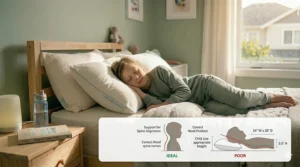
What “appropriate firmness” actually means for a child’s spine: The cervical curve that creates the need for pillow height in adults does not fully develop until early adolescence. Children aged 2–6 have proportionally larger heads relative to their bodies, meaning their head-to-shoulder ratio already provides natural neck alignment when lying down. An overly thick pillow pushes the head forward, creating misalignment rather than correcting it. This is why every pillow on this list is substantially thinner than an adult equivalent — and why you should be sceptical of any children’s pillow that looks like a scaled-down adult pillow. According to age-by-age children’s pillow guidance published by Canadian sleep specialists, children aged 2–3 should use pillows under 5 cm (2 inches) thick, while children aged 8–12 can move to pillows in the 8–10 cm (3–4 inch) range as their cervical spine begins to develop adult curvature.
For school-aged children aged 8 and up, CSA-certified Canadian mattresses and sleeping surfaces also play a role in how much pillow loft is appropriate — a firmer mattress requires slightly less pillow height than a softer one, since the child’s shoulder sinks less into the sleep surface. It’s worth reassessing your child’s pillow every year or two as they grow — the same way you check whether their shoes still fit.
How to Choose a Pillow for Kids in Canada: 6 Expert Criteria
This is the section I wish someone had handed me before I started researching. Here’s a numbered framework for making this decision with confidence:
- Match size to age, not preference. Toddlers (ages 2–5) need 33 × 46 cm (13 × 18 inches). Children ages 5–8 can size up to 40 × 50 cm (16 × 20 inches). Teens can use standard adult pillows. Going bigger too early creates spine misalignment, not comfort.
- Assess your child’s sleep position first. Back sleepers need the least loft — in children under 6, sometimes no pillow at all is optimal. Side sleepers need a pillow that fills the gap between ear and mattress. Stomach sleepers need the thinnest possible pillow, or none.
- Prioritise certifications on the fill, not just the cover. OEKO-TEX Standard 100 on the finished product, GOTS for organic cotton claims, and CertiPUR-US for memory foam are the three credentials worth trusting. Many cheap pillows carry certifications on their outer fabric only — meaningless if the fill inside is untested.
- Consider your Canadian climate. Wool fill (like the Woolino) regulates temperature across seasons. Polyester fill is less expensive but can trap heat. If your child’s room runs warm, prioritise breathability over softness.
- Plan for maintenance. Children’s pillows get dirty — quickly and thoroughly. If the full pillow is not machine washable, ensure the cover is, and that the pillow itself is easy to spot-clean. This eliminates one of the main sources of dust mite accumulation, which is a significant concern for Canadian kids with winter allergies.
- Budget for the full lifespan. A $25 CAD toddler pillow used from ages 2–5 is actually a better value calculation than a $70 CAD premium pillow that also fits ages 2–5. But a $70 CAD adjustable pillow that covers ages 3–10 is exceptional value. Think cost-per-year-of-use, not sticker price.
Common Mistakes Canadian Parents Make When Buying a Pillow for Kids
Even parents who have done their research make these errors. I’ve seen — and made — most of them.
Mistake 1: Buying a toddler pillow for an infant. This is the most consequential mistake on this list. No matter how “toddler-sized” or “firm” a pillow claims to be, Health Canada and the Canadian Paediatric Society are aligned: no pillows for children under 18 months, period, and only when they’ve moved to a bed and can reposition independently.
Mistake 2: Choosing based on visual appeal rather than loft. The cutest pillow in the catalogue is often the thickest and puffiest one. For toddlers, thick equals problematic. Train yourself to check the loft measurement before anything else — ideally under 5 cm (2 inches) for under-5s.
Mistake 3: Assuming Amazon.ca availability equals Amazon.com availability. Several popular US children’s pillows — particularly specialty organic or latex options — simply don’t ship to Canada or come at a significant CAD premium once customs and exchange rates are factored in. Stick to products confirmed available on Amazon.ca for the most predictable pricing and delivery timelines.
Mistake 4: Never replacing the pillow. Children’s pillows should be assessed for replacement every 1–2 years, not just washed. A flattened, lumpy fill that was once a firm and supportive toddler pillow is now essentially providing no spinal support. As children grow, their pillow requirements change — the same way their shoes do.
Mistake 5: Ignoring Canadian winter allergen context. Dust mites thrive in pillows, and in Canada, we spend far more time indoors in winter than households in warmer climates. Hypoallergenic fill, a tightly woven cover, and consistent hot-wash laundering (at 60°C / 140°F to kill mites) matter more here than they might in a warmer country.
Kids’ Pillow vs. Standard Pillow: The Full Comparison
| Feature | Kids’ Pillow (Toddler/Child) | Standard Adult Pillow |
|---|---|---|
| Typical size | 33–40 × 46–50 cm | 50 × 66 cm (standard) |
| Loft height | 2–5 cm (toddler), 5–10 cm (child) | 10–18 cm |
| Fill firmness | Soft to medium-firm | Variable |
| Cervical support | Minimal (head is proportionally large) | Full cervical curve support |
| Recommended age | 2 years+ (out of crib) | 12–13 years+ |
| Safety certification | OEKO-TEX, GOTS, CertiPUR-US recommended | Variable |
| CAD price range | $15–$70 | $30–$200+ |
The key insight from this comparison: a standard adult pillow is not just “too big” for a young child — it actively supports the wrong anatomical structure. Adult pillows are designed to fill the gap created by adult shoulder-width and adult cervical curvature. Neither of those anatomical features exist in a 3- or 5-year-old. Using an adult pillow for a young child is like putting adult orthotics in a child’s shoes — the support is aimed at the wrong anatomy entirely.
This comparison also helps explain why transitioning to an adult pillow is appropriate in the early teen years, when the cervical spine’s adult curvature has largely developed and shoulder-to-head ratios have normalised.
✨ Don’t Miss These Exclusive Deals!
🔍 Ready to upgrade your child’s sleep? Click on any highlighted product above to check live pricing and availability on Amazon.ca. Use the comparison tables to match the right pick to your child’s age and sleep position — and sleep better knowing they are too! 🛌🇨🇦
FAQ: Pillows for Kids in Canada
❓ What age can a child start using a pillow in Canada?
❓ What's the best children's pillow available on Amazon.ca?
❓ Does Amazon.ca offer free shipping on children's pillows?
❓ Are memory foam pillows safe for toddlers in Canada?
❓ How often should I replace my child's pillow in Canada?
Conclusion: Choosing the Right Pillow for Kids in Canada
The pillow your child sleeps on is quietly influencing their spine development, sleep quality, and morning mood — every single night. Getting it right isn’t complicated once you know what to look for, but it does require thinking beyond brand names and adorable prints.
For most Canadian families, the KeaBabies Toddler Pillow covers ages 2–5 beautifully: it’s certified safe, machine washable, appropriately sized, and excellent value in CAD. If your child sleeps hot in a summer-warm bedroom or a climate-controlled high-rise, the Woolino Wool Toddler Pillow is worth the premium. Once your child hits school age and starts side-sleeping with growing shoulder width, the MLILY Adjustable Pillow earns its higher price tag with years of adjustable use.
Above all: wait until your child is safely out of the crib before introducing any pillow, follow Health Canada’s safe sleep guidelines for infants, and reassess your child’s pillow every year or two as they grow. Sleep is how children develop — their brains, their bodies, and their energy for the next adventure. A well-chosen pillow for kids is one of the easiest investments you can make in that process.
✨ Don’t Miss These Exclusive Deals!
🔍 Found the perfect match for your little one? Click on any highlighted product in this guide to check current pricing and availability on Amazon.ca. Happy sleeping, Canada! 🇨🇦😊
Recommended for You
- Best Easy Care Pillow for Seniors in Canada 2026 (Top 7)
- 7 Best Supportive Pillows for Elderly Canada 2026
- Best Easy to Adjust Pillow for Seniors in Canada 2026 (Top 7 Picks)
Disclaimer: This article contains affiliate links. As an Amazon Associate, I earn from qualifying purchases. If you purchase products through these links, we may earn a small commission at no additional cost to you.
✨ Found this helpful? Share it with your friends! 💬🤗
