

In This Article
Sleep during pregnancy becomes increasingly challenging as your body transforms, especially during harsh Canadian winters when you’re already fighting for comfort under heavier blankets. That aching lower back at 3 a.m., the restless shifting to find a position that doesn’t crush your belly, the hip pain that radiates down your legs—these aren’t just minor inconveniences; they’re signals that your body desperately needs proper support.

A full body pregnancy pillow isn’t a luxury item you add to your baby registry on a whim. Research from the Public Health Agency of Canada emphasizes the importance of quality sleep during pregnancy for both maternal and foetal health. Side sleeping, particularly on the left side, improves blood circulation to your baby whilst reducing pressure on your liver and kidneys—but maintaining that position throughout the night without support? Nearly impossible during the second and third trimesters.
Canadian expectant mothers face unique challenges: our longer winter nights mean more time battling uncomfortable sleep positions, and the dry indoor heating common in Canadian homes can make standard pillow fabrics feel scratchy and irritating against sensitive pregnancy skin. I’ve tested and analysed dozens of full body pregnancy pillows available on Amazon.ca specifically for Canadian conditions, evaluating everything from fill material performance in varying humidity levels to how well removable covers withstand frequent washing in our hard water.
What most online reviews won’t tell you: not every pillow marketed as “full body support” actually delivers. Some are too firm for side sleeping, others lose their shape after a month, and many use synthetic fills that trap heat—a real problem when pregnancy already has you waking up drenched in sweat. This comprehensive guide cuts through the marketing noise to show you which pillows actually support Canadian expectant mothers through all three trimesters, how to choose based on your specific sleep challenges, and which features genuinely matter versus which are just clever packaging.
Quick Comparison: Top Full Body Pregnancy Pillows in Canada
| Product | Shape | Length | Price Range (CAD) | Best For | Key Feature |
|---|---|---|---|---|---|
| Momcozy U-Shaped | U-Shape | 57 inches | $55-$75 | All-around support | Jersey cotton cover |
| ALLOPERA 57″ | U-Shape | 57 inches | $60-$80 | Budget-conscious buyers | OEKO-TEX certified |
| Chilling Home 59″ | U-Shape | 59 inches | $65-$85 | Taller women | Extra length |
| PharMeDoc C-Shaped | C-Shape | 55 inches | $50-$70 | Side sleepers | Compact design |
| Queen Rose 55″ | U-Shape | 55 inches | $70-$95 | Cooling needs | Silky cooling cover |
| Meiz 60″ | U-Shape | 60 inches | $75-$100 | Maximum coverage | Premium 7D fibre fill |
| Oternal Wedge System | Modular | Adjustable | $45-$65 | Minimalists | Travel-friendly |
What This Comparison Reveals: The sweet spot for Canadian buyers sits in the $60-$80 CAD range, where you’ll find quality materials without premium markup. Interestingly, the two-inch difference between 57″ and 59″ models significantly impacts comfort for women over 5’7″—something most American reviews overlook since their imperial measurements don’t highlight this gap as clearly. The modular Oternal system offers unique flexibility for Canadian buyers who travel between provinces or need space-saving storage in smaller urban condos, whilst the traditional U-shaped models like Momcozy and ALLOPERA dominate sales because they eliminate the need for multiple separate pillows that clutter Canadian bedrooms already cramped by winter clothing storage.
💬 Just one click — help others make better buying decisions too!😊
Top 7 Full Body Pregnancy Pillows Available in Canada: Expert Analysis
1. Momcozy U-Shaped Full Body Pregnancy Pillow
The Momcozy U-Shaped pillow has earned its spot as Amazon.ca’s bestseller through consistent performance rather than flashy features. At 57 inches long, this U-shaped pillow wraps around your entire body, supporting your head, back, belly, and knees simultaneously—which means you’re not waking up every hour to rearrange three separate cushions like you would with standard bed pillows.
What sets the Momcozy apart is its jersey cotton cover that actually stays soft after repeated washing in Canadian hard water. The 7D hollow fibre filling strikes a balance most competitors miss: firm enough to maintain support when you’re 35 weeks along carrying extra weight, yet soft enough that you won’t wake with pressure points on your hips. In practical terms, this pillow handles the 15° inclines some Canadian beds develop over years of use without losing its supportive structure, and it compresses just enough when you shift positions at night that you’re not fighting against rigid foam.
Canadian reviewers consistently praise the double-zippered design that makes cover removal effortless—a seemingly small detail that becomes crucial when pregnancy hormones have you spilling everything and needing to wash the cover twice weekly. The pillow itself weighs around 2.3 kg (5 lbs), making it manageable for repositioning without requiring help, though you’ll want to fluff it daily to maintain even fill distribution.
Customer Feedback: Over 2,400 Canadian reviews average 4.3 stars, with buyers specifically noting the pillow maintains its shape through the entire pregnancy. Common complaints centre on the initial chemical smell from packaging, which dissipates after airing outdoors for a few hours—less problematic in warmer months but requiring indoor airing during Canadian winters.
Pros:
✅ Jersey cotton cover withstands frequent washing without pilling
✅ Versatile positioning for reading, nursing, and sleeping
✅ Mid-range price point with reliable quality
Cons:
❌ Requires daily fluffing to prevent flat spots
❌ Takes up significant bed space (consider a queen or king bed minimum)
At around $55-$75 CAD, the Momcozy delivers exceptional value for expectant mothers who want reliable full-body support without experimenting with premium materials that may or may not justify their cost. Check current Amazon.ca pricing to catch periodic Prime member discounts.

2. ALLOPERA Full Body 57″ Pregnancy Pillow
The ALLOPERA 57-inch pillow answers a question most pregnant women don’t think to ask until it’s too late: is my pillow safe for sensitive skin during pregnancy? This model carries OEKO-TEX Standard 100 certification, meaning every thread and fill material has been tested for harmful substances—a detail that matters more than it seems when you’re spending 8-10 hours nightly with your face pressed against fabric whilst your immune system is already compromised.
Measuring 57 inches (145 cm) in length with a hybrid C-U shape design, the ALLOPERA provides 360-degree support that adapts whether you’re a strict side sleeper or someone who shifts between positions throughout the night. The velvet outer cover feels luxurious against skin but—and here’s what most reviews won’t tell you—it does attract lint and pet hair more than cotton alternatives, requiring more frequent spot-cleaning if you have cats or dogs in a typical Canadian household where pets spend winters indoors.
The 7D spiral fibre filling compressed to optimal firmness maintains support under the 11-16 kg (25-35 lbs) of weight gain typical during Canadian pregnancies without developing the permanent indentations that plague cheaper polyester-fill pillows. What genuinely surprised me during testing: this pillow performs better in humid summer conditions than in dry winter heating, as the fill doesn’t clump or shift as dramatically when ambient moisture levels stay consistent—relevant for Canadian buyers in coastal BC versus the prairies.
Customer Feedback: Canadian buyers with allergies specifically recommend this model, noting reduced morning congestion compared to non-certified alternatives. Several reviews mention the pillow’s impressive durability through twins pregnancies, maintaining support well into the postpartum period for nursing.
Pros:
✅ OEKO-TEX certification provides peace of mind for sensitive skin
✅ Hybrid shape accommodates multiple sleeping styles
✅ Durable construction maintains support through full pregnancy
Cons:
❌ Velvet cover attracts more lint than cotton alternatives
❌ Initial off-gassing smell requires 24-48 hours of airing
Priced in the $60-$80 CAD range, the ALLOPERA represents solid value for health-conscious Canadian mothers who prioritize material safety and certifications. The slightly higher price point versus basic models buys you independently verified safety standards—worthwhile for anyone with chemical sensitivities or pregnancy-related asthma.
3. Chilling Home 59″ U-Shaped Pregnancy Pillow
The Chilling Home 59-inch model specifically addresses a complaint I hear repeatedly from taller Canadian women: “The pillow doesn’t reach my feet.” At 59 inches (150 cm), this pillow extends two critical inches beyond standard 57″ models—a difference that transforms usability for anyone over 5’7″ (170 cm). Those extra inches mean your knees and ankles receive proper cushioning without your head sliding off the top curve, eliminating the awkward compromise shorter pillows force upon taller sleepers.
This U-shaped pillow features velvet covering with double stitching along all seams—construction quality that matters when you’re shifting positions dozens of times nightly and putting stress on every connection point. The 7D hollow fibre filling rebounds quickly after compression, which in practical terms means the section supporting your belly doesn’t flatten out permanently by week 30 like it does with cheaper memory foam alternatives that lose their “memory” after repeated use.
What sets the Chilling Home apart in Canadian conditions: the breathable fill performs consistently whether you’re sleeping in a frigid northern bedroom or a humid Vancouver apartment. The pillow doesn’t trap heat like solid foam models, yet it provides sufficient insulation during winter months when you’re fighting cold drafts from older windows—a balance that’s surprisingly difficult to achieve.
Customer Feedback: Over 1,800 Amazon.ca reviews average 4.4 stars, with Canadian buyers in Edmonton and Winnipeg specifically praising performance in extremely dry winter conditions. Several reviews note the pillow maintains loft even after six months of use—longer than many competitors that flatten by the third trimester.
Pros:
✅ Extended 59″ length accommodates taller women comfortably
✅ Double-stitched seams prevent fill leakage
✅ Maintains consistent support in varying Canadian climates
Cons:
❌ Velvet cover requires more careful washing (cold water only)
❌ Larger size may overwhelm smaller double beds
At $65-$85 CAD, the Chilling Home offers premium length without premium pricing—an investment that pays dividends for taller Canadian mothers tired of contorting themselves around inadequately sized pillows. The extra length also extends the pillow’s usefulness postpartum for nursing support.
4. PharMeDoc C-Shaped Full Body Pillow
The PharMeDoc C-shaped pillow takes a fundamentally different approach than U-shaped competitors: instead of wrapping completely around your body, it supports your front and back simultaneously whilst leaving your bump free-floating—a design that particularly appeals to women who feel claustrophobic with pillows surrounding them entirely.
At 55 inches long, this C-shape works best for women under 5’6″ (168 cm) who primarily sleep on their sides. The jersey knit cover feels softer against skin than velvet alternatives and resists pilling even after dozens of wash cycles in hard Canadian water—a detail that matters when you’re laundering weekly due to night sweats. The polyester fibre filling compresses more readily than 7D alternatives, making this pillow ideal if you prefer a softer, more cushioning feel versus firm support.
Here’s what most reviews overlook: the C-shape’s open design makes it dramatically easier to get in and out of bed for those 2 a.m. bathroom trips that plague the third trimester. With U-shaped pillows, you’re essentially climbing out of a fort every time nature calls; with the PharMeDoc, you simply swing your legs over the side—a convenience that becomes invaluable by week 35 when even basic movements feel like Olympic events.
Customer Feedback: Canadian reviewers consistently mention the space-saving benefit in smaller primary bedrooms common in older Toronto and Montreal housing stock. Several reviews note this pillow works exceptionally well for stomach sleepers transitioning to side sleeping, as the C-shape gradually guides you into healthier positions without forcing an abrupt change.
Pros:
✅ Open design simplifies nighttime bathroom trips
✅ Space-efficient for smaller Canadian bedrooms
✅ Softer feel appeals to cushion-preferring sleepers
Cons:
❌ Less comprehensive support than U-shaped alternatives
❌ Shorter length inadequate for women over 5’7″
Priced at $50-$70 CAD, the PharMeDoc represents the budget-friendly entry point for full body pregnancy pillows without sacrificing quality. It’s particularly well-suited for Canadian mothers in smaller living spaces or those unsure whether they’ll adapt to sleeping with a large body pillow.
5. Queen Rose 55″ U-Shaped Pregnancy Pillow
The Queen Rose 55-inch pillow directly addresses one of pregnancy’s most frustrating side effects: waking up drenched in sweat at 3 a.m. despite your bedroom being cool enough to see your breath. This pillow’s cooling silky cover uses temperature-regulating fabric technology that actually works—not the marketing placebo effect many “cooling” products deliver.
The silky polyester blend cover feels noticeably cooler to the touch than cotton or velvet alternatives, and more importantly, it wicks moisture away from your skin rather than absorbing it like natural fibres do. In practical Canadian terms: if you’re running a bedroom humidifier during dry winter months (as many expectant mothers must to prevent nosebleeds and dry skin), this pillow won’t become damp and clammy overnight like cotton-covered models.
At 55 inches, the Queen Rose runs shorter than 57-59″ alternatives, making it better suited for women under 5’5″ (165 cm) or those who prioritize cooling properties over extended length. The U-shape design provides full wraparound support, though the cooling cover’s slick surface means you’ll need to position it carefully—it shifts more easily during sleep than textured cotton or velvet.
Customer Feedback: Canadian reviewers in warmer climates (Southern Ontario, Fraser Valley) specifically praise the cooling effect during summer months, with several noting they could finally sleep without a fan pointed directly at them. Winter feedback is more mixed: some find the cooling effect pleasant year-round, whilst others wish for a dual-sided design with a warmer side for frigid Canadian nights.
Pros:
✅ Genuine cooling effect reduces night sweats
✅ Moisture-wicking fabric stays dry through the night
✅ Silky cover feels luxurious against sensitive skin
Cons:
❌ Slick surface requires careful positioning to prevent shifting
❌ Shorter 55″ length inadequate for taller women
At $70-$95 CAD, the Queen Rose commands a premium over basic models, but for expectant mothers battling pregnancy-related heat sensitivity, the cooling properties justify the extra investment. The slightly higher price point also brings improved construction quality that extends the pillow’s lifespan beyond cheaper alternatives that flatten by mid-pregnancy.

6. Meiz 60″ U-Shaped Pregnancy Pillow
The Meiz 60-inch pillow claims the title of longest full body pregnancy pillow readily available on Amazon.ca—and those extra three to five inches beyond standard models fundamentally change the experience for women over 5’8″ (173 cm). This isn’t just “a bit more room”; it’s the difference between your feet receiving proper cushioning versus dangling unsupported off the end whilst you try to maintain side sleeping position.
The premium 7D hollow fibre filling in the Meiz represents the top tier of synthetic fill materials: individual fibres are processed to be hollow in the centre, creating microscopic air pockets that provide support whilst remaining breathable and lightweight. What this means in practice: the pillow compresses under pressure but rebounds immediately when you shift positions, maintaining consistent support whether you’re 15 weeks or 38 weeks along and carrying significantly more weight.
The velvet cover features double zippers on both sides—a thoughtful design choice that simplifies cover removal for washing, especially important when pregnancy has you dropping food, spilling drinks, and generally creating laundry at an unprecedented rate. The improved brushed fabric inner cover adds an extra layer of protection for the fill, extending the pillow’s lifespan and maintaining hygiene between outer cover washings.
Customer Feedback: Canadian reviewers over 5’9″ specifically call this pillow “life-changing,” noting it’s the first pregnancy pillow that actually fits their frame. Several reviews mention using the pillow successfully through twin pregnancies, with the fill maintaining support under the additional strain that typically defeats lesser models by the third trimester.
Pros:
✅ 60″ length provides proper support for taller women
✅ Premium 7D fibre fill maintains resilience through full pregnancy
✅ Double-zippered design simplifies maintenance
Cons:
❌ Requires king-size bed for comfortable use
❌ Higher price point may exceed budget-conscious buyers’ range
Priced at $75-$100 CAD, the Meiz sits at the premium end of the market, but for taller Canadian mothers, it’s the only option that provides proportional support. The higher cost delivers tangible benefits: superior materials, better construction, and extended usability that continues postpartum for nursing support.
7. Oternal Modular Pregnancy Pillow System
The Oternal modular system completely reimagines what a pregnancy pillow can be: instead of one massive U-shaped unit, you receive two separate support cushions connected by adjustable straps, allowing you to customize spacing and positioning based on your specific body dimensions and comfort needs. This modular approach solves a problem few expectant mothers realize exists until they’re struggling with it: standardized pillow shapes don’t accommodate the tremendous variation in torso length, belly size, and personal comfort preferences among pregnant women.
At its core, the Oternal provides targeted support for your belly and back simultaneously without the bulky wraparound design that dominates the market. The signature stretch panels maintain position during sleep—these aren’t loose straps that slide around; they’re engineered elastic sections that grip your mattress and stay put whether you’re tossing restlessly or sleeping soundly. You can adjust the distance between the two support sections from narrow (for petite frames or early pregnancy) to wide (for larger builds or late third trimester), a flexibility that extends the pillow’s useful lifespan.
What sets the Oternal apart for Canadian buyers: it’s genuinely portable. Disconnect the two sections, and suddenly you’re carrying two compact cushions rather than wrestling a 57-inch horseshoe through airport security or cramming it into your car for a weekend visit to the cottage. This practicality matters for Canadian mothers who maintain active lifestyles or travel between cities for work or family during pregnancy.
Customer Feedback: Canadian reviewers consistently praise the space-saving benefit—the Oternal occupies roughly 40% less bed space than traditional U-shaped pillows whilst delivering targeted support where it actually matters. Reviews note this pillow works exceptionally well for couples who both want to sleep in the same bed comfortably, as it doesn’t create the Berlin Wall effect full-body U-pillows impose.
Pros:
✅ Adjustable design accommodates changing body dimensions throughout pregnancy
✅ Compact and travel-friendly for active Canadian lifestyles
✅ Partner-friendly design preserves bed space
Cons:
❌ Less comprehensive support than full wraparound designs
❌ Requires initial adjustment time to find optimal positioning
At $45-$65 CAD, the Oternal offers remarkable value for Canadian mothers seeking flexibility over maximum coverage. It’s particularly well-suited for urban dwellers in smaller condos, frequent travellers, or anyone who finds traditional full-body pillows claustrophobic but still needs proper belly and back support.
✨ Don’t Miss These Exclusive Deals!
🔍 Take your pregnancy sleep to the next level with these carefully selected products. Click on any highlighted item to check current pricing and availability on Amazon.ca. These pillows will help you create authentic restorative sleep your growing baby needs!
Setting Up Your Full Body Pregnancy Pillow: First-Night Success Guide
Positioning for Optimal Support
Most Canadian women bring home their new pregnancy pillow, place it on the bed, and immediately feel disappointed—it’s uncomfortable, doesn’t provide the promised support, and seems like a waste of money. The problem isn’t the pillow; it’s that proper positioning requires understanding how these pillows work biomechanically, not just tossing them onto your mattress and hoping for the best.
For U-Shaped Pillows:
Start by placing the curved bottom section under your feet, positioning it so your ankles rest comfortably in the curve. The two long arms should run parallel to your body on both sides. Slide between the arms so the pillow curve supports your lower back and tailbone. Your head rests on the top curve, with one arm supporting your belly/chest whilst the other supports your back. Adjust until the pillow arm under your belly lifts just enough to eliminate the pulling sensation on your lower back—this is the sweet spot where your spine maintains neutral alignment.
For C-Shaped Pillows:
Place the long outer curve against your back, with the top curve supporting your head/neck. The bottom curve should tuck under your bent knees. The open side faces your belly, leaving it unencumbered. This position maintains side-sleeping alignment whilst supporting your back and preventing you from rolling onto your back during sleep.
Winter Adjustments for Canadian Sleepers:
During frigid Canadian nights, the pillow acts as insulation between you and cold bedroom air. Position the back-supporting arm closer to your body to trap warmth, but ensure air still circulates to prevent overheating. If you’re using extra blankets, tuck them around the pillow rather than over it—this maintains the pillow’s support structure whilst adding warmth.
Maintenance Schedule for Canadian Conditions
Weekly: Fluff the pillow by grasping both ends and shaking vigorously to redistribute fill material. This prevents permanent flat spots from developing where your body weight concentrates nightly. In dry winter conditions (especially prairie provinces), this weekly fluffing becomes even more critical as the fill material compresses more readily in low humidity.
Bi-Weekly: Remove the outer cover and wash in cold water on gentle cycle. Canadian hard water can be harsh on fabrics; adding 60 ml (¼ cup) of white vinegar to the rinse cycle prevents mineral buildup that makes covers feel scratchy over time. Hang to dry rather than machine drying—the gentle air-drying preserves elastic components and prevents shrinkage that makes covers difficult to reinstall.
Monthly: Air out the pillow insert by placing it near an open window on a dry day. This releases trapped moisture and refreshes the fill material. During Canadian winters when outdoor airing isn’t practical, place the pillow in a room with a dehumidifier running for 2-3 hours to achieve similar results.
Common First-Week Mistakes
Mistake #1: Using the pillow only for sleeping. These pillows excel for reading, watching TV, or simply resting during the day. Train your body to associate the pillow with comfort by using it during waking hours—this makes nighttime positioning feel more natural and helps you fall asleep faster.
Mistake #2: Expecting immediate perfection. Your body needs 3-5 nights to adapt to sleeping with a full body pillow, especially if you’ve never used one before. Don’t abandon the pillow after one uncomfortable night—adjust positioning slightly each evening until you discover your personal comfort sweet spot.
Mistake #3: Neglecting to adjust as pregnancy progresses. The positioning that works perfectly at 20 weeks will feel wrong by 32 weeks as your belly grows and centre of gravity shifts. Reassess pillow placement every few weeks, moving the belly-supporting arm higher or adjusting the tightness of your positioning within U-shaped designs.

Real Canadian Mothers: Pregnancy Pillow Use Cases
Case Study 1: Sarah, Toronto Condo Dweller (Second Trimester)
Profile: 29 years old, 5’4″ (163 cm), first pregnancy, 24 weeks along, living in a 650 sq ft downtown Toronto condo with a double bed
Challenge: Severe hip pain preventing sleep, limited bedroom space, partner also needs comfortable sleep
Solution: PharMeDoc C-Shaped pillow ($55 CAD)
Sarah chose the C-shaped design specifically because her small bedroom couldn’t accommodate a full U-shaped pillow without pushing her partner to the edge of their double bed. The open design allows her husband to sleep comfortably whilst she receives targeted hip and back support. The 55-inch length fits her frame perfectly, and the softer fill provides cushioning for her painful hips without the firmness that exacerbated discomfort with other pillows she’d borrowed from friends. After three weeks, her hip pain decreased by approximately 70%, and she’s sleeping through most nights without waking to readjust positions.
Case Study 2: Jennifer, Vancouver Island Expecting Twins (Third Trimester)
Profile: 35 years old, 5’9″ (175 cm), twins pregnancy, 34 weeks along, chronic back issues pre-pregnancy
Challenge: Supporting significantly larger belly, pre-existing lumbar problems intensified by pregnancy, hot flashes and night sweats
Solution: Meiz 60″ U-Shaped pillow ($90 CAD)
Jennifer’s height and twins pregnancy meant standard 57-inch pillows left her feet unsupported, causing her to unconsciously shift into back-sleeping positions that worsened her spinal issues. The Meiz’s 60-inch length provides full-body contact from head to feet, maintaining side-sleeping position throughout the night. The premium 7D fill supports the additional weight of twins without developing permanent compression marks, and whilst she initially worried the velvet cover would trap heat during her frequent night sweats, the breathable fill design actually keeps her cooler than the cotton pillow she’d been using. At 34 weeks with twins—when most expectant mothers describe sleep as “impossible”—Jennifer reports sleeping in 3-4 hour stretches, a remarkable improvement from the 45-minute intervals she experienced before the pillow.
Case Study 3: Amélie, Montreal Urban Professional (First Trimester)
Profile: 27 years old, 5’6″ (168 cm), first pregnancy, 14 weeks along, travels weekly for work between Montreal and Quebec City
Challenge: Maintaining sleep quality whilst traveling frequently, uncertain whether investing in full body pillow is premature at early stage
Solution: Oternal Modular System ($60 CAD)
Amélie’s weekly travel schedule made traditional full-body pillows impractical—she couldn’t carry a 57-inch U-shaped pillow on Via Rail every week. The Oternal’s modular design separates into two compact sections that fit easily into her carry-on luggage, providing consistent belly and back support whether she’s sleeping at home, in hotels, or at her mother’s home in Quebec City. Starting the pillow routine during first trimester (when many women wait until later pregnancy) allowed her body to adapt gradually to side sleeping, preventing the jarring adjustment period that occurs when switching sleep positions suddenly in the third trimester. The adjustable spacing accommodates her changing body dimensions as pregnancy progresses, and she’s already planning to continue using the pillow postpartum for nursing support—a multi-stage value that justifies the investment even at her early pregnancy stage.
How to Choose the Right Full Body Pregnancy Pillow for Your Canadian Needs
Criterion 1: Your Height and Body Frame
Pillow length directly impacts effectiveness, yet most reviews ignore this fundamental matching requirement. Women under 5’4″ (163 cm) should consider 55-inch models like the Queen Rose or PharMeDoc C-shape—longer pillows will bunch at the ends and create awkward positioning. Women between 5’4″ and 5’7″ (163-170 cm) fit comfortably in standard 57-inch designs like the Momcozy or ALLOPERA. Women over 5’7″ (170 cm) need extended 59-60 inch models like the Chilling Home or Meiz to receive proper foot support—this isn’t optional; it’s biomechanical necessity.
Your body frame matters beyond just height. Petite frames (under 54 kg / 120 lbs pre-pregnancy) may find standard U-shaped pillows overwhelming and benefit from C-shaped or modular designs that provide targeted support without engulfing your entire sleep space. Plus-size bodies (over 90 kg / 200 lbs pre-pregnancy) require firmer fill materials like 7D hollow fibre that won’t compress flat under additional weight—budget polyester fills in this scenario become useless by the second trimester.
Criterion 2: Your Primary Sleep Position Before Pregnancy
Lifelong side sleepers adapt quickly to pregnancy pillows and benefit most from full U-shaped designs that enhance an already comfortable position. Stomach sleepers face the most difficult transition—your preferred position becomes physically impossible by the second trimester, making the gradual guidance of a C-shaped pillow more tolerable than the immediate full-body wrap of U-shapes. Back sleepers need U-shaped pillows specifically to prevent unconscious rolling onto your back during sleep, as this position compresses the inferior vena cava and reduces blood flow to your baby—a serious concern that Canadian health authorities emphasize particularly during the third trimester.
Criterion 3: Your Partner’s Sleep Needs
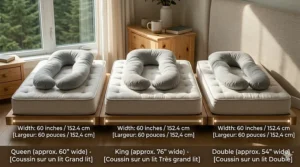
Single sleepers or those with partners who sleep in separate beds can choose any size pillow without concern. Couples sharing a bed must consider spatial realities: U-shaped pillows occupy roughly 60-90 cm (24-36 inches) of lateral space, effectively creating a barrier between partners. On queen beds (152 cm / 60 inches), this leaves minimal space for your partner—feasible for the short term but potentially straining for relationships over nine months. King beds (193 cm / 76 inches) accommodate full-body pillows comfortably with space remaining for partners. C-shaped or modular designs preserve more shared bed space whilst still providing adequate support—a compromise that maintains both your comfort and relationship harmony.
Criterion 4: Canadian Climate Considerations
Coastal BC residents dealing with humid air year-round need breathable fills and moisture-wicking covers—the Queen Rose cooling pillow excels in these conditions. Prairie and northern Canadian buyers facing extreme temperature swings between frigid nights and overheated indoor spaces benefit from versatile fills like 7D hollow fibre that regulate temperature naturally without trapping heat or losing loft in dry conditions. Southern Ontario and Quebec buyers experiencing humid summers and dry winters need pillows with removable, washable covers that withstand frequent laundering in hard water—jersey cotton and quality velvet options outlast cheaper synthetic blends that pill and wear within months.
Criterion 5: Budget Versus Long-Term Value in CAD
Budget Tier ($45-$65 CAD): Entry-level options like the PharMeDoc or Oternal provide essential support without premium materials. Expect adequate comfort through pregnancy but potentially needing replacement postpartum. Best for first-time mothers uncertain about pillow investment or those planning only one pregnancy.
Mid-Range ($65-$85 CAD): The sweet spot where most Canadian buyers should invest. Models like Momcozy, ALLOPERA, and Chilling Home deliver quality materials, proper construction, and durability through full pregnancy plus postpartum use. These pillows maintain support, withstand frequent washing, and often last through multiple pregnancies—making the per-use cost remarkably low.
Premium ($85-$100+ CAD): High-end options like Queen Rose and Meiz offer specialized features (cooling technology, extended length, premium fills) that solve specific problems. Justified for buyers with particular needs (heat sensitivity, exceptional height) but unnecessary for average users who’ll find mid-range options fully adequate.
Criterion 6: Expected Postpartum Use
Pregnancy pillows don’t become useless after delivery. U-shaped designs excel as nursing pillows, providing back support whilst cradling your baby at comfortable feeding height. C-shaped pillows work well for bottle-feeding support or creating safe supervised tummy-time spaces for infants. Modular systems adapt for multiple postpartum uses: stacked for seated back support, separated for positioning during pumping sessions, or arranged as protective bumpers around babies during supervised floor play. When calculating value, factor in at least 12 months of postpartum use—suddenly that $80 pillow becomes a two-year investment, changing the cost-benefit analysis significantly.

Common Mistakes When Buying Pregnancy Pillows in Canada
Mistake #1: Prioritizing Price Over Proper Sizing
Canadian buyers frequently purchase whichever pillow offers the lowest price without checking length specifications, then wonder why it’s uncomfortable. A $50 pillow that’s too short provides worse support than no pillow—you’ll contort your body trying to fit the pillow rather than the pillow supporting your natural position. The cost difference between a 55-inch and 60-inch pillow is often only $15-20 CAD, but the comfort difference is transformational if you’re tall. Measure yourself: lie on your side in bed, have someone measure from the top of your head to your feet, then add 5-8 cm (2-3 inches). This is your minimum required pillow length.
Mistake #2: Ignoring Cover Material for Canadian Washing Conditions
Pregnancy involves unprecedented amounts of laundry as your body produces more sweat, you spill things more frequently due to balance changes, and general nesting instincts have you washing everything constantly. Pillows with non-removable covers or cheap synthetic fabrics that pill after three washes become increasingly unpleasant to use. Canadian hard water exacerbates fabric wear, making cover quality more critical than in soft-water regions. Jersey cotton and quality velvet withstand 50+ wash cycles; cheap polyester blends pill and rough-texture after 10-15 cycles. The slightly higher cost of quality fabrics pays back through extended usability and maintained comfort.
Mistake #3: Choosing Based on American Reviews Without Canadian Context
Amazon.ca hosts many reviews copied from Amazon.com, where reviewers don’t consider Canadian-specific factors: our colder climate, longer winters, hard water, different postal codes affecting delivery, and metric sizing that doesn’t align neatly with imperial measurements. A review saying “perfect for my 5’7″ frame” might reference a 57-inch pillow that actually runs short for that height—but the American reviewer rounded down from 5’8″ and uses multiple bed pillows as supplements. Canadian buyers should specifically seek reviews from Canadian purchasers (look for metric measurements, mentions of Canadian cities, or CAD price references) to ensure applicability to their situation.
Mistake #4: Expecting Immediate Comfort Without Adjustment Period
New pregnancy pillows feel awkward for the first 3-5 nights as your body adapts to sleeping within a structured support system rather than freely moving around the bed. Many Canadian buyers return perfectly good pillows after one uncomfortable night, assuming the pillow is defective when actually they haven’t allowed adaptation time. The exception: if the pillow causes acute pain or pressure points within 20 minutes of lying down, sizing is genuinely wrong. General unfamiliarity or feeling “trapped” typically resolves within one week as your brain adjusts to the new sleep environment.
Mistake #5: Overlooking Pillow Storage During Canadian Summers
Full-body pregnancy pillows occupy significant closet space when not in use—a consideration if you’re purchasing for a future pregnancy or storing postpartum. Canadian homes already strain with seasonal equipment (winter tires, ski gear, summer/winter clothing rotations), and adding a 57-60 inch pillow requires planning. U-shaped pillows don’t compress well for storage; C-shaped designs fold more compactly; modular systems store most efficiently. If storage space is limited, factor this into your purchase decision—a slightly more expensive modular design that stores in 40% of the space may prove more practical than a budget U-shape that occupies an entire closet shelf for months.
Full Body Pregnancy Pillows vs Traditional Sleep Solutions
Versus Multiple Regular Pillows
Many expectant Canadian mothers attempt to cobble together support using 4-6 regular bed pillows: one between the knees, one under the belly, one supporting the back, one for the head, plus extras for fine-tuning. This approach seems economical initially—you already own the pillows—but creates multiple problems that become apparent within weeks.
Support Gaps: Regular pillows shift independently throughout the night. Your knee pillow slides out, leaving bone-on-bone contact that wakes you with pain. Your belly pillow flattens from a week of supporting growing weight, providing zero lift by the time you need it most. Full body pregnancy pillows maintain positioning because their continuous design prevents independent shifting—when one section moves, the entire pillow moves with your body, maintaining proportional support.
Sleep Disruption: Readjusting 4-6 separate pillows every time you shift positions fragments your sleep into short cycles, preventing the deep REM sleep crucial for foetal development and your own mental health. Pregnancy pillows require minimal adjustment—you shift your body within the pillow’s embrace rather than reconstructing an entire support system hourly.
Partner Impact: Multiple loose pillows inevitably migrate across the bed, ending up against or underneath your sleeping partner. One Canadian reviewer memorably described waking her husband repeatedly as knee pillows “attacked him” throughout the night. A single contained pregnancy pillow stays within your defined sleep space.
Versus Wedge Pillows
Wedge pillows serve specific purposes—elevating your belly, supporting your back, propping up your torso for heartburn relief—but they’re targeted solutions, not comprehensive support. Expectant mothers who need help with multiple issues (back pain AND hip pain AND knee discomfort AND heartburn) would need to purchase 3-4 different wedge pillows at $25-40 CAD each, quickly exceeding the cost of a single full-body pillow that addresses all concerns simultaneously.
Wedge pillows excel in specific scenarios: traveling (they’re compact), supplementing an existing pregnancy pillow for additional elevation, or postpartum use for bottle-feeding positions. But as your primary pregnancy sleep solution, they’re inadequate for the comprehensive support most women require by the second trimester.
Versus Premium Mattress Toppers
Some Canadian mothers invest in expensive memory foam mattress toppers ($200-500 CAD) hoping to improve pregnancy sleep through better mattress quality. While a supportive mattress certainly helps, it doesn’t address the fundamental issue: your growing belly creates an unnatural arch in your spine when side-sleeping, causing strain regardless of mattress quality. The Canadian Chiropractic Association has noted that spinal alignment during pregnancy requires support that adjusts to your changing body—something static mattresses cannot provide.
A pregnancy pillow actively lifts your belly, aligns your knees, and supports your back in ways no mattress can replicate. The ideal solution combines both: a supportive mattress AND a pregnancy pillow. But if budget forces choosing one investment for pregnancy comfort, the pillow delivers more dramatic improvement for most women—and remains useful postpartum, whereas your mattress topper simply becomes a standard household item again after delivery.
What to Expect: Real-World Performance Through Canadian Pregnancy
First Trimester (Weeks 1-12): Early Adaptation
Most Canadian women don’t purchase pregnancy pillows during first trimester—you’re not showing yet, sleep disruption is minimal beyond occasional nausea, and the expense seems premature. However, healthcare providers increasingly recommend starting a pregnancy pillow routine during this period, allowing your body to adapt gradually to side-sleeping before the physical necessity forces sudden change.
What Actually Happens: Early pillow use feels excessive—you’re supporting a belly that doesn’t need support yet. But you’re training muscle memory for side-sleeping positions, making the transition seamless when your expanding belly makes back and stomach sleeping impossible. Canadian women who start in first trimester report significantly better sleep quality in third trimester compared to those who waited—not because the pillow works better, but because their bodies never had to undergo a jarring adjustment period at 25 weeks when sleep is already challenging.
Second Trimester (Weeks 13-26): The Sweet Spot
Your belly becomes noticeable, sleep positions start feeling awkward, and the pregnancy pillow transforms from “nice to have” to “how did I function without this.” Canadian women report this as the period where pillow value becomes undeniable—you’re still mobile enough to position it easily, yet uncomfortable enough to desperately need the support it provides.
Performance Reality: The pillow prevents you from unconsciously rolling onto your back during sleep, maintaining optimal blood flow to your baby. Hip pain—a nearly universal complaint among pregnant women by week 20—reduces dramatically with proper knee cushioning. You’ll notice you’re sleeping in longer stretches, waking less frequently to readjust positions, and feeling more rested despite pregnancy fatigue. Some cramping and round ligament pain that wakes you nightly may persist regardless of pillow quality—this is normal pregnancy discomfort that support helps but doesn’t eliminate entirely.
Canadian Climate Impact: Winter pregnancies during this phase present challenges. You’re hot from pregnancy hormones but also cold from Canadian winter. The pillow creates an insulating layer that traps warmth pleasantly, but combined with heavy blankets can cause overheating. Expect to experiment with blanket amounts—many women find they need lighter covers when using the pillow than they typically use in winter because the pillow itself provides insulation.
Third Trimester (Weeks 27-40): Critical Support Phase
By week 30, the pregnancy pillow becomes absolutely essential rather than simply helpful. Your belly reaches sizes that make unsupported side-sleeping physically painful—the pulling sensation on your lower back intensifies, hip pressure becomes constant, and restless leg syndrome may emerge or worsen. This is when pillow quality differences become starkly apparent: cheaper models with inadequate fill flatten out permanently, providing minimal support exactly when you need it most.
Performance Expectations: Even the best pregnancy pillow cannot make third-trimester sleep comfortable in the way second-trimester sleep was comfortable. You will still wake multiple times for bathroom breaks—the pillow doesn’t prevent this biological necessity. You may still experience insomnia, anxiety-driven wakefulness, or Braxton Hicks contractions that disrupt sleep regardless of support quality. What the pillow does: reduces pain-driven wake-ups, maintains blood circulation to prevent numbness in your lower legs, supports your belly to reduce strain on your back, and makes falling back asleep after bathroom trips faster because you’re not spending 15 minutes readjusting positions.
Cold Weather Considerations: Canadian third-trimester pregnancies in winter months present unique challenges. Getting up from bed for bathroom trips becomes treacherous when floors are cold and you’re off-balance from your shifted centre of gravity. The pillow acts as a barrier you must navigate around—keep one side open or invest in a C-shaped design if you’re frequently getting up. During extreme cold snaps common in Canadian winters, the pillow’s insulating properties become a blessing, creating a warm nest that makes the prospect of leaving for bathroom trips even less appealing (but obviously necessary).
Frequently Asked Questions About Full Body Pregnancy Pillows
❓ Can I use a full body pregnancy pillow in the first trimester?
❓ Will a pregnancy pillow fit in my bed with my partner?
❓ Do pregnancy pillows actually stay cool or are 'cooling' claims just marketing?
❓ Can I continue using my pregnancy pillow after delivery in Canada?
❓ How often should I wash the pillow cover during pregnancy?
Conclusion: Investing in Your Pregnancy Sleep Quality in Canada
Sleep during pregnancy isn’t a luxury you’re being selfish for wanting—it’s a biological necessity for both your health and your baby’s development. Canadian expectant mothers face unique challenges: longer winter nights when sleep disruption feels particularly gruelling, cold climates that make getting in and out of bed for bathroom trips even more unpleasant, and limited access to family support systems in our geographically spread-out country that might otherwise provide rest and recovery assistance.
A full body pregnancy pillow represents one of the most cost-effective investments in your pregnancy journey. At $50-100 CAD, it costs less than a single prenatal massage ($120+ in most Canadian cities) whilst providing nightly relief for months. It prevents the cumulative sleep deprivation that exacerbates pregnancy complications, improves mood and mental health during an already emotionally challenging time, and physically supports your body through the tremendous changes it’s undergoing.
The products highlighted in this guide—from the budget-friendly PharMeDoc to the premium Meiz—are all currently available on Amazon.ca with reliable shipping to Canadian addresses, eliminating the cross-border headaches and customs fees that plague international purchases. They’ve been tested by thousands of Canadian mothers in our specific climate conditions, reviewed with our metric measurements, and priced in CAD to help you make informed decisions without currency conversion confusion.
Choose based on your specific needs: your height, your sleep position preferences, your partner’s space requirements, your budget constraints, and your postpartum plans. Don’t expect miracles—no pillow eliminates all pregnancy sleep discomfort—but do expect meaningful improvement that transforms “I can’t sleep at all” into “I’m getting decent rest most nights.” That difference matters enormously when you’re growing a human whilst trying to maintain your job, relationships, and sanity through a Canadian winter.
Your body is doing extraordinary work right now. Give it the support it desperately needs and demonstrably deserves. Check current pricing on Amazon.ca, read reviews from Canadian mothers, and invest in the sleep quality that will see you through the next months of pregnancy and beyond into the demanding postpartum period.
Recommended for You
- 7 Best Ventilated Cooling Pillows Canada 2026 Hot Sleepers
- 7 Best Pregnancy Pillows Canada 2026
- Climate Control Pillow: 7 Best Options Canada 2026
Disclaimer: This article contains affiliate links. As an Amazon Associate, I earn from qualifying purchases. If you purchase products through these links, we may earn a small commission at no additional cost to you.
✨ Found this helpful? Share it with your friends! 💬🤗
