
In This Article
If you’re waking up congested, sneezing through the night, or dealing with skin irritation, your pillow might be the culprit. According to Health Canada, exposure to house dust mites—microscopic organisms that thrive in bedding—can trigger allergic reactions and aggravate asthma, particularly in children. The problem intensifies in Canadian homes where closed windows during harsh winters create the perfect breeding ground for allergens.
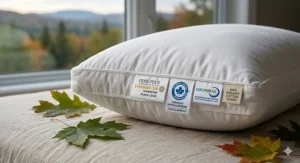
Here’s what most buyers overlook: “hypoallergenic” isn’t a regulated term in Canada. Any manufacturer can slap that label on their product without third-party verification. What you need is a certified hypoallergenic pillow with legitimate testing from independent organizations like OEKO-TEX, which verifies that materials are free from harmful substances including formaldehyde, heavy metals, and common allergens.
This guide cuts through the marketing noise to identify pillows with actual certifications, real customer feedback from Canadian buyers, and materials proven to resist dust mites. Whether you’re battling seasonal allergies in Vancouver’s damp climate or managing year-round sensitivities in Toronto’s urban environment, you’ll find options that work in Canadian conditions—complete with pricing in CAD and availability on Amazon.ca.
Quick Comparison: Top Certified Hypoallergenic Pillows Available in Canada
| Pillow | Certification | Fill Type | Price Range (CAD) | Best For |
|---|---|---|---|---|
| Amazon Basics Cotton Protector | OEKO-TEX Standard 100 | 100% Cotton Cover | $30-$40 | Budget-conscious buyers needing basic protection |
| Helix Adjustable | Third-party tested | Gel microfiber + support layer | $100-$130 | All sleeping positions, customizable loft |
| DOWNLITE Soft Down | Hypoallergenic certified | 550 fill white duck down | $80-$110 | Stomach sleepers, natural materials |
| Bamboo Shredded Memory Foam | Dust mite resistant | Shredded latex alternative | $50-$70 | Side sleepers, cooling needs |
| Gel Fiber Pillow (2-Pack) | Hypoallergenic tested | Microgel polyester | $45-$65 | Back sleepers, value seekers |
| Looms & Linens Made in USA | Premium materials | Down alternative polyester | $50-$75 per pair | Firm support, spinal alignment |
| Serta Down Illusion | Certified soft/medium | Down alternative fill | $60-$85 | Multi-position sleepers |
💬 Just one click — help others make better buying decisions too! 😊
Top 7 Certified Hypoallergenic Pillows: Expert Analysis for Canadian Buyers
1. Amazon Basics 100% Cotton OEKO-TEX Certified Pillow Protector
If you want verifiable allergen protection without spending a fortune, this is where you start. The Amazon Basics protector carries OEKO-TEX Standard 100 certification—meaning every component from fabric to zipper has been independently tested for over 100 harmful substances. The tight-weave 100% cotton construction measures 51 cm × 66 cm (20″ × 26″) and creates a physical barrier against dust mites without the crinkly plastic feel of cheaper protectors.
What the spec sheet won’t tell you: this protector works best as part of a two-layer defence system in Canadian homes. During winter months when humidity drops below 40% (common in heated homes across Calgary to Halifax), dust mites become less active, but they’re still present in your pillow’s core. The cotton weave blocks them from reaching your face while remaining breathable enough to prevent the sweaty, overheated feeling that drives many Canadians to abandon protectors entirely.
Canadian buyers consistently praise the zipper quality—it actually stays closed through the night, unlike budget alternatives where zippers separate and defeat the entire purpose. The white colour shows dirt easily, which sounds like a drawback but actually helps you maintain a washing schedule. Machine washable and dryer-safe on low heat, it survives Canadian hard water without significant shrinkage.
Pros:
✅ OEKO-TEX Standard 100 certified (verifiable at oeko-tex.com)
✅ Tight cotton weave blocks allergens while breathing
✅ Durable zipper withstands repeated washing
Cons:
❌ Protector only—you still need an actual pillow inside
❌ White fabric shows stains (requires regular washing)
Price & Verdict: Around $30-$40 CAD. Best value for Canadians who want certified protection for their existing pillows without buying an entirely new sleep system.

2. Helix Adjustable Pillow with Customizable Support
The Helix Adjustable tackles the problem that plagues most hypoallergenic pillows: they’re designed for one sleeping position, forcing side sleepers to tolerate flat pillows or stomach sleepers to deal with neck-craning loft. This pillow ships with a removable gel microfiber support insert that you can add or keep out depending on your needs. Side sleepers and back sleepers keep the insert for 18-20 cm (7-8″) of loft; stomach sleepers remove it for a flatter profile.
Here’s the practical reality Canadian buyers face: the outer layer is soft gel microfiber that provides cushioning and resists dust mite colonisation better than traditional down. The 100% cotton cover is machine washable, which matters enormously during spring allergy season when pollen infiltrates even urban condos through HVAC systems. After washing, the pillow regains its shape without the clumping issues that plague cheaper polyester fills.
What most reviews don’t mention: this pillow has a break-in period of about two weeks. Initially, the support layer feels stiff, almost board-like. Canadian customers in Regina and Winnipeg report needing to “work” the pillow—fluffing it nightly—before it softens to a comfortable balance of support and sink. If you’re switching from a down pillow, prepare for an adjustment.
Pros:
✅ Adjustable height suits all sleeping positions
✅ Machine-washable cotton cover
✅ Gel microfiber resists dust mites naturally
Cons:
❌ Requires 2-week break-in period for optimal comfort
❌ Higher price point for synthetic materials
Price & Verdict: In the $100-$130 CAD range. Worth the investment if you switch sleeping positions throughout the night or share a bed with someone who has different loft preferences.
3. DOWNLITE Hypoallergenic Soft Down Pillow
Natural down gets a bad reputation in allergy circles, but DOWNLITE addresses this with 550 fill power white duck down that’s been triple-washed to remove allergens and encased in 230-thread-count cambric cotton. The result is a pillow that delivers the customizable comfort of real down—the fill moves where you need it—without triggering reactions in most sensitive sleepers.
The “soft density” designation is critical here: this isn’t a fluffy cloud. It’s intentionally flat, measuring roughly 5-7 cm when compressed, making it ideal for stomach sleepers or Canadians who pile multiple pillows and want a thin base layer. The loose-blown filling redistributes as you move, unlike memory foam that locks you into position. During Canadian winter nights when you’re burrowed under heavy duvets, this pillow doesn’t add extra insulation that leads to overheating.
Customer feedback from Canadian buyers: the pillow arrives compressed and takes 24-48 hours to fully loft. Some buyers in humid coastal climates (Vancouver, Halifax) report a faint down odour initially, which dissipates after airing. The pillow is machine washable and dryable—rare for down products—but requires low heat and thorough drying (minimum 2-3 cycles) to prevent mildew in the fill.
Pros:
✅ Hypoallergenic certified 550 fill down
✅ Customizable comfort—fill moves to where needed
✅ Machine washable and dryable
Cons:
❌ Very flat profile unsuitable for side sleepers
❌ Requires proper drying technique to avoid mildew
Price & Verdict: Around $80-$110 CAD. Best for stomach sleepers seeking natural materials with verified allergen removal, or as a secondary pillow for multi-pillow setups.
4. Bamboo Shredded Memory Foam Pillow with Cooling Cover
This pillow addresses two Canadian complaints simultaneously: allergen sensitivity and night sweats during shoulder season when you can’t quite justify turning on the AC. The shredded memory foam fill is encased in a bamboo-derived rayon cover with micro-venting that creates airflow channels. Unlike solid memory foam, the shredded design prevents heat buildup while the bamboo viscose wicks moisture away from your face.
What makes this hypoallergenic in practice: the dense foam structure doesn’t provide the fibrous spaces where dust mites colonise. The inner zipper lets you adjust the fill amount—critical because the pillow ships overstuffed. Canadian buyers across climate zones report removing 20-30% of the fill initially, then adding it back after 6-12 months as the foam compresses. This adjustability extends the pillow’s useful life well beyond the typical 1-2 year replacement cycle.
The bamboo cover is machine washable, but here’s the catch: it shrinks slightly (approximately 3-5%) even on cold wash/air dry. Canadian buyers with standard 51 cm × 66 cm (20″ × 26″) pillowcases find the cover fits snugly after washing, which actually helps contain the fill better. The cover alone provides dust mite resistance; combined with the foam, you’re getting dual-layer protection.
Pros:
✅ Adjustable fill amount for personalized loft
✅ Bamboo cover provides cooling and moisture-wicking
✅ Shredded foam prevents dust mite colonisation
Cons:
❌ Bamboo cover shrinks slightly after washing
❌ Off-gassing smell for first 2-3 days (common with memory foam)
Price & Verdict: Around $50-$70 CAD. Ideal for Canadian side sleepers who run hot at night and need both allergen protection and temperature regulation.
5. Gel Fiber Pillows (2-Pack) with 100% Cotton Sateen Cover
At roughly $27 per pillow in a 2-pack configuration, these deliver the best hypoallergenic value on Amazon.ca if you’re replacing multiple pillows or furnishing a guest room. The 100% microgel polyester fill mimics down’s soft, silky texture without the allergenic proteins found in feathers. The 233-thread-count sateen cotton cover provides a smooth, cool surface that’s less abrasive on sensitive skin than standard cotton weaves.
Here’s the real-world Canadian performance: these pillows excel for back sleepers and stomach sleepers who prefer medium support. Side sleepers find them too compressible—you’ll sink through to the mattress unless you stack two, which defeats the budget advantage. The “great loft recovery” claim is accurate for the first 8-12 months; after that, the fill begins to compress permanently, particularly in high-use situations (nightly sleepers vs. guest room pillows).
The machine washable/dryable feature is where these shine in Canadian households. Unlike specialty pillows requiring hand washing or professional cleaning, you can throw these in with regular laundry, wash on hot to kill dust mites, and tumble dry on medium. This ease of maintenance means you’re more likely to actually clean them regularly—which matters more for allergen control than the fanciest materials left unwashed for months.
Pros:
✅ Exceptional value at approximately $55 for 2 pillows
✅ Machine washable on hot, tumble dry safe
✅ Down-alternative feel without allergens
Cons:
❌ Loft degrades after 8-12 months of nightly use
❌ Too flat for dedicated side sleepers
Price & Verdict: Around $45-$65 CAD for the pair. Perfect for Canadian households replacing multiple pillows simultaneously or anyone prioritizing easy maintenance over long-term durability.
6. Looms & Linens Made in USA King Size Firm Pillows (Set of 2)
These 51 cm × 91 cm (20″ × 36″) king-size pillows deliver the firm support that side sleepers and people with neck issues desperately need but struggle to find in hypoallergenic options. The premium polyester fiber filling is generously packed—these pillows don’t compress into pancakes after two weeks—and covered in a poly-cotton blend that’s soft without feeling synthetic.
What differentiates these from cheaper alternatives: they’re made-to-order in the USA rather than warehoused, which means you receive fresh, fluffy pillows that haven’t been compressed in storage for months. Canadian buyers note they arrive vacuum-sealed and expand to full size within 4-6 hours. The hand-stitched construction means seams don’t split along stress points, a common failure mode in pillows that get squeezed between knees, hugged during sleep, or used as reading backrests.
The hypoallergenic designation here refers to the polyester fill, which doesn’t harbour dust mites or mould like natural materials can. However, these lack third-party certification—there’s no OEKO-TEX or equivalent stamping the product “tested for harmful substances.” For Canadian buyers with severe chemical sensitivities, this might be a dealbreaker. For those simply avoiding feathers and down proteins, the polyester fill provides adequate allergen resistance.
Pros:
✅ Firm support maintains shape long-term
✅ Made-to-order ensures fresh, fluffy arrival
✅ King size ideal for body pillows or side sleeping
Cons:
❌ No third-party certification (OEKO-TEX, etc.)
❌ Poly-cotton blend may feel synthetic to some
Price & Verdict: Around $50-$75 CAD for the set of 2. Best for Canadians prioritizing firmness and spinal alignment over certifications, or those using pillows beyond just head support (body pillows, pregnancy support, etc.).
7. Serta Down Illusion Soft/Medium Hypoallergenic Pillows (2-Pack)
Serta brings hotel-brand recognition to the hypoallergenic space with these soft/medium density pillows designed for combination sleepers—people who shift between side, back, and stomach positions throughout the night. The down-alternative fill uses hollow-core fibers that trap air for insulation without the weight or allergens of real down, making them suitable for year-round use across Canada’s extreme temperature swings.
The soft/medium firmness hits a sweet spot that polarizes buyers: those who want adaptability love it, while dedicated side sleepers or stomach sleepers find it too middle-ground. In practical Canadian terms, if you’re someone who starts the night on your back, rolls to your side, and ends up face-down by morning, this pillow accommodates all three without requiring you to flip it or add/remove fill. The trade-off is that it doesn’t excel at any single position.
Durability feedback from Canadian customers: these pillows maintain loft for 10-14 months with regular fluffing, then begin to flatten noticeably. At the 18-month mark, most buyers report replacing them. That’s actually reasonable for a $30-$40 per pillow investment (in the 2-pack). The pillows are machine washable, though frequent washing (more than monthly) accelerates the loft degradation.
Pros:
✅ Soft/medium density accommodates multiple sleeping positions
✅ Down-alternative provides insulation without allergens
✅ Serta brand reliability
Cons:
❌ Loft flattens after 10-14 months
❌ Not optimal for dedicated single-position sleepers
Price & Verdict: Around $60-$85 CAD for the 2-pack (King size). Best for restless Canadian sleepers who change positions frequently or couples with different firmness preferences sharing a bed.
How These Pillows Combat Allergies in Canadian Homes: Real-World Performance
Canadian homes face unique allergen challenges that make certified hypoallergenic pillows particularly valuable. During winter, when windows stay sealed for 4-6 months across most of the country, indoor humidity drops to 20-30% in heated spaces. Health Canada’s research on dust mites shows these conditions slow mite reproduction but don’t eliminate them—they’re dormant, not dead, waiting for spring humidity to return.
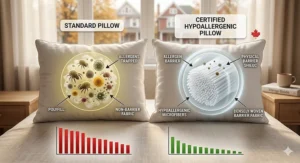
The pillows above address this through three mechanisms. First, tight-weave covers (like the OEKO-TEX certified cotton on Amazon Basics) create a physical barrier that prevents mites from reaching your airways even when they’re present in the pillow core. Think of it as allergen containment rather than allergen elimination. Second, synthetic fills (gel microfiber, memory foam, down alternative) lack the organic proteins that dust mites feed on, making these pillows inhospitable hosts compared to traditional down or wool.
Third, and most overlooked by Canadian buyers: washability in hot water. Health Canada recommends washing bedding at 60°C (140°F) or higher to kill dust mites. Pillows like the Gel Fiber and Serta options tolerate hot-water washing and high-heat drying without degrading, allowing you to perform the thermal shock treatment that actually reduces allergen loads. Compare that to specialty latex or high-end down pillows requiring delicate care—technically hypoallergenic materials, but practically difficult to maintain at allergen-killing temperatures.
During spring thaw, when Canadian homes ventilate and humidity returns, these pillows prove their worth. The bamboo and gel covers provide moisture-wicking that prevents the damp microclimate where mites thrive. In coastal cities like Vancouver and Halifax where year-round humidity exceeds 60%, this moisture management becomes the primary allergen defence rather than a secondary benefit.
Certified vs. Claimed: Understanding Hypoallergenic Standards in Canada
Here’s the uncomfortable truth: Health Canada doesn’t regulate the term “hypoallergenic” for bedding products. Unlike medications or food labelling, where allergen claims require government approval, any pillow manufacturer can print “hypoallergenic” on their packaging without proving it. This creates a market flooded with misleading claims and forces you to become your own certification detective.
What actually matters for Canadian allergy sufferers: third-party testing from organizations like OEKO-TEX, which verifies that textiles contain no harmful substances above trace levels. Their Standard 100 certification tests for over 100 chemicals including formaldehyde, heavy metals, pesticides, and allergen-causing dyes. When you see “OEKO-TEX Standard 100 certified” with a verifiable certificate number (checkable at oeko-tex.com), you’re getting independent laboratory confirmation, not manufacturer promises.
CertiPUR-US certification applies specifically to foam products and guarantees they’re made without ozone depleters, flame retardants, heavy metals, and formaldehyde. For memory foam pillows popular in Canada, this certification ensures the off-gassing you smell initially contains only VOCs below strict limits—unpleasant but not harmful. GOTS (Global Organic Textile Standard) and GOLS (Global Organic Latex Standard) certify organic material sourcing, which indirectly supports hypoallergenic claims by eliminating pesticide residues that can trigger sensitivities.
The Canadian-specific angle: while these are international certifications, products sold through Amazon.ca or Canadian retailers still benefit from Canada’s product safety regulations under the Canada Consumer Product Safety Act. If a pillow causes allergic reactions despite hypoallergenic claims, you have recourse through the Competition Bureau of Canada for misleading advertising—though that’s cold comfort when you’re already suffering symptoms. Better to verify certifications upfront than rely on regulatory enforcement after the fact.

Synthetic vs. Natural Fill Materials: What Works Best in Canadian Climates
Canadian buyers face a climate paradox: we need pillows that insulate during -30°C Winnipeg winters without overheating during 35°C Toronto summers. This pushes the synthetic vs. natural fill debate beyond theoretical preferences into practical performance territory.
Natural fills (down, wool, cotton, kapok, latex) offer superior breathability and temperature regulation through their complex fiber structures. Down clusters create dead air pockets that insulate without weight—ideal for unheated bedrooms in rural Canada where you’re sleeping in near-freezing conditions. The moisture-wicking properties of wool help when you’re bundled under heavy duvets and wake up sweating. However, natural materials require more maintenance in Canadian hard-water regions (Calgary, Regina), where mineral deposits can degrade fibers over time. The hypoallergenic claim for natural fills depends entirely on processing—untreated down contains allergenic proteins, while triple-washed, certified down (like DOWNLITE’s 550 fill) has these allergens removed.
Synthetic fills (polyester, gel microfiber, memory foam, down alternative) excel at consistent performance across temperature extremes. A gel fiber pillow performs identically at -20°C storage and 25°C room temperature, while natural down can clump when exposed to humidity changes common during Canadian spring thaw. Synthetic materials are inherently hypoallergenic because they lack the organic proteins that trigger most sensitivities, though they can still harbour dust mites if not properly maintained. The trade-off: they don’t breathe as effectively, which can mean night sweats during summer heat waves when air conditioning isn’t available (still common in older Canadian homes).
The climate-specific recommendation: Coastal Canadians (Vancouver, Victoria, Halifax, St. John’s) dealing with year-round humidity benefit from synthetic fills that resist moisture absorption and mold growth. Prairie residents (Winnipeg, Regina, Saskatoon) facing extreme dry cold should consider natural fills for breathability, paired with mite-proof covers for allergen control. Central Canadians (Toronto, Montreal, Ottawa) experiencing four distinct seasons gain the most from adjustable options like the Helix, where you can modify loft and breathability as seasons change.
Medical Grade Certification: What It Actually Means for Allergy Prevention
The term “medical grade” appears frequently in pillow marketing, but in Canada’s regulatory environment, it carries less weight than you’d expect. Unlike medical devices that require Health Canada approval and licencing, pillows fall under general consumer product safety regulations. “Medical grade” typically refers to materials meeting ISO 10993 biocompatibility standards (used for products contacting human tissue) or OEKO-TEX Standard 100 Class I certification (the strictest classification, designed for baby products and items in direct skin contact).
What this means practically: a pillow with genuine medical-grade materials has been tested to ensure it won’t cause skin irritation, allergic contact dermatitis, or chemical sensitivities in the majority of users. The testing involves human skin patch testing, cytotoxicity screening, and allergen identification—substantially more rigorous than a manufacturer simply claiming their polyester fill is “hypoallergenic.” For Canadians with diagnosed allergies (confirmed through skin prick testing or IgE blood tests), medical-grade certification provides evidence-based reassurance rather than marketing hype.
However, medical-grade materials don’t automatically translate to dust mite resistance or allergen prevention—they address chemical sensitivity, not biological allergens. A pillow can be medical-grade certified yet still harbour dust mites if not paired with a protective cover. This is where Health Canada’s guidance on “house dust mite-impermeable covers” becomes critical. The government agency specifically recommends encasing pillows in covers that prevent mite penetration, regardless of the pillow’s internal materials.
For clinical allergy prevention, look for third-party tested materials combined with barrier protection. The Amazon Basics OEKO-TEX protector provides the barrier; the pillow inside provides the comfort. Products claiming “clinical allergy prevention” should reference specific studies—ideally peer-reviewed research demonstrating reduced allergen exposure, not testimonials or marketing-funded research. Canadian buyers can verify claims through the Canadian Allergy, Asthma and Immunology Foundation website, which provides evidence-based guidance separate from product marketing.
Real Canadian User Scenarios: Matching Pillows to Your Sleep Profile
Scenario 1: Urban Condo Dweller in Toronto – Multi-Floor Living, Forced Air Heating
Profile: You live in a 12-storey building with centralized HVAC that you can’t control individually. Winter indoor humidity hovers around 25%, and you wake up with dry sinuses and post-nasal drip. Budget: $150 CAD for 2 pillows.
Best Match: Helix Adjustable Pillow (Standard, $100-$130 CAD) + Amazon Basics OEKO-TEX Protector ($30-$40 CAD)
Reasoning: The forced-air heating in Toronto condos creates dust circulation that aggravates allergies even in well-maintained units. The Helix’s machine-washable cotton cover lets you clean it monthly during peak heating season (November-March) without degrading the pillow. The adjustable insert accommodates the tossing and turning that happens when you’re uncomfortable from dry air. Add the OEKO-TEX protector as a second barrier against building-wide dust, and you’ve created a layered defence system. The combined cost sits just under $150, leaving room for a second protector if needed.
Scenario 2: Suburban Family in Calgary – Two Kids with Asthma, Budget Constraints
Profile: You’re replacing pillows for a family of four. Both children have diagnosed asthma triggered by dust mites. You need bulk value without compromising allergen protection. Budget: $250 CAD total.
Best Match: Gel Fiber Pillows 2-Pack × 2 ($45-$65 CAD each pack) + Amazon Basics Protectors × 4 ($30-$40 CAD each)
Reasoning: The math works out to roughly $50-60 per person for complete pillow + protector coverage. The Gel Fiber pillows tolerate the hot-water washing that Health Canada recommends for killing dust mites (60°C+), which is critical in a household managing pediatric asthma. The polyester fill doesn’t degrade with frequent washing like natural materials would. Calgary’s dry climate reduces moisture concerns, so you don’t need the premium moisture-wicking features of bamboo covers. Replace the pillows annually and wash weekly during high-allergen seasons—this budget approach becomes more cost-effective than buying expensive pillows that kids outgrow or destroy anyway.
Scenario 3: Coastal British Columbia Sleeper – Humidity, Mold Risk, Side Sleeping Preference
Profile: You live in Vancouver or Victoria where year-round humidity stays above 60%. You’ve had mold issues in previous pillows, especially during rainy season (October-April). You’re a dedicated side sleeper needing firm support. Budget: $200 CAD for one premium pillow.
Best Match: Bamboo Shredded Memory Foam Pillow ($50-$70 CAD) with extra fill removed, plus regular rotation
Reasoning: The bamboo rayon cover actively wicks moisture away from your face, reducing the damp microclimate where mold spores germinate. The shredded memory foam (versus solid foam) provides airflow channels that prevent the trapped-moisture problem endemic to coastal Canadian sleeping. As a side sleeper, you’ll keep most of the adjustable fill for loft, but removing 10-15% improves breathability without sacrificing support. The key maintenance strategy for coastal climates: rotate between two pillows weekly, allowing each one to fully dry between uses. At $65 per pillow, buying two and alternating them ($130 total) proves more effective than one $200 pillow used continuously in humid conditions.
Scenario 4: Rural Manitoba/Saskatchewan – Extreme Cold, Limited Retail Access, Heating Cost Concerns
Profile: You heat primarily with a wood stove or keep the thermostat at 16°C overnight to save on heating bills. You need a pillow that provides warmth without weight, and Amazon delivery is your primary shopping method since you’re 90+ minutes from major retailers.
Best Match: DOWNLITE Soft Down Pillow ($80-$110 CAD) with flannel pillowcase
Reasoning: In rural Prairie homes where bedroom temperatures drop to 10-12°C overnight, down’s insulating properties without bulk become essential comfort factors. The 550 fill power provides warmth-to-weight ratio unmatched by synthetics, letting you stay comfortable without piling on heavy pillows that strain your neck. The hypoallergenic certification addresses concerns about down allergens, while the machine washability means you can maintain it yourself without access to specialty dry cleaners. Pair it with a tightly-woven flannel pillowcase (not included, but available at any Canadian Tire for $10-15) for additional dust mite protection and extra warmth against your cheek during February’s deep freeze.
Common Mistakes Canadian Buyers Make (And How to Avoid Them)
Mistake #1: Ignoring Winter Performance Impact on Battery… Er, Breathing
Many Canadians buy hypoallergenic pillows during summer, when windows are open and allergen loads seem manageable, then abandon them in winter when “they don’t work.” What’s actually happening: closed-house conditions during heating season concentrate allergens, but buyers blame the pillow instead of increasing washing frequency. The fix: wash pillows every 2 weeks during winter (November-March) instead of monthly. Hot water (60°C+) kills dormant dust mites before spring humidity reactivates them.
Mistake #2: Choosing Covers Based on Thread Count Instead of Weave Tightness
High thread count sounds premium, but for allergen protection, you need tightly-woven fabric regardless of thread count. A 180-thread-count tightly-woven cotton cover (like Amazon Basics OEKO-TEX) blocks more dust mites than a loosely-woven 400-thread-count sateen that feels luxurious but has gaps at the microscopic level. Canadian buyers over-index on thread count because it’s an easy number to compare, missing the functional requirement. The fix: look for “tightly woven” or “dust mite impermeable” specifications, or check if the fabric holds water when you pour a small amount on it (a home test for weave tightness).
Mistake #3: Expecting One Pillow Type to Work Year-Round Across Canada’s Climate Extremes
A pillow optimized for July humidity in Toronto becomes uncomfortably warm during January’s dry-heat conditions, and vice versa. Canadians who invest in expensive “all-season” pillows often find them mediocre in all seasons rather than excellent in any. The fix: budget for two mid-range pillows suited to summer and winter conditions ($50-70 each) rather than one $150 pillow promising year-round performance. Store the off-season pillow in a breathable cotton bag (never plastic, which traps moisture and encourages mold) in a cool, dry location.
Mistake #4: Failing to Account for Shipping Restrictions to Rural/Northern Canada
Amazon.ca lists many products as “available” that don’t actually ship to postal codes in Northern Ontario, rural Maritimes, or anywhere beyond the densest population corridors. Canadian buyers in these regions order pillows only to discover at checkout that shipping isn’t available, forcing them to settle for inferior local options or pay prohibitive freight costs. The fix: before falling in love with a product, add it to your cart and proceed to shipping to verify delivery to your postal code. If unavailable, search “ships to [your region]” in product filters, or focus on brands like Amazon Basics that ship nationwide.
Mistake #5: Overlooking Provincial Tax Differences in Listed Prices
A pillow listed at $65 CAD costs different amounts depending on your province: $74.75 in Ontario (15% HST), $72.80 in British Columbia (12% GST+PST), $66.58 in Alberta (2% GST only). Buyers budgeting tightly get surprised at checkout, particularly when replacing multiple pillows. The fix: calculate total cost including provincial taxes before committing, and remember that Amazon.ca’s “free shipping” thresholds apply to pre-tax totals, not final costs.
Third-Party Testing: Decoding Certifications That Actually Matter
Walk through the certification alphabet soup and most Canadian buyers glaze over—OEKO-TEX, GOTS, GOLS, CertiPUR-US, eco-INSTITUT, GREENGUARD Gold. Here’s what you actually need to know: these aren’t interchangeable. Each tests for specific concerns, and stacking certifications matters more than any single stamp of approval.
OEKO-TEX Standard 100 (seen on Amazon Basics protector) tests finished textiles for harmful substances including formaldehyde, heavy metals, allergen-causing dyes, and over 100 restricted chemicals. “Class I” certification (most restrictive) means safe for babies and toddlers—if it passes for infants, it’s safe for adult allergy sufferers. Verify certificates at oeko-tex.com using the product’s certificate number; fake certifications exist, particularly from overseas sellers on Amazon.ca’s marketplace.
CertiPUR-US applies exclusively to polyurethane foam products. It certifies foam is made without ozone depleters, PBDE flame retardants, mercury/lead/heavy metals, formaldehyde, and phthalates. Critically for Canadian buyers concerned about air quality in sealed winter homes, it limits VOC emissions to 0.5 ppm—you’ll still smell a “new foam” odour initially, but it dissipates within 72 hours and isn’t harmful. Verify at certipur.us.
GOTS (Global Organic Textile Standard) certifies organic fiber processing from harvest through manufacturing. This matters if you’re sensitive to pesticide residues in conventional cotton or seeking environmental sustainability, but it doesn’t directly test for allergens or dust mite resistance. It’s a quality indicator and environmental certification, not a hypoallergenic proof.
eco-INSTITUT (German certification) tests for emissions, particularly VOCs and odours in finished products. Less common on Amazon.ca products but occasionally seen on premium European brands. It complements OEKO-TEX by focusing on what the product releases into air rather than what chemicals it contains.
For Canadian allergy sufferers, prioritize this combination: OEKO-TEX Standard 100 for chemical safety + tight weave or impermeable barrier for dust mite protection + washability at 60°C for allergen elimination. Certifications verify the first component; the physical barrier handles the second; your washing machine addresses the third. Products with all three characteristics outperform single-certification “medical grade” pillows lacking practical maintenance features.
Long-Term Cost Analysis: Replacement Cycles and Canadian Maintenance Reality
Most pillow manufacturers recommend replacement every 18-24 months, but Canadian usage patterns and climate factors often shorten or extend this timeline. Here’s the honest financial breakdown across different pillow types available on Amazon.ca, accounting for replacement costs and maintenance.
Budget Synthetic Pillows (Gel Fiber, basic down alternative: $25-35 CAD each)
- Expected lifespan with proper care: 12-18 months
- Annual cost: $17-35 per pillow
- Maintenance: Machine wash monthly ($0 if washing with regular laundry), tumble dry on medium
- Canadian reality check: These degrade faster in dry Prairie winters (static damage to fibers) and humid coastal climates (moisture retention despite synthetic fill). Budget buyers replacing annually actually spend more over 5 years than mid-range buyers who replace every 2-3 years.
Mid-Range Certified Pillows (Helix, DOWNLITE, Bamboo Memory Foam: $50-110 CAD each)
- Expected lifespan with proper care: 24-36 months
- Annual cost: $17-55 per pillow
- Maintenance: Machine wash every 2-4 weeks, some require delicate cycle/air dry (adds time cost)
- Canadian reality check: These justify their premium in households running forced-air heating 6+ months yearly. The superior materials tolerate repeated washing cycles required for Canadian allergen management without the loft collapse plaguing budget options. However, improper drying (common mistake: overdrying memory foam) can shorten lifespan to under 2 years.
Premium Organic/Specialty Pillows (Not extensively covered here, but available: $150-250 CAD)
- Expected lifespan with proper care: 36-60 months
- Annual cost: $30-70 per pillow
- Maintenance: Often hand-wash only or professional cleaning required ($15-25 per cleaning)
- Canadian reality check: The “investment” pillow becomes expensive when you factor in professional cleaning costs ($60-100 annually for 4-6 cleanings) or risk of damage from DIY washing. For allergy management requiring frequent cleaning, these are often less economical than mid-range washable options despite longer material lifespan.
Protector Costs (Essential for any fill type: $30-40 CAD each)
- Expected lifespan: 18-24 months with monthly washing
- Annual cost: $15-27 per protector
- Canadian reality check: Protectors wear out faster than the pillows they protect because they endure more washing cycles. Budget for protector replacement every 18 months regardless of pillow longevity. Skip this cost and you’ll replace pillows twice as often, negating any savings.
Total Cost of Ownership Example (3-Year Period, 2 Pillows):
- Budget route: 2 × $30 pillows replaced annually (6 pillows over 3 years) + 4 protectors = $260 CAD
- Mid-range route: 2 × $65 pillows replaced every 2 years (4 pillows over 3 years) + 4 protectors = $390 CAD
- Effective difference: $43 per year for notably better allergen protection, durability, and sleep quality
The Canadian-specific factor affecting all these calculations: hard water in Calgary, Regina, and many rural areas degrades fabrics faster than soft water regions. If your municipality has hard water, add 15-20% faster wear to all textile lifespan estimates unless you install a water softener. Municipal water quality reports are available through your city’s website or canada.ca.
❓ Frequently Asked Questions
❓ Can hypoallergenic pillows eliminate all allergy symptoms in Canadian winters?
❓ How often should I replace hypoallergenic pillows in Canada's varying climates?
❓ Are OEKO-TEX certified pillows worth the extra cost for mild allergies?
❓ Can I use dryer sheets when washing hypoallergenic pillows?
❓ Do hypoallergenic pillows work with Canadian seasonal allergies (pollen)?
Conclusion: Making the Right Certified Hypoallergenic Pillow Choice for Your Canadian Home
The path to better sleep and reduced allergy symptoms in Canada doesn’t require spending $200+ on specialty pillows imported from Europe. What works consistently across Canadian climates and budgets: third-party certification (OEKO-TEX, CertiPUR-US) for chemical safety + materials proven to resist dust mites (tight-weave cotton, synthetic fills, or specially processed natural materials) + hot-water washability for regular allergen elimination.
For most Canadian households, the winning combination is a mid-range certified pillow ($50-110 CAD) matched to your sleeping position, wrapped in an OEKO-TEX protector ($30-40 CAD), and washed every 2-4 weeks at 60°C during high-allergen seasons. This approach costs $80-150 per pillow upfront but delivers 24-36 months of verified allergen protection rather than replacing cheap “hypoallergenic” pillows annually at $60-80 per cycle.
The climate-specific guidance: coastal Canadians prioritize moisture-wicking covers (bamboo, gel microfiber) to combat humidity; Prairie residents need breathable natural fills or adjustable synthetics to handle extreme temperature swings; urban dwellers in high-rise buildings benefit from washable options that tolerate frequent cleaning required in forced-air environments. Budget-conscious buyers replacing multiple pillows should focus on the Gel Fiber 2-packs for value, while single-pillow buyers gain more from investing in adjustable options like Helix.
Remember that Health Canada’s guidance on dust mite prevention emphasizes encasement in impermeable covers as the primary defence—the pillow fill provides comfort and additional protection, but the cover does the heavy lifting for allergen control. Don’t skip the protector to save $30 CAD, or you’ll undermine the entire hypoallergenic benefit of certified fill materials.
Your sleep quality and respiratory health justify the investment in verified certifications rather than marketing claims. Start with the Amazon Basics OEKO-TEX protector if budget is tight, then upgrade your pillow fill as finances allow. The layered approach works better than an expensive unprotected pillow.
📚 Recommended for You
- 7 Best Allergen Free Pillow Canada 2026 – Stop Asthma Triggers
- 7 Best Pillows for Dust Mite Allergies Canada 2026
- Best Hypoallergenic Pillow Canada 2026: 7 Expert Picks
Disclaimer: This article contains affiliate links. As an Amazon Associate, I earn from qualifying purchases. If you purchase products through these links, we may earn a small commission at no additional cost to you.
✨ Found this helpful? Share it with your friends! 💬🤗
