
In This Article
Ever wake up with a stiff neck, wondering if your pillow’s to blame? You’re not alone. According to research published by the National Institutes of Health, pillow height directly affects cervical spine alignment and is closely related to the mechanical environment of your neck during sleep. An inappropriate pillow height can lead to musculoskeletal problems, including neck pain and muscle stiffness—issues that affect thousands of Canadians every night.

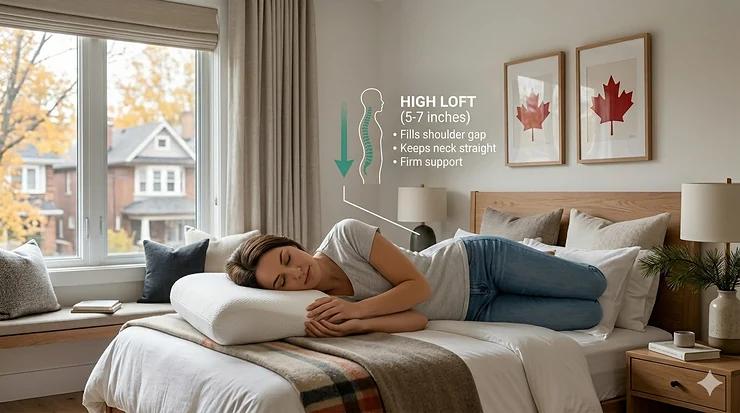
Here’s the thing: your sleep position dictates your ideal pillow height. Side sleepers need more loft to fill the shoulder gap, back sleepers require medium support, and stomach sleepers (sorry, but you’re sleeping in the worst position) need something flatter. Yet most Canadians are using pillows that weren’t designed for their specific needs.
This comprehensive pillow height guide for sleep positions will walk you through everything—from measuring loft correctly to choosing the right pillow based on whether you’re sprawled on your back or curled up on your side. We’ve tested products available on Amazon.ca, analyzed the science, and gathered feedback from Canadian buyers to bring you actionable advice you can use tonight.
Let’s fix that neck pain and transform your sleep, shall we?
Quick Comparison Table
| Pillow Type | Height Range | Best For | Price (CAD) | Rating |
|---|---|---|---|---|
| Osteo Cervical Pillow | Adjustable 4-6″ | Side/Back Sleepers | $45-65 | 4.3/5 |
| DONAMA Ergonomic Pillow | Dual-height 4-5.5″ | All Positions | $40-55 | 4.2/5 |
| UTTU Sandwich Pillow | 3.2-5.2″ | Side/Back Sleepers | $50-70 | 4.4/5 |
| Coop Home Goods Adjustable | Custom 3-7″ | Combo Sleepers | $70-90 | 4.5/5 |
| Pancake Pillow | 1-6 layers adjustable | All Sleepers | $80-100 | 4.1/5 |
| Buckwheat Pillow | Adjustable 3-6″ | Traditional Preference | $55-75 | 4.0/5 |
| Memory Foam Contour | Fixed 3.7-5.3″ | Back Sleepers | $35-50 | 4.2/5 |
💬 Just one click – help others make better buying decisions too! 😊
✨ Don’t Miss These Exclusive Deals!
🔍 Take your sleep to the next level with these carefully selected products available in Canada. Click on any highlighted item to check current pricing and availability on Amazon.ca. These tools will help you create authentic restful nights your body will love!
Top 7 Pillow Height Guide for Sleep Positions: Expert Analysis
1. Osteo Cervical Pillow – Best Adjustable Height Option
The Osteo Cervical Pillow stands out with its unique hollow center design and dual-height system. This ergonomic marvel features two different curve heights (approximately 13 cm and 9.4 cm) that you can flip between depending on your sleep position.
Key Specifications:
- Dual-height design (high side 5.3″, low side 3.7″)
- CertiPUR-US certified memory foam
- Removable height insert for customization
- 3D mesh breathable cover
Price: $45-65 CAD on Amazon.ca
Availability: In stock with Prime shipping across Canada
Customer Feedback from Canadian Buyers:
Buyers in Ontario and BC rave about the immediate neck pain relief, though some mention a 2-week adjustment period. The hollow center design is particularly praised by those who struggled with traditional contour pillows.
✅ Pros:
- True height adjustability
- Excellent for cervical spine alignment
- Breathable cooling cover
❌ Cons:
- Initial odour (dissipates in 3-5 days)
- May feel firm for first-time memory foam users

2. DONAMA Cervical Pillow – Best Value for Multiple Sleep Positions
The DONAMA Ergonomic Pillow offers exceptional versatility with its dual-height contour design and specific grooves that allow arms to slide under comfortably—perfect for side sleepers who tuck their hands under the pillow.
Key Specifications:
- Dimensions: 24.8″L x 14.96″W x 5.51″H
- Dual-height contoured surfaces
- Arm rest grooves for side sleeping
- Machine-washable cover
Price: $40-55 CAD
Availability: Available on Amazon.ca with free shipping
Customer Feedback:
Canadian reviewers particularly appreciate the arm grooves, noting they’re a game-changer for side sleepers. Several buyers from Alberta mentioned significant reduction in shoulder pain after switching.
✅ Pros:
- Innovative arm-rest design
- Affordable price point
- Fits standard pillowcases
❌ Cons:
- Fixed dimensions (not adjustable)
- May be too high for petite individuals
3. UTTU Sandwich Pillow – Best Premium Adjustable Option
The UTTU Cervical Pillow uses UTTU DYNAMIC FOAM technology that never hardens in cold Canadian winters—a crucial feature for anyone in colder provinces. The removable middle layer provides four different height combinations.
Key Specifications:
- Adjustable from 3.2″ to 5.2″
- UTTU DYNAMIC FOAM (cold-resistant)
- Four height configurations
- Bamboo-blend breathable cover
Price: $50-70 CAD
Availability: In stock on Amazon.ca
Customer Feedback:
Buyers in Manitoba and Saskatchewan specifically praise the cold-weather performance. The pillow maintains consistent firmness even in -30°C bedroom temperatures.
✅ Pros:
- Superior cold-weather performance
- Multiple height options
- Excellent pressure relief
❌ Cons:
- Slightly higher price point
- Takes time to find ideal configuration
4. Coop Home Goods Adjustable Pillow – Best for Combination Sleepers
The Coop Home Goods pillow features shredded memory foam fill that you can add or remove to achieve your perfect loft. This makes it ideal for combination sleepers who shift positions throughout the night.
Key Specifications:
- Customizable 3-7″ loft range
- Shredded memory foam + microfiber blend
- CertiPUR-US certified
- 5-year warranty
Price: $70-90 CAD
Availability: Ships to Canada via Amazon.ca
Customer Feedback:
Toronto and Vancouver buyers appreciate the precise customization. Many report removing 20-30% of the fill initially, then fine-tuning over several nights.
✅ Pros:
- Highly customizable
- Long warranty
- Machine washable
❌ Cons:
- Can be messy to adjust
- Some find it too soft initially
5. Pancake Pillow – Best Layer System
The Pancake Pillow uses six individual pillow layers that stack like—you guessed it—pancakes. This unique system lets you add or remove layers to achieve heights from 1 inch to 6 inches.
Key Specifications:
- Six stackable layers
- 300 thread count cotton case
- Down alternative fill
- Height range: 1-6″
Price: $80-100 CAD
Availability: Available through Amazon.ca
Customer Feedback:
Canadian families love that different members can customize pillows from the same product. Some buyers keep extra layers for guests or seasonal adjustments.
✅ Pros:
- Extremely versatile
- Great for families
- Easy to modify
❌ Cons:
- Layers can shift during sleep
- Storage needed for unused layers

6. Buckwheat Pillow – Best Traditional Adjustable Option
For those preferring natural materials, buckwheat pillows offer traditional adjustable support. The hulls can be added or removed to customize height from 3 to 6 inches.
Key Specifications:
- Organic buckwheat hull fill
- Adjustable 3-6″ loft
- Breathable cotton cover
- Naturally cooling
Price: $55-75 CAD
Availability: Available on Amazon.ca
Customer Feedback:
Eco-conscious Canadians appreciate the natural materials. The rustling sound is initially noticeable but most users report adapting within a week.
✅ Pros:
- Natural and eco-friendly
- Excellent air circulation
- Moulds to head shape
❌ Cons:
- Rustling noise
- Heavier than foam pillows
7. Memory Foam Contour Pillow – Best Budget Fixed-Height Option
A standard Memory Foam Contour Pillow offers reliable cervical support at an entry-level price. While not adjustable, it provides consistent medium-high loft suitable for most back and side sleepers.
Key Specifications:
- Fixed dual heights (3.7″ and 5.3″)
- High-density memory foam
- Contoured shape
- Cooling gel infusion
Price: $35-50 CAD
Availability: Widely available on Amazon.ca
Customer Feedback:
Budget-conscious Canadian buyers find this a solid starter pillow. Many transition to adjustable options later but appreciate the low-risk entry point.
✅ Pros:
- Affordable
- No adjustment needed
- Consistent support
❌ Cons:
- No height customization
- One size doesn’t fit all
Understanding Pillow Loft Measurement Guide
What Is Pillow Loft Anyway?
Loft refers to the height or thickness of a pillow when it’s resting on a flat surface uncompressed. Think of it as the pillow’s profile. According to research from the Sleep Foundation, loft is actually more important than firmness for proper spinal alignment during sleep.
The measurements typically fall into three categories:
Low Loft: 7.5-10 cm (3-4 inches)
Best for stomach sleepers and petite individuals. This minimal height keeps the neck from angling upward unnaturally.
Medium Loft: 10-12.5 cm (4-5 inches)
Ideal for back sleepers and those with medium builds. Provides support without excessive elevation.
High Loft: 12.5-15+ cm (5-6+ inches)
Perfect for side sleepers and broad-shouldered individuals. Fills the gap between shoulder and head to maintain neutral spine alignment.
How to Measure Your Current Pillow
Measuring your pillow’s loft is straightforward:
- Place the pillow on a flat, firm surface (not your mattress)
- Let it expand to its natural state (wait 10 minutes after unwrapping)
- Use a ruler or measuring tape from the surface to the pillow’s highest point
- Measure in both uncompressed and when your head rests on it
The difference between these measurements tells you about compression—crucial for understanding how your pillow performs during actual sleep.
Body Dimension Measurements Matter
Research published in the healthcare journal by Lei et al. emphasizes that pillow height should correlate with specific body measurements. For Canadian adults, key dimensions include:
- Width from ear to shoulder (for side sleeping height)
- Length from hindbrain to wall (for supine position height)
- Neck-to-shoulder width
Most Canadian men need 12-15 cm for side sleeping, while women typically require 10-13 cm. Back sleeping requires 7-10 cm for most adults, regardless of gender.

Choosing Pillow Height by Position: The Science Behind Sleep Postures
Side Sleepers: High Loft Is Your Friend
If you’re among the 39% of Canadians who prefer side sleeping, you need the highest loft of all sleep positions. Here’s why: when you lie on your side, there’s a significant gap between your mattress and head due to shoulder width.
A 2021 study in Healthcare journal found that side sleepers require pillows with loft equivalent to their shoulder width to maintain neutral cervical spine alignment. For the average Canadian adult, this translates to 12-15 cm (approximately 5-6 inches).
Signs your pillow is too low:
- Shoulder pain upon waking
- Arm numbness during sleep
- Neck bending toward the mattress
Signs your pillow is too high:
- Neck strain in upper cervical region
- Morning headaches
- Jaw tension
The ideal side-sleeping pillow should keep your spine straight when viewed from the front—no lateral bending in the neck.
Back Sleepers: Medium Support Zone
Back sleeping is often recommended by chiropractors for its neutral spine positioning. According to Wikipedia’s entry on supine position, this position can help reduce heartburn and back pain when proper pillow height is used.
For back sleepers, the goldilocks zone is 10-12.5 cm (4-5 inches). Research from Northwestern Polytechnical University suggests that 10 cm pillow height is optimal for maintaining the physiological curvature of the cervical spine in supine position.
Key considerations:
- The pillow should support your neck’s natural curve
- Your head should be elevated enough to prevent acid reflux
- Avoid pillows so thick they push your chin toward your chest
Some back sleepers benefit from a contoured design with a bolster under the neck and a lower area for the head.
Stomach Sleepers: Go Low or Go Home
Here’s the uncomfortable truth: stomach sleeping is the least recommended position by sleep specialists. When you sleep face-down, you rotate your neck to one side for breathing, creating sustained lateral strain on cervical vertebrae.
If you absolutely cannot break this habit, use the lowest loft possible—ideally 7.5 cm (3 inches) or less. Some stomach sleepers even sleep without a pillow, which is preferable to using a thick one.
Better alternatives:
- Try transitioning to side sleeping with a body pillow
- Place a pillow under your pelvis to reduce back strain
- Gradually shift to back sleeping using positional therapy
Combination Sleepers: Adjustability Is Key
Most people don’t maintain one position all night. Research indicates that average sleepers change positions approximately 20-24 times per night.
For combination sleepers, adjustable-loft pillows are game-changers. Products like the Coop Home Goods or UTTU Sandwich allow you to modify height based on your starting position, knowing you’ll shift naturally during sleep.

Height to Body Ratio: Finding Your Perfect Match
The Anthropometric Approach
Modern pillow science uses anthropometric measurements—body dimensions that predict optimal pillow specifications. This approach, detailed in research by Chen and Cai (2012), considers:
For Side Sleeping:
- Shoulder width (ear to shoulder distance)
- Mattress firmness interaction
For Back Sleeping:
- Occipital to C7 distance
- Neck circumference
- Head depth
Quick Self-Measurement Guide
- Stand against a wall naturally, as you would stand in daily life
- For side-sleeping height: Measure from the wall to the outer edge of your shoulder
- For back-sleeping height: Have someone measure from the wall to the back of your head at its most prominent point
These measurements give you a starting baseline. Remember to account for mattress compression—softer mattresses require slightly taller pillows since your shoulder sinks deeper.
Canadian Size Averages
Based on Statistics Canada anthropometric data and adapted for sleep research:
Canadian Men:
- Side sleeping: 13-15 cm (5-6″)
- Back sleeping: 8-11 cm (3-4.3″)
Canadian Women:
- Side sleeping: 10-13 cm (4-5″)
- Back sleeping: 7-10 cm (2.75-4″)
These are averages—your individual needs may vary based on shoulder breadth, neck length, and mattress firmness.
Position-Specific Requirements: Dialing In the Details
The Shoulder Width Factor
Your shoulder width is the single most important measurement for side-sleeping pillow height. Broader shoulders create a larger gap requiring more loft to bridge.
Small Frame (shoulder width <40 cm): 10-11 cm pillow
Medium Frame (shoulder width 40-45 cm): 11-13 cm pillow
Large Frame (shoulder width >45 cm): 13-15+ cm pillow
Canadian men with athletic builds or those who work physical jobs often need custom-height pillows or highly adjustable options.
Mattress Interaction: The Missing Variable
Here’s what most guides miss: your mattress firmness dramatically affects required pillow height. Soft mattresses allow deeper shoulder sinkage in side sleeping, requiring taller pillows to compensate.
Mattress-to-Pillow Adjustment:
- Soft mattress: Add 2-3 cm to standard recommendation
- Medium mattress: Use standard recommendation
- Firm mattress: Reduce by 1-2 cm
The Temperature Factor in Canadian Homes
Pillow loft can change with temperature—an important consideration for Canadian winters. Memory foam becomes firmer in cold temperatures, effectively increasing perceived loft. Some materials like UTTU DYNAMIC FOAM resist this effect.
If you keep your bedroom below 18°C (65°F) in winter, consider this when selecting pillow materials.
Loft Measurement Standards: Industry Benchmarks Explained
Manufacturing Standards
The pillow industry doesn’t have universal measurement standards, which creates confusion. When manufacturers claim a pillow is “medium loft,” they’re using their own internal benchmarks.
Common Industry Classifications:
Low Loft:
- Thickness: ≤10 cm uncompressed
- Target: Stomach sleepers, children
- Common materials: Down, thin memory foam
Medium Loft:
- Thickness: 10-12.5 cm uncompressed
- Target: Back sleepers, combination sleepers
- Common materials: Medium-density foam, down alternative
High Loft:
- Thickness: 12.5-15+ cm uncompressed
- Target: Side sleepers, larger builds
- Common materials: Dense memory foam, layered construction
Compression Rating: The Hidden Metric
Smart pillow shoppers look beyond advertised loft to compression rate—how much the pillow compresses under head weight.
Compression categories:
Low compression (<20%): Dense foam, buckwheat
Medium compression (20-40%): Quality memory foam, latex
High compression (>40%): Down, low-density foam, polyester fill
A 15 cm “high loft” pillow that compresses 50% effectively becomes a 7.5 cm pillow under your head—barely medium loft. This is why “loft after compression” is more meaningful than uncompressed measurements.

Testing Your Own Pillow’s Compression
- Measure uncompressed height
- Lie on pillow in normal sleep position
- Have someone measure height with your head resting
- Calculate: (Uncompressed – Compressed) / Uncompressed × 100 = Compression %
If your pillow compresses more than 40%, it may not be providing adequate support.
Cervical Spine Alignment: The Health Connection
Why Alignment Matters So Much
Your cervical spine has a natural lordotic curve—a gentle C-shape when viewed from the side. Proper pillow height maintains this curve during sleep, distributing stress across vertebrae and reducing pressure on intervertebral discs.
Research from the National Center for Biotechnology Information shows that inappropriate pillow height can lead to:
- Increased cervical spine angle (forward head posture)
- Elevated muscle tension in trapezius and sternocleidomastoid
- Compressed nerve pathways
- Disrupted blood flow to the head and neck
The T1 Slope Measurement
Healthcare professionals measure cervical alignment using several parameters, with T1 slope being particularly important. Studies found that as pillow height increases, T1 slope increases and neck tilt decreases.
Optimal ranges for Canadian adults:
- T1 slope: 13-25 degrees
- Cervical Cobb angle: 10-30 degrees (normal lordosis)
- Neck tilt: 45-55 degrees
When these parameters fall outside normal ranges due to poor pillow height, you’re at increased risk for chronic neck pain.
Pressure Distribution and Blood Flow
High pressure points can affect blood circulation in subcutaneous tissue, leading to numbness and pain. Research indicates that contact pressure should remain below 4.2 kPa (kilopascals) for optimal comfort and blood perfusion.
Well-designed pillows distribute pressure evenly across:
- Occipital region (back of head)
- Cervical region (neck)
- Shoulder contact points (side sleeping)
Average pressure readings for comfortable sleep:
- Cranial region: 2-3 kPa average, 5-6 kPa peak
- Cervical region: 3-4 kPa average, 6-8 kPa peak
Common Mistakes When Choosing Pillow Height
Mistake #1: Ignoring Mattress Firmness
Many Canadians select pillows based solely on sleep position, forgetting their mattress plays a crucial role. A side sleeper on a plush mattress needs 2-3 cm more loft than the same sleeper on a firm mattress.
Solution: Test pillows on your actual mattress. What works on the showroom floor might not work at home.
Mistake #2: Confusing Firmness with Loft
“I need a firmer pillow” is often code for “I need different loft.” Firmness refers to compression resistance, while loft refers to height. A pillow can be very firm but low loft, or soft but high loft.
Solution: Identify whether you need height adjustment or support adjustment. Often, it’s the former.
Mistake #3: Not Allowing Adjustment Time
Your body needs 1-2 weeks to adapt to significant pillow height changes, especially if correcting years of poor alignment. Initial discomfort doesn’t mean the pillow is wrong—it might mean your muscles are finally getting proper support.
Solution: Give new pillows a full 14-day trial period before judging. Track morning stiffness—it should gradually improve.
Mistake #4: Using the Same Pillow for All Positions
If you’re a combination sleeper using a pillow optimized for just one position, you’re compromising support during position changes. This is why adjustable pillows exist.
Solution: Choose adjustable-loft pillows or keep different pillows nearby for different positions.
Mistake #5: Neglecting Seasonal Changes
Memory foam pillows behave differently in summer vs. Canadian winter. Temperature affects compression rates and perceived firmness.
Solution: Assess your pillow’s performance across seasons. You might need minor adjustments when winter hits.
Special Considerations for Canadian Climates
Cold Weather Performance
Memory foam pillows can become noticeably firmer in cold bedrooms, effectively increasing their loft. In Calgary or Winnipeg winters, where bedroom temperatures might drop to 15°C, this can add 0.5-1 cm of effective height.
Materials to consider for cold climates:
- UTTU DYNAMIC FOAM (maintains consistency)
- Latex (less temperature-sensitive than memory foam)
- Buckwheat (unaffected by temperature)
Heating Season Considerations
Canadian homes with forced-air heating can have very dry air in winter, affecting some pillow materials. Down and feather pillows may compress more in dry conditions as natural oils dissipate.
Humidity management:
- Use humidifiers to maintain 40-50% relative humidity
- Rotate pillows regularly
- Air out memory foam monthly during heating season
Summer Cooling Needs
High-loft pillows can trap heat, making them uncomfortable during humid summer nights in Ontario or Quebec. If you need high loft for side sleeping but overheat easily:
Look for:
- Gel-infused memory foam
- Phase-change cooling covers
- Perforated foam designs
- Breathable cotton or bamboo covers
How to Test if Your Current Pillow Height Is Wrong
The Wall Test for Side Sleepers
- Lie on your side against a wall
- Have someone observe your spine from behind
- Your cervical spine (neck) should form a straight line with your thoracic spine (mid-back)
Red flags:
- Head tilting down toward mattress = too low
- Head angling up away from mattress = too high
- Visible gap between neck and pillow = wrong shape
The Mirror Test for Back Sleepers
- Lie on your back with your regular pillow
- Set up a mirror or phone camera to view from the side
- Check if your nose points straight to ceiling
Red flags:
- Chin tilted toward chest = too high
- Head tilted back with visible neck extension = too low
- Visible gap under neck curve = insufficient support
The Morning Pain Inventory
Keep a 7-day log tracking:
- Neck stiffness upon waking (scale 1-10)
- Shoulder pain presence (yes/no)
- Headache (yes/no)
- Quality of sleep (scale 1-10)
Patterns emerge quickly. Consistent morning neck stiffness that improves through the day strongly suggests pillow height issues.
The Partner Observation
Ask your partner to observe you sleeping. They should note:
- Whether your head/neck position looks natural
- If you frequently adjust the pillow during sleep
- Whether you wake to reposition
Frequent micro-adjustments signal your body searching for proper support that isn’t there.

Adjustable vs. Fixed-Height Pillows: Making the Right Choice
When Adjustable Makes Sense
Adjustable-loft pillows shine for:
Combination sleepers who shift between multiple positions nightly
People in transition trying to change from stomach to side sleeping
Couples sharing one pillow type but having different needs
Anyone uncertain about their exact requirements
Budget-conscious shoppers who want one pillow to serve multiple needs
The Coop Home Goods and UTTU Sandwich models are excellent Canadian-available options with proven track records.
When Fixed-Height Is Better
Some sleepers prefer fixed-height pillows because:
Consistency matters – You know exactly what you’re getting nightly
No adjustment hassle – Just lie down and sleep
Often more affordable – Simple designs cost less
Proven position preference – You’ve definitively established your needs
If you’re a confirmed side sleeper who never changes positions, a quality fixed-height contour pillow might be ideal.
The Hybrid Approach
Some Canadians keep both types:
- Adjustable pillow for travel and experimentation
- Premium fixed-height pillow for regular home use
This strategy lets you fine-tune requirements with the adjustable model, then invest in a high-quality fixed pillow once you’ve identified your perfect specs.
Pillow Height and Sleep Disorders
Sleep Apnea Considerations
Improper pillow height can worsen obstructive sleep apnea. Research shows that supine sleeping with improper head elevation can increase apnea events.
For OSA sufferers:
- Slight head elevation (15-30 degrees) helps
- Side sleeping generally better than back sleeping
- Avoid pillows that flex neck forward, restricting airway
Many sleep specialists recommend wedge pillows or adjustable bases in addition to proper pillow height for Canadian OSA patients.
Acid Reflux and GERD
Elevation helps prevent stomach acid from flowing into the esophagus. Back sleepers with GERD benefit from:
- Medium to slightly high loft (11-13 cm)
- Gradual slope rather than sharp angle
- Potentially adding a wedge under the pillow
Chronic Neck Pain
If you’re dealing with existing neck issues, pillow height selection becomes medical territory. The 2021 study in Healthcare journal found that proper pillow height can reduce neck pain significantly, but recommendations vary based on:
- Specific cervical issues (herniated disc vs. muscle strain)
- Treatment plan from your physiotherapist
- Current range of motion limitations
Always consult healthcare providers when adjusting pillow height to address pain conditions.

FAQ: Your Pillow Height Questions Answered
❓ How high should pillow be for side sleeping in Canada?
❓ What is the standard pillow loft measurement in centimeters?
❓ How do I choose pillow height by sleep position?
❓ What are proper loft measurement standards?
❓ How does height to body ratio affect pillow choice?
Conclusion: Your Journey to Better Sleep Starts Tonight
Finding the right pillow height guide for sleep positions isn’t just about comfort—it’s about protecting your cervical spine health and ensuring restorative sleep for decades to come. The research is clear: proper pillow height maintains physiological cervical curvature, reduces muscle tension, and prevents the chronic neck pain that plagues millions of Canadians.
Here’s what we’ve learned: side sleepers need the highest loft (12-15 cm), back sleepers thrive with medium support (10-12 cm), and stomach sleepers should go as low as possible (under 9 cm). But these are starting points, not absolute rules. Your individual shoulder width, neck dimensions, mattress firmness, and even Canadian climate conditions all factor into your perfect match.
The adjustable pillows we’ve reviewed—particularly the Osteo Cervical, UTTU Sandwich, and Coop Home Goods options available on Amazon.ca—give you the flexibility to dial in your exact requirements. Start with manufacturer recommendations based on your primary sleep position, then fine-tune over 7-14 days as your body adapts.
Remember: the best pillow investment isn’t always the most expensive one. It’s the pillow that maintains neutral spinal alignment, distributes pressure evenly, and lets you wake refreshed rather than stiff. Track your morning neck comfort for two weeks with any new pillow before making final judgments.
Your neck will thank you, your sleep quality will improve, and those morning groans will become a thing of the past. Sweet dreams, Canada.
Recommended for You
- 7 Best Soft Pillows for Stomach Sleepers Canada 2026
- 7 Best Memory Foam Pillows for Back Sleepers Canada 2026
- 7 Best Travel Pillow for Side Sleepers Canada 2026 | Expert Picks
Disclaimer: This article contains affiliate links to Amazon.ca. If you purchase products through these links, we may earn a small commission at no additional cost to you.
✨ Found this helpful? Share it with your friends! 💬🤗
