
In This Article
I’ll be honest with you — choosing between memory foam and down pillows used to keep me up at night (ironically). After spending hundreds on pillows that promised “hotel luxury” but delivered neck pain instead, I finally cracked the code. The secret? Understanding that side sleepers have unique needs that neither memory foam nor down automatically fulfils without the right specifications.

Side sleepers make up approximately 60% of Canadians, yet most of us are using pillows designed for back sleepers. The result? Morning stiffness, shoulder pain, and that groggy feeling that no amount of coffee can fix. Research published in PMC shows that proper cervical spine alignment during sleep requires the spine to be horizontal in the coronal plane when lying laterally, which means your pillow needs to fill the gap between your shoulder and ear perfectly.
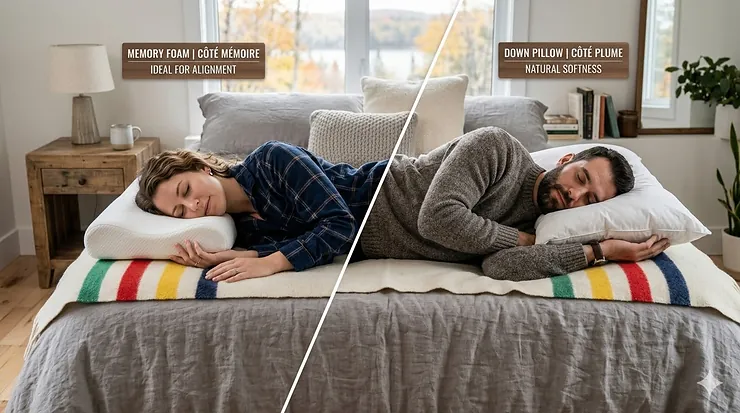
Memory foam pillows offer contouring support that adapts to your unique head and neck shape, distributing pressure evenly. Down pillows provide that cloud-like luxury feel with natural breathability. But here’s the twist — recent Canadian market data shows that hybrid approaches and adjustable lofts are changing everything in 2026.
This guide examines seven real products available on Amazon.ca right now, with actual CAD pricing, specifications verified by Canadian customer reviews, and honest pros and cons. Whether you’re battling Calgary’s dry winter air or Toronto’s humid summers, you’ll discover which pillow material suits your sleep style, budget, and Canadian climate conditions. No fluff (well, maybe some down fluff), just actionable guidance to help you wake up feeling genuinely refreshed.
Quick Comparison: Memory Foam vs Down Pillow for Side Sleepers
| Feature | Memory Foam | Down/Feather | Winner for Side Sleepers |
|---|---|---|---|
| Support Level | High to Medium-Firm | Soft to Medium | Memory Foam ✅ |
| Loft Retention | Excellent (3-5 years) | Good (needs fluffing) | Memory Foam ✅ |
| Temperature | Can sleep warm | Naturally cool | Down ✅ |
| Allergen Resistance | Hypoallergenic | Potential allergens | Memory Foam ✅ |
| Adjustability | Limited (unless shredded) | Naturally compresses | Tie 🤝 |
| Price Range (CAD) | $45-$280 | $60-$300 | Memory Foam ✅ |
| Durability | 3-5 years | 1-3 years | Memory Foam ✅ |
| Luxury Feel | Contouring | Cloud-like | Personal Preference 🤝 |
💬 Just one click – help others make better buying decisions too! 😊
Top 7 Pillows for Side Sleepers: Expert Analysis
1. Coop Home Goods Original Adjustable Pillow
The Coop Home Goods Original dominates the Canadian market for good reason — it’s the rare pillow that actually delivers on its adjustability promise. This shredded memory foam pillow comes overstuffed, with an extra bag of fill so you can customize the loft precisely for your shoulder width.
Key Specifications:
- Cross-cut memory foam blend with microfiber
- Queen size: 5.5 inches loft (fully stuffed)
- CertiPUR-US certified foam
- Machine-washable cover
Price: $99-$120 CAD on Amazon.ca
Canadian Availability: Ships free across Canada, arrives within 3-5 business days to major cities
According to testing by Canadian sleep experts, adjustable pillows let you match the pillow height to your specific shoulder width, which is the most important feature for side sleepers. Ontario buyers particularly praise how the cross-cut foam stays cool compared to solid memory foam blocks.
Pros:
✅ Fully customizable loft — perfect for finding your exact height
✅ Breathable shredded foam prevents heat buildup
✅ Five-year warranty (exceptional for this price range)
Cons:
❌ Initial fluffing required (takes 24-48 hours to expand fully)
❌ May feel too firm for lightweight sleepers initially
Customer Insight: A Vancouver reviewer noted it maintained shape for 18 months with nightly use, significantly outperforming their previous $50 Amazon pillow.

2. Tempur-Pedic TEMPUR-Cloud Pillow
The Tempur-Pedic TEMPUR-Cloud represents memory foam at its pinnacle. This solid memory foam pillow uses NASA-developed pressure-relieving material that adapts to your unique contours with remarkable precision.
Key Specifications:
- Solid TEMPUR material (proprietary memory foam)
- Fixed 5-inch loft
- Removable, washable cover
- Made in the USA, ships to Canada
Price: $180-$280 CAD
Canadian Availability: Available through Amazon.ca and select Canadian retailers with 30-day trial
This pillow excels for side sleepers who want consistent, unchanging support. The TEMPUR material responds to temperature and weight, creating a custom cradle for your head and neck. However, pillow specialists note that the incredibly soft memory foam may be too soft for some side sleepers who need firmer support, making it better suited for lighter individuals or those who prefer plush comfort over maximum elevation.
Pros:
✅ Premium material that outlasts budget options by years
✅ Exceptional pressure relief for sensitive necks
✅ Minimal motion transfer (great for couples)
Cons:
❌ Non-adjustable loft may not suit all shoulder widths
❌ Higher price point limits accessibility
Customer Insight: Calgary purchasers report it maintains support even in dry winter conditions, unlike cheaper foam that can harden.
3. Silk & Snow Adjustable Pillow
The Silk & Snow Pillow has become a Canadian favourite, engineered specifically with our climate variations in mind. This pillow features a dual-layer design: shredded memory foam core surrounded by microfiber fill that mimics down’s luxurious feel without animal products.
Key Specifications:
- Shredded memory foam + microfiber blend
- Adjustable fill (zippered access)
- 100% cotton cover
- Soy-based foam (eco-friendly)
Price: $80-$95 CAD
Canadian Availability: Free shipping across Canada, designed and tested in Canada
The genius here is the combination approach. The memory foam provides the structural support side sleepers need, while the microfiber outer layer adds that cloud-like comfort down lovers crave. Montreal buyers specifically mention the breathable cotton cover stays cool during humid summer nights.
Pros:
✅ Best of both worlds: support + softness
✅ Canadian-designed for our climate extremes
✅ Machine-washable cover simplifies maintenance
Cons:
❌ May require re-fluffing after washing
❌ Lighter fill than some competitors (some prefer more substance)
Customer Insight: Toronto-area customers note it works particularly well for combination sleepers who start on their side but shift positions overnight.
4. Canadian Down & Feather Company Down Perfect Pillow
For down purists, the Canadian Down & Feather Company Down Perfect Pillow delivers authentic luxury with Canadian craftsmanship. This three-chamber design places goose feather in the centre for support, wrapped by 575-loft goose down for softness.
Key Specifications:
- 90% goose feather core + 10% goose down outer chambers
- Medium firmness (best for side sleepers)
- 255 thread count cotton shell
- Filled in Canada
Price: $70-$110 CAD (varies by size)
Canadian Availability: Amazon.ca and direct from manufacturer with free shipping
The three-chamber pillow-in-a-pillow design offers the luxury of a down pillow with the support of a feather pillow, addressing the main weakness of pure down pillows (insufficient loft for side sleepers). The medium firmness provides enough elevation while the down chambers prevent that “sleeping on a brick” feeling some feather pillows deliver.
Pros:
✅ Authentic down luxury feel
✅ Naturally breathable — excellent for hot sleepers
✅ Made in Canada supports local manufacturing
Cons:
❌ Not suitable for those with feather allergies
❌ Requires regular fluffing to maintain loft
Customer Insight: Winnipeg buyers appreciate that the feather core maintains support even in cold conditions when some synthetic fills become stiff.
5. LUCID Shredded Memory Foam Pillow
The LUCID Shredded Memory Foam Pillow offers exceptional value for Canadians seeking memory foam benefits without premium pricing. This adjustable pillow uses bamboo-derived cover material paired with shredded memory foam that allows airflow.
Key Specifications:
- Shredded memory foam (CertiPUR-US certified)
- Bamboo-rayon blend cover
- Adjustable loft via zipper
- Queen size: 27″ x 20″ x 5.5″
Price: $50-$70 CAD (often on sale)
Canadian Availability: Prime shipping available, arrives within 2-3 days
The bamboo-derived cover isn’t just marketing fluff—it genuinely enhances breathability and moisture-wicking capabilities, making the LUCID pillow particularly suitable for hot sleepers. Vancouver customers specifically mention the pillow arrives vacuum-sealed but expands to full size within 24-48 hours.
Pros:
✅ Outstanding value — premium features at budget price
✅ Bamboo cover enhances cooling properties
✅ Compressed packaging makes storage easy
Cons:
❌ May require 48-hour airing period to eliminate new foam smell
❌ Less durable than premium options (expect 2-3 year lifespan)
Customer Insight: Edmonton purchasers note that placing the pillow in the dryer on medium heat for 20 minutes accelerates the expansion process after unboxing.

6. Serta Gel Memory Foam Side Sleeper Pillow
The Serta Gel Memory Foam Side Sleeper Pillow is specifically engineered for the side sleeping position, featuring a higher loft (6 inches) and contoured design that many generic pillows lack.
Key Specifications:
- Gel-infused memory foam
- 6-inch loft (optimal for side sleepers)
- Contoured shape for shoulder accommodation
- Cooling gel technology
Price: $85-$115 CAD
Canadian Availability: Available on Amazon.ca with free shipping on orders over $35
The 6-inch loft addresses a critical issue: most “universal” pillows offer 4-5 inches, which leaves side sleepers’ necks unsupported. The gel infusion helps dissipate heat, though the cooling effect typically diminishes after 20-30 minutes as the gel reaches body temperature.
Pros:
✅ Purpose-built loft height for side sleepers
✅ Contoured design accommodates shoulder naturally
✅ Gel technology provides initial cooling burst
Cons:
❌ Non-adjustable (works great or not at all)
❌ Gel cooling effect is temporary
Customer Insight: Halifax buyers mention the contoured shape takes 2-3 nights to adapt to but then provides exceptional neck alignment.
7. Eli & Elm Cotton Side-Sleeper Pillow
The Eli & Elm Cotton Side-Sleeper Pillow features an innovative U-curve design specifically for side sleeping, with a cutout for your shoulder that traditional rectangular pillows can’t match.
Key Specifications:
- 75% shredded latex or memory foam (choose your fill)
- 25% polyester fiber
- U-shaped ergonomic design
- CertiPUR-US certified
Price: $105-$135 CAD on Amazon.ca
Canadian Availability: Ships to Canada, arrives within 5-7 business days
The curved shape allows shoulders to rest naturally into the pillow’s contour while your neck remains supported. The Side-Sleeper Pillow has a medium to high loft that suited the needs of side sleepers in testing, with adjustable loft by adding or removing fill. The choice between memory foam (softer, pressure-relieving) and latex (firmer, more responsive) lets you match your preference.
Pros:
✅ Ergonomic shape designed exclusively for side sleeping
✅ Choose between latex or memory foam fill
✅ Overstuffed with extra fill bags available
Cons:
❌ Unconventional shape takes adjustment period
❌ Higher price point than traditional rectangular pillows
Customer Insight: Ottawa customers report the memory foam version provides superior pressure relief, while broader-shouldered individuals prefer the latex option’s firmer support.
How Memory Foam Pillows Work for Side Sleepers
Memory foam revolutionised sleep comfort when NASA developed it for aircraft cushions in the 1960s. The material responds to heat and pressure, creating a custom mould of your head and neck that distributes weight evenly across the surface.
For side sleepers, this technology solves a specific problem: pressure points. When you sleep on your side, your ear, temple, and shoulder bear most of your head’s weight (typically 4.5-5.5 kg for adults). Traditional pillows create concentrated pressure zones that restrict blood flow and trigger pain receptors. Memory foam spreads this pressure across a larger area, reducing discomfort.
Types of Memory Foam for Side Sleepers:
Solid Memory Foam
One-piece construction that maintains consistent shape. Solid memory foam maintains a consistent shape and is good for sleepers who stay in one position, but can sleep hot because of closed-cell structure. Examples include the Tempur-Pedic TEMPUR-Cloud.
Shredded Memory Foam
Loose pieces of memory foam inside a cover, offering adjustability and improved airflow. This style dominates the Canadian market because it combines memory foam’s supportive properties with the ability to customize loft. The Coop Home Goods and LUCID pillows use this approach.
Gel-Infused Memory Foam
Standard memory foam with cooling gel beads or gel layers added. The Serta pillow employs this technology to address memory foam’s historical weakness: heat retention. While effective initially, the cooling effect diminishes as the gel reaches body temperature.
Canadian Climate Considerations: Winter heating systems in Canadian homes can make bedrooms particularly dry. Memory foam actually performs better in slightly humid conditions (35-45% relative humidity), so consider using a humidifier in winter months if you notice your pillow becoming firmer.
The Down Pillow Advantage for Side Sleepers
Down pillows offer a completely different sleep experience built on natural materials harvested from geese and ducks. Pure down consists of the fluffy undercoating beneath feathers — three-dimensional clusters that trap air and create insulation.
Natural Properties Benefits:
Breathability: Down clusters allow air circulation that synthetic materials can’t match. This makes down pillows naturally temperature-regulating — they stay cool in summer, warm in winter. For Canadian climates with extreme temperature swings, this is a significant advantage.
Luxury Feel: There’s a reason five-star hotels default to down pillows. The softness and lightness create that “sleeping on a cloud” sensation that memory foam, despite its pressure-relieving properties, simply cannot replicate.
Durability with Care: Quality down pillows, when properly maintained, can last 5-10 years. The Canadian Down & Feather Company’s products demonstrate this longevity, though they require more care than memory foam.
The Side Sleeper Challenge: Pure down pillows compress too much for side sleeping. Your head sinks in, failing to maintain the critical cervical alignment. This is why the Canadian Down & Feather Company Down Perfect uses a three-chamber design — the feather core provides structural support while down chambers add comfort.
Allergen Concerns Debunked: Many Canadians avoid down assuming it triggers allergies. However, research shows that feather pillows, whether covered or not, do not internally accumulate dust-mite allergen when used in mite-infested bedrooms over a 3-month period. The tightly-woven feather-proof casing actually prevents dust mites better than loosely-woven synthetic pillow covers.
Interestingly, medical studies show that synthetic pillows may contain eight times more allergens from mites than down- and feather-filled pillows. The allergic reactions people attribute to down are often actually reactions to dust mite waste in any pillow type.

Pillow Fill Comparison: Side Sleepers’ Ultimate Guide
Understanding fill materials helps you make informed decisions rather than relying on marketing claims.
| Fill Material | Loft Retention | Support Level | Cooling | Lifespan | Best For |
|---|---|---|---|---|---|
| Memory Foam | Excellent | Medium-Firm to Firm | Moderate | 3-5 years | Side sleepers needing consistent support |
| Shredded Memory Foam | Very Good | Adjustable | Good | 3-4 years | Side sleepers wanting customization |
| Gel Memory Foam | Excellent | Medium-Firm | Good (initially) | 3-5 years | Hot side sleepers |
| Down | Good (needs fluffing) | Soft to Medium | Excellent | 5-10 years | Luxury seekers with proper budget |
| Feather | Very Good | Medium to Firm | Excellent | 3-5 years | Side sleepers on budget |
| Down/Feather Blend | Very Good | Medium | Excellent | 4-6 years | Side sleepers wanting balance |
| Latex | Excellent | Firm | Excellent | 5-7 years | Side sleepers preferring responsiveness |
The Goldilocks Zone for Side Sleepers: Research indicates side sleepers need 4-6 inches (10-15 cm) of loft with medium-firm to firm support. Memory foam and feather/down blends hit this target most consistently, explaining their popularity in the Canadian market.
Shoulder Width Matters: Broader shoulders require higher loft pillows. As a reference:
- Narrow shoulders (under 40 cm): 4-5 inch loft
- Average shoulders (40-45 cm): 5-6 inch loft
- Broad shoulders (over 45 cm): 6+ inch loft
Adjustable pillows (Coop Home Goods, Silk & Snow, LUCID) solve this by letting you add or remove fill to match your exact measurements.
Material Durability Comparison: Long-Term Investment
Smart pillow shopping considers lifespan alongside initial cost. Here’s how materials perform over time in Canadian conditions:
Memory Foam Durability (3-5 Years Average)
High-density memory foam (4+ pounds per cubic foot) maintains support longer than lower-density alternatives. CertiPUR-US certification indicates quality foam that won’t develop permanent body impressions within the first two years.
Canadian Factor: Extreme temperature fluctuations can affect foam longevity. Pillows in unheated cottages or rooms with inconsistent heating may harden faster.
Maintenance: Spot clean only; machine washing destroys memory foam structure. Use pillow protectors to extend lifespan.
Replacement Signs: When the foam no longer bounces back within 3-5 seconds of compression, it’s lost its supportive properties.
Down/Feather Durability (3-10 Years Depending on Quality)
Quality matters enormously. Premium 575+ loft goose down lasts significantly longer than duck feather or low-fill-power options.
Canadian Factor: Low humidity from winter heating can dry out down clusters, reducing loft. The solution: occasional exposure to humid environments (bathrooms after showers) helps down rehydrate.
Maintenance: Wash every 6 months in large-capacity washers with down-specific detergent. Dry thoroughly on low heat with dryer balls to restore loft.
Replacement Signs: If fluffing no longer restores height, or if you notice quills poking through the casing, replacement time has arrived.
Lifespan Cost Analysis (CAD)
- Budget Memory Foam ($50 / 2 years = $25/year)
- Premium Memory Foam ($120 / 4 years = $30/year)
- Quality Down/Feather ($90 / 5 years = $18/year)
- Hybrid Options ($95 / 4 years = $24/year)
Down pillows offer the best cost-per-year value when properly maintained, though they require more care effort.
Support vs Softness: Finding Your Balance
The eternal pillow paradox: side sleepers need firm support for alignment but crave softness for comfort. Understanding this balance separates excellent pillows from mediocre ones.
What “Support” Actually Means: Support refers to a pillow’s resistance to compression. High support means the pillow maintains elevation under your head’s weight, keeping your neck aligned with your spine. For side sleepers, a pillow that’s at least 5 inches thick and firm is ideal for keeping the head and shoulders aligned.
The Softness Illusion: Many people mistakenly equate softness with comfort. In reality, overly soft pillows allow your head to sink too low, creating an upward neck angle that strains muscles. You want surface-level softness (comfortable against your skin) paired with structural firmness (maintains loft).
The Three-Layer Solution: Premium pillows use layered construction:
- Supportive Core: Memory foam or feather provides structural elevation
- Transitional Layer: Microfiber or down adds conforming comfort
- Cover Material: Bamboo, cotton, or cooling fabric enhances surface feel
The Silk & Snow and Eli & Elm pillows exemplify this approach, explaining their popularity despite higher prices.
Testing Your Current Pillow: Place your pillow on a flat surface and press down with your hand. If it takes more than 3 seconds to return to original height, it lacks support. If it feels hard against your cheek, it lacks surface softness. Side sleepers need pillows that pass both tests.
Personal Preference Factor: Some side sleepers prefer firmer pillows (often those with neck pain or broad shoulders), while others favour softer options (lighter individuals or those without chronic pain). This is why adjustable pillows dominate recommendations — they let you discover your personal sweet spot.
Allergen Considerations for Canadian Side Sleepers
Bedroom allergens affect approximately 20% of Canadians, making material selection crucial for quality sleep. The relationship between pillows and allergies is more complex than most people realize.
The Dust Mite Reality
Your mattress may house anywhere between 100,000 and 10 million microscopic dust mites, and if your pillow is at least two years old, roughly 10% of its weight may come from dead dust mites and dust mite waste. These microscopic creatures feed on shed skin cells and thrive in warm, humid environments.
Memory Foam Advantages:
- Closed-cell structure resists dust mite penetration
- Doesn’t provide organic material mites need
- CertiPUR-US certification ensures no harmful chemicals
- Hypoallergenic by nature
Down/Feather Reality Check: Contrary to popular belief, properly processed down doesn’t cause allergies. The issue is dust mites, not the down itself. Modern processing techniques wash down multiple times in specialized solutions that remove oils, debris, and potential allergens.
Canadian-Specific Considerations
Winter Heating Systems: Forced-air heating common in Canadian homes circulates dust and allergens. HEPA air filters in bedrooms significantly reduce airborne particles. The Public Health Agency of Canada recommends maintaining indoor humidity between 30-50% to discourage dust mite reproduction without promoting mould growth.
Seasonal Allergies: Canadian pollen seasons (tree pollen February-May, grass pollen April-June, weed pollen August-October) mean keeping bedroom windows closed during peak times. Using air conditioning instead of open windows prevents outdoor allergens from settling on pillows.
Protection Strategies
Pillow Protectors: Dust-mite-proof pillow covers create a physical barrier. Look for covers with pore sizes less than 10 micrometres — anything larger allows dust mites and their waste to pass through. The Alberta Health Services recommends these for all allergy sufferers regardless of pillow type.
Washing Protocols:
- Memory foam pillows: Spot clean only; wash cover weekly in hot water (60°C minimum)
- Down/feather pillows: Machine wash every 3-6 months in large-capacity washers
- All pillowcases: Weekly washing in 60°C+ water kills dust mites and removes waste
Replacement Schedule: Replace any pillow every 1-3 years regardless of material. Even hypoallergenic memory foam accumulates dead skin cells on the surface that can trigger reactions.
Temperature Regulation for Canadian Sleepers
Canadian bedroom temperatures vary wildly — from below 15°C in cottages to above 24°C in over-heated apartments. Your pillow’s temperature regulation capabilities significantly impact sleep quality.
Memory Foam Temperature Properties
Traditional Memory Foam Heat Issues: Standard memory foam’s closed-cell structure traps body heat. As the foam warms, it becomes softer and more moldable, which enhances contouring but creates a “hot spot” around your head and neck. For Canadian summer nights or those experiencing night sweats, this is problematic.
Solutions in Modern Memory Foam:
- Gel Infusion: Gel particles absorb heat temporarily but reach equilibrium quickly
- Open-Cell Foam: Air circulates through the foam structure, dissipating heat
- Shredded Foam: Air flows between foam pieces, dramatically improving cooling
- Phase-Change Materials: Advanced covers actively wick heat away from skin
The LUCID and Coop Home Goods pillows use shredded foam, explaining their popularity among Canadian hot sleepers.
Down/Feather Natural Cooling
Down clusters create three-dimensional air pockets that regulate temperature naturally. Air circulates freely, wicking moisture away and preventing heat buildup. This makes down pillows self-regulating — they adjust to ambient temperature rather than trapping body heat.
For Canadians dealing with bedroom temperature swings, down pillows offer consistency. The same pillow works in -30°C February and +30°C July without seasonal adjustments.
Winter Performance: Down provides insulation when needed. In unheated bedrooms common in older Canadian homes, down pillows maintain comfortable head temperatures without feeling cold to the touch like memory foam can.
Optimal Sleep Temperature
Sleep research indicates optimal bedroom temperature for quality sleep is 15-19°C. At these temperatures:
- Memory foam with cooling technology performs adequately
- Standard memory foam may feel slightly warm
- Down/feather pillows excel
For Canadians who keep bedrooms warmer (20-22°C) due to heating preferences, cooling-enhanced memory foam or down pillows become essential for comfortable sleep.
Price Range & Value Analysis in Canada
Understanding pillow pricing helps you invest wisely rather than overspending or buying false bargains.
| Price Range | What You Get | Best Options | Canadian Value Assessment |
|---|---|---|---|
| $35-$60 CAD | Basic materials, minimal features, 1-2 year lifespan | LUCID Shredded Memory Foam | Good for testing pillow types |
| $60-$100 CAD | Quality materials, decent durability, 2-4 year lifespan | Silk & Snow, Canadian Down & Feather | Best value zone for most Canadians |
| $100-$150 CAD | Premium materials, advanced features, 3-5 year lifespan | Coop Home Goods, Serta, Eli & Elm | Justifiable for chronic neck pain sufferers |
| $150-$300 CAD | Top-tier materials, exceptional durability, 5+ year lifespan | Tempur-Pedic TEMPUR-Cloud | Only worthwhile if budget permits luxury |
The False Economy of Cheap Pillows
$20-$35 pillows sold on Amazon.ca typically use:
- Low-density memory foam (2-3 pounds per cubic foot) that loses shape within months
- Scraps from mattress production (lumpy, inconsistent)
- Duck feather with high quill content (pokey, uncomfortable)
- Minimal fill (flattens quickly)
Cheaper pillows also tend to use less filling, which can result in a flatter pillow, and many of the cheaper shredded memory foam pillows under $50 tend to use junk foam from leftover scraps of mattress production, which results in lumpy pillows.
Canadian Pricing Considerations
Import Duties: Pillows manufactured outside Canada may include duty costs. Canadian-made options (Silk & Snow, Canadian Down & Feather Company) avoid these fees.
Shipping Costs: Free shipping typically applies to orders over $35 on Amazon.ca. Factor this when comparing prices across retailers.
Currency Fluctuations: USD-to-CAD exchange rates affect imported pillow prices. Watch for sales when the Canadian dollar strengthens.
Provincial Taxes: GST/HST/PST adds 5-15% to pillow costs depending on province:
- Alberta: 5% (GST only)
- Ontario: 13% (HST)
- Quebec: 14.975% (GST + PST)
- British Columbia: 12% (GST + PST)
Investment Value Formula
Calculate true value using: (Total Cost Including Tax) / (Expected Lifespan in Years) = Annual Cost
Example:
- Coop Home Goods: $120 CAD + 13% HST = $135.60 / 4 years = $33.90/year
- Budget foam: $45 CAD + 13% HST = $50.85 / 1.5 years = $33.90/year
The premium pillow costs the same annually but provides superior sleep quality throughout its lifespan.
✨ Don’t Miss These Exclusive Deals!
🔍 Take your side sleeping to the next level with these carefully selected products available in Canada. Click on any highlighted item to check current pricing and availability on Amazon.ca. These pillows will help you achieve authentic restorative sleep your body needs!
Choosing the Right Pillow: Step-by-Step Guide
Follow this systematic approach to select your ideal pillow:
Step 1: Measure Your Shoulder Width Lie on your side on a flat surface. Have someone measure from the mattress to the top of your shoulder. Add 1 inch (2.5 cm) to this measurement — this is your ideal loft height.
Step 2: Identify Your Firmness Preference Consider your current pillow’s feel:
- Too soft = need firmer (memory foam or feather core)
- Too firm = need softer (down or shredded foam)
- Frequent re-fluffing = need better support (memory foam wins)
Step 3: Assess Temperature Needs Hot sleepers or those in warm apartments need cooling features:
- Gel-infused memory foam (Serta)
- Shredded foam with airflow (LUCID, Coop)
- Down/feather natural cooling (Canadian Down & Feather)
Step 4: Check Allergy Status Confirmed dust mite allergy = Memory foam + pillow protector No allergies = Down/feather acceptable (often superior cooling)
Step 5: Budget Appropriately
- Testing phase: $50-$70 budget option (LUCID)
- Regular upgrade: $80-$120 quality option (Silk & Snow, Coop, Canadian Down)
- Serious investment: $120+ premium option (Tempur-Pedic, Eli & Elm)
Step 6: Plan Trial Period Most Canadian retailers offer 30-day trials. Use the full period:
- Days 1-7: Adjustment period (may feel uncomfortable)
- Days 8-21: True assessment period
- Days 22-30: Final evaluation before return deadline
Common Mistakes Canadian Side Sleepers Make
Avoid these pitfalls that waste money and prolong poor sleep:
Mistake #1: Choosing Based on Back/Stomach Sleeping Advice
Side sleepers need different specifications. Pillows marketed as “universal” typically optimize for back sleeping (lower loft, medium firmness) which leaves side sleepers’ necks unsupported.
Mistake #2: Ignoring Mattress Firmness
Your pillow and mattress work together. Soft mattresses allow shoulders to sink deeper, requiring less pillow loft. Firm mattresses keep shoulders elevated, requiring more pillow height. Changed your mattress recently? Your pillow needs reassessment.
Mistake #3: Skipping Pillow Protectors
Even hypoallergenic memory foam benefits from protectors. They prevent oils and sweat from degrading foam, extending lifespan by 6-12 months. In Canadian climates with dry heating, protectors also prevent dust accumulation.
Mistake #4: Replacing Too Infrequently
The “fold test” reveals when replacement is needed: fold your pillow in half. If it stays folded rather than springing back, it’s lost supportive properties. Most Canadians wait too long, sleeping on pillows that actively harm sleep quality.
Mistake #5: Buying Without Proper Research
Impulse purchases based on sale prices or attractive packaging rarely deliver. Successful pillow selection requires understanding your specific needs (shoulder width, sleep temperature, firmness preference) before shopping.

FAQ: Memory Foam vs Down Pillow for Side Sleepers
❓ Which lasts longer memory foam or down pillow for side sleepers in Canada?
❓ Are memory foam pillows better than down for side sleepers with neck pain?
❓ Can you wash memory foam and down pillows in Canada?
❓ Do down pillows cause more allergies than memory foam for side sleepers?
❓ What's the best pillow height for side sleepers in Canada?
Conclusion: Making Your Final Decision
After examining seven top pillows and analyzing memory foam versus down properties, the clear winner for most Canadian side sleepers is adjustable shredded memory foam — specifically the Coop Home Goods Original Adjustable Pillow. It balances support, cooling, customization, and durability at a reasonable $99-$120 CAD price point.
However, your personal circumstances might favour different options:
Choose Memory Foam If:
- You prioritize consistent support and alignment
- Neck pain is a primary concern
- Low-maintenance care appeals to you
- Allergies are a factor
- Budget permits $80-$120 CAD investment
Choose Down/Feather If:
- Temperature regulation is critical
- You prefer luxurious, cloud-like feel
- You’re willing to perform regular maintenance
- No feather allergies exist
- Budget allows $70-$110 CAD for quality options
Choose Hybrid Options If:
- You want benefits of both materials
- Adjustability is important
- You sleep in multiple positions
- Canadian climate extremes affect your sleep
The $80-$120 CAD range delivers optimal value in Canada’s market. Cheaper options compromise on materials and durability, while premium pillows above $150 CAD offer diminishing returns unless you’re addressing specific medical needs.
Remember: even the perfect pillow requires proper care. Use pillow protectors, wash covers weekly, and replace pillows every 2-4 years regardless of material. Your pillow is the only thing supporting your head and neck for 2,500-3,000 hours annually — it deserves proper investment and maintenance.
Start with measuring your shoulder width, assess your temperature preferences, and select from this guide’s seven options. Most offer 30-day trials, giving you risk-free testing periods. Your morning neck pain-free awakening awaits.
Recommended for You
- 7 Best Contour Pillows for Side Sleepers Canada 2026 Guide
- 7 Best Adjustable Pillow Canada 2026: Sleep Better Tonight
- 7 Best Cooling Pillow for Side Sleepers Canada 2026
Disclaimer: This article contains affiliate links to Amazon.ca. If you purchase products through these links, we may earn a small commission at no additional cost to you.
✨ Found this helpful? Share it with your friends! 💬🤗
